185 DISCOVERIES · ONE LAKEFRONT
Follow your curiosity. A hidden pocket of birdsong. A grand old beach house. A skyline you’ve never seen quite this way. There’s a place for every kind of wander.
Find your place on the map ↗ Beachs Nature Harbors Landmarks BEACH
Sand, sky & a place to pause. On the trail
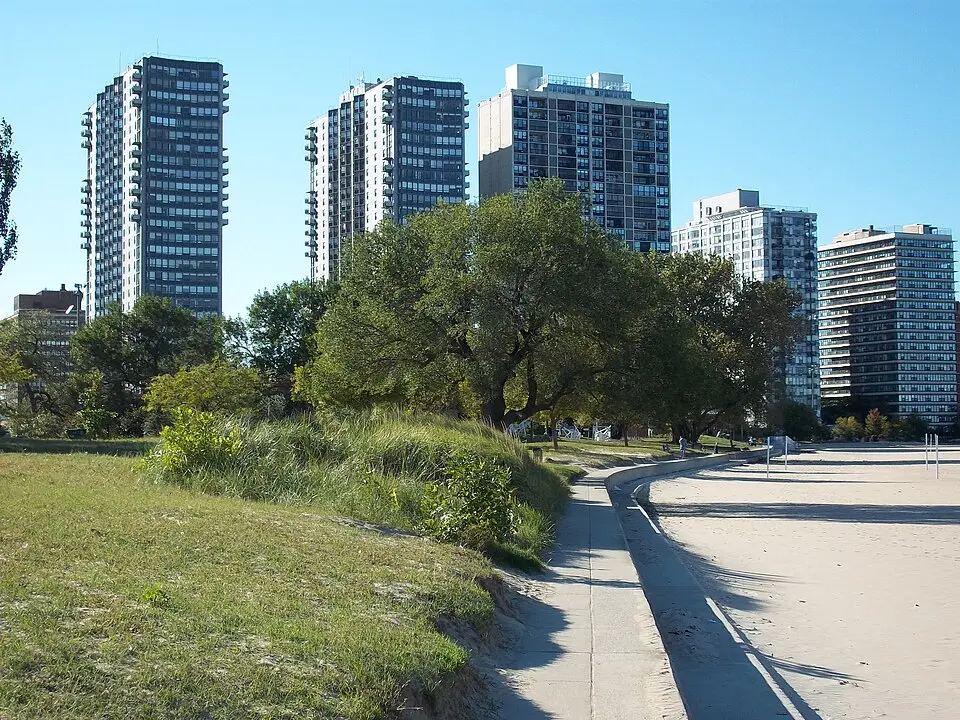
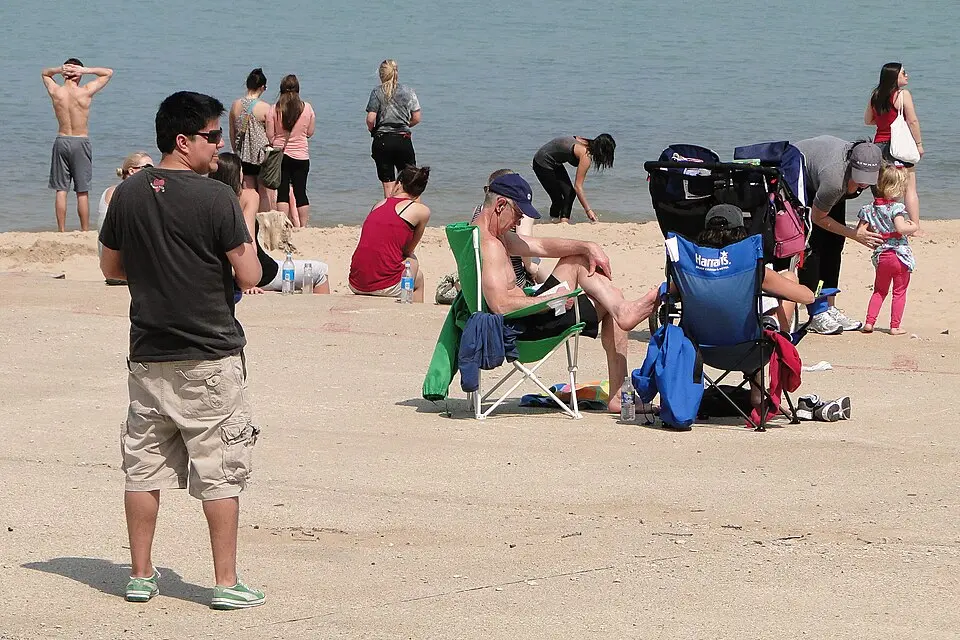
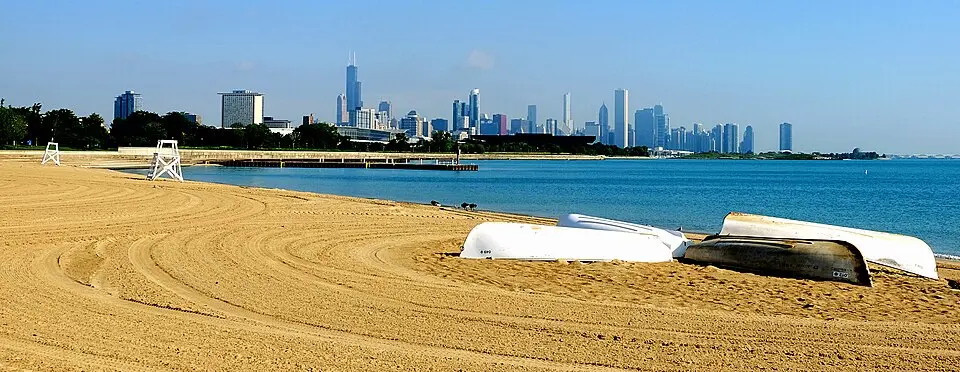
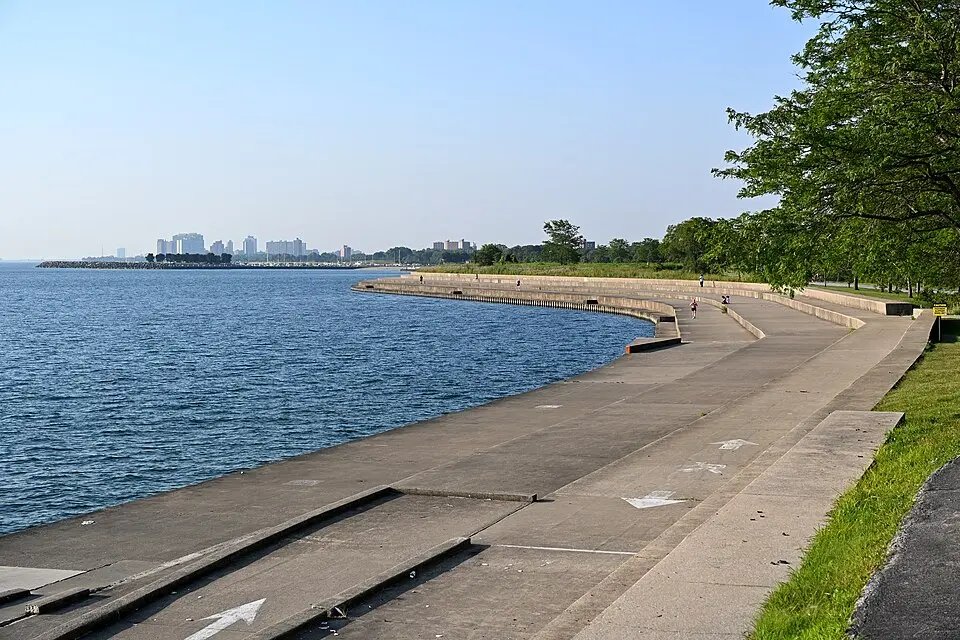
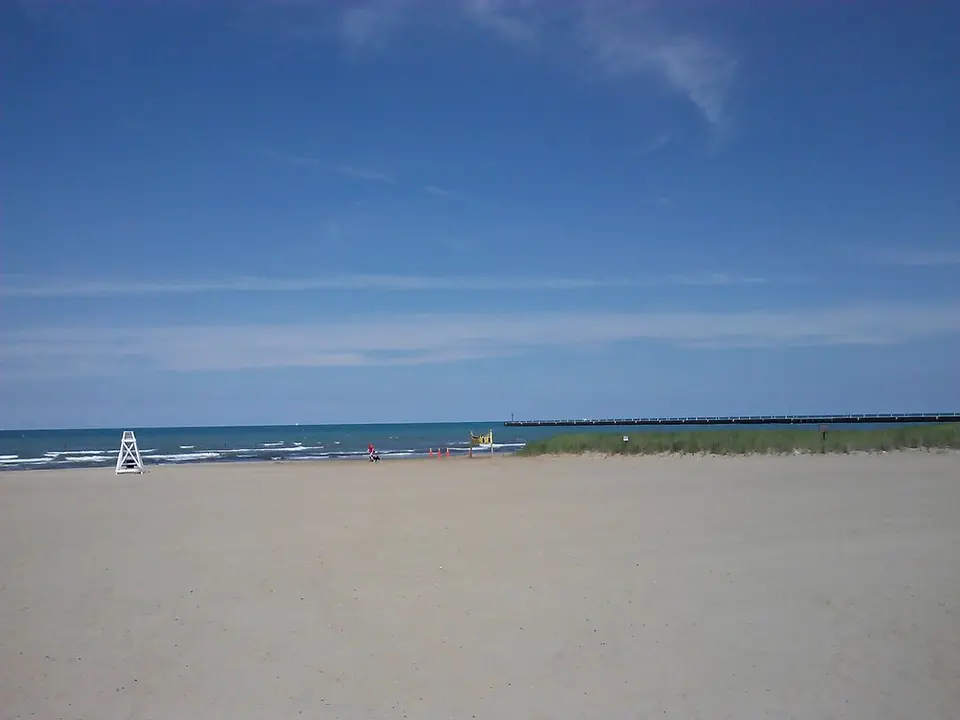
Kathy Osterman Beach A generous crescent of pale sand, neighborhood picnics, and a horizon that seems to go on forever.
Locals also call this Hollywood Beach, after the nearby avenue.
Check the Park District’s daily swimming status and posted lifeguard hours.
Photo: Alanscottwalker · CC BY-SA 3.0 ↗
On the trail
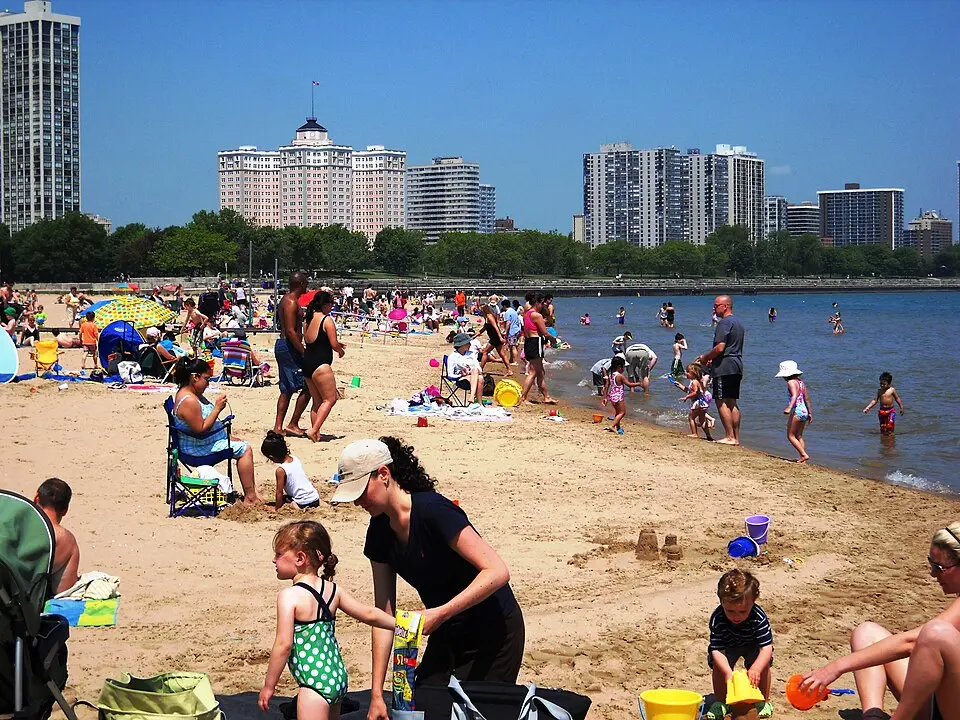
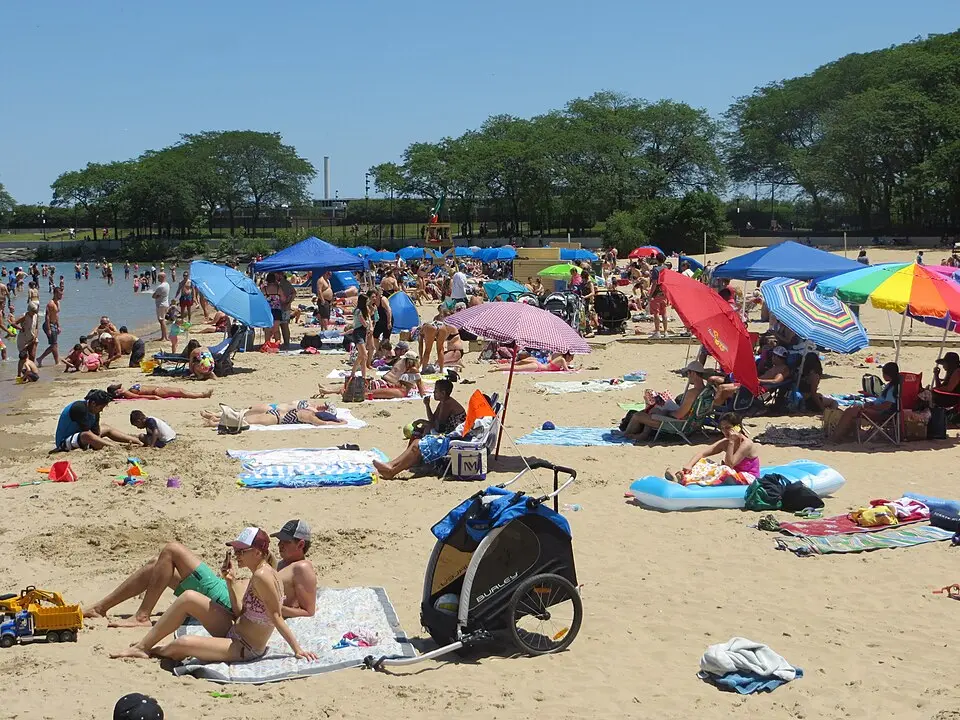
Foster Beach Lawn becomes sand, sand becomes lake. Foster is an easy place to let a short stop become an afternoon.
The beach is part of Lincoln Park’s long North Side landscape.
Use designated beach access paths and check daily swimming conditions.
Photo: Alanscottwalker · CC BY 3.0 ↗
Via a connector
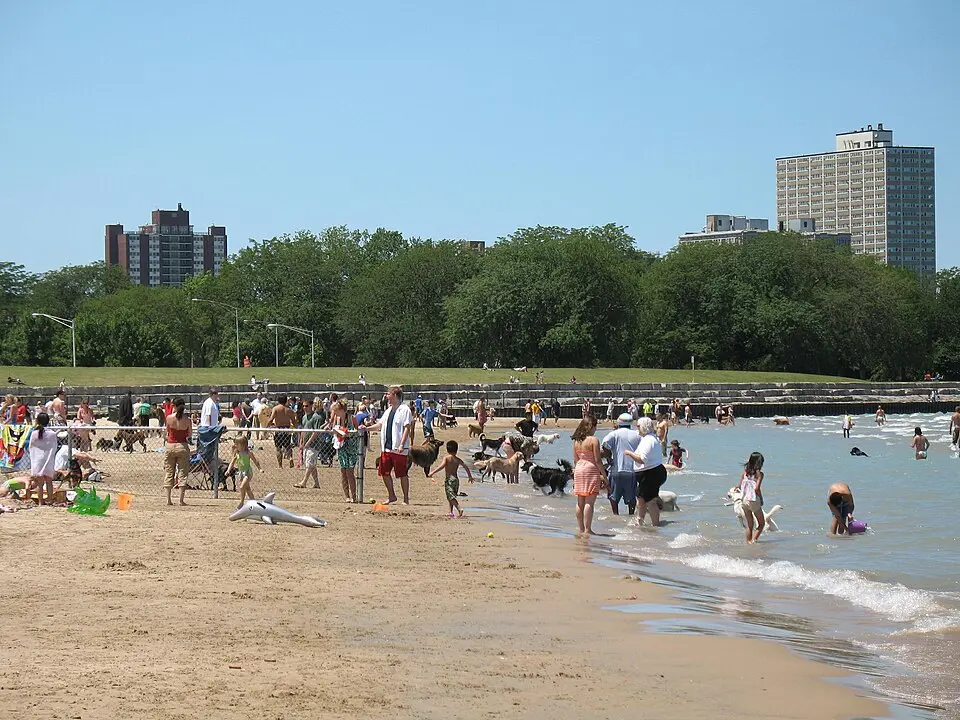
Montrose Dog Beach A separate stretch of sand at Montrose welcomes dogs and their people beside the lake.
The official dog-friendly area occupies the north end of Montrose Beach.
Dogs require the Park District permit and tag. Follow the posted dog-area rules and keep dogs out of nearby bird habitat.
Photo: TonyTheTiger (t/c/bio/WP:CHICAGO/WP:LOTM) · CC BY-SA 3.0 ↗
Via a connector
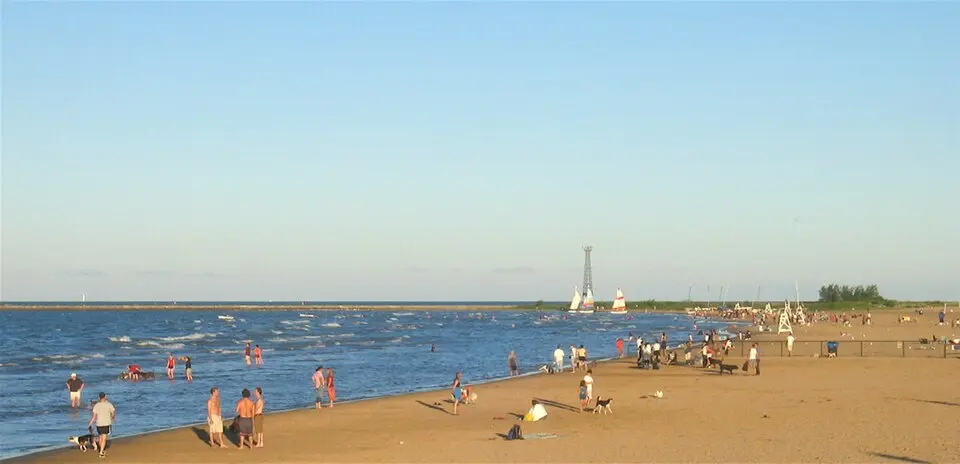
Montrose Beach An expansive beach where volleyball nets and lake breezes give way to protected dunes and bird habitat.
Montrose’s dunes and neighboring sanctuary create an unusually rich urban habitat.
Respect fenced nesting areas. Dogs are allowed only in the designated dog-friendly area.
Photo: User:JeremyA · CC BY-SA 2.5 ↗
On the trail
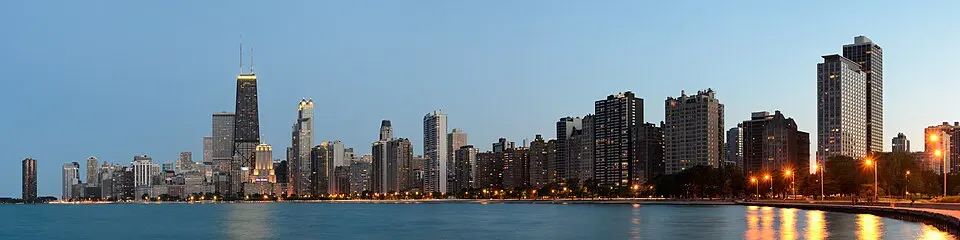
North Avenue Beach The Chicago postcard comes into focus: sand, volleyball courts, a ship-shaped beach house, and towers beyond.
The beach house’s silhouette evokes an ocean liner.
Slow down at beach crossings. Swimming and concessions have seasonal schedules.
Chicago skyline viewed from North Avenue Beach · 2015.
Photo: King of Hearts · CC BY-SA 3.0 ↗
On the trail
Oak Street Beach The Gold Coast meets the sand. Few places put beach towels and skyscrapers quite this close together.
The shoreline bends dramatically here toward the downtown waterfront.
The exposed lake edge can be affected by wind and waves. Follow signs and official notices.
Photo: Adam Jones, Ph.D. · CC BY-SA 3.0 ↗
On the trail
Ohio Street Beach A small pocket of sand tucked beside Streeterville, with Navy Pier just around the corner.
Ohio Street Beach sits beside the peninsula containing Olive Park.
Check official beach conditions; watch for swimmers and pedestrians at beach approaches.
Photo: David Wilson from Oak Park, Illinois, USA · CC BY 2.0 ↗
Nearby detour
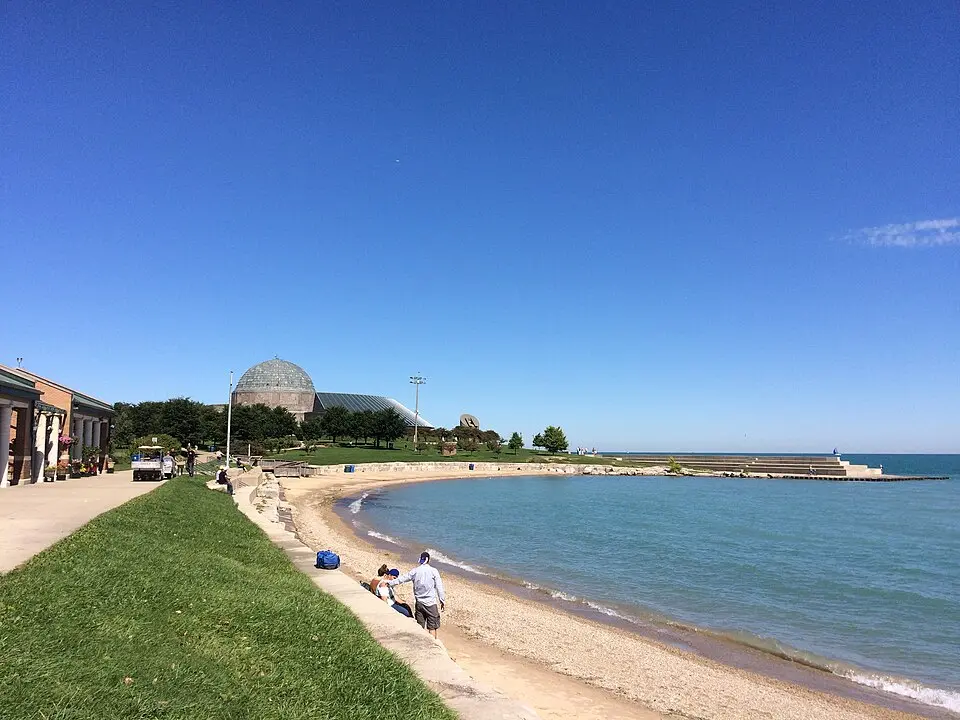
12th Street Beach A sheltered sand beach sits just south of Adler Planetarium on Northerly Island.
The beach is separate from the natural area farther south on the peninsula.
Swimming is seasonal and limited to designated areas when lifeguards are on duty; check current conditions.
Photo: DwightSchruteDunderMifflin · CC BY 4.0 ↗
On the trail
Margaret T. Burroughs Beach At 31st Street, turn back toward the city: the skyline stretches across the water beyond sand and sailboats.
The beach honors artist, educator, and DuSable Museum co-founder Margaret T. Burroughs.
Also called 31st Street Beach. Check official swimming conditions and signed neighborhood connections.
Photo: Brian Kay · CC BY 3.0 ↗
On the trail
Oakwood Beach An open stretch of South Side sand, with room to pause between Burnham Park’s longer trail sections.
Oakwood Beach is reached from the 41st Street area.
Use the designated neighborhood connector and check current swimming conditions.
On the trail
57th Street Beach Hyde Park’s sweep of sand, a short distance from the Point and the grand museum across the drive.
The beach sits near the northern edge of Jackson Park.
Use signed crossings for inland destinations and check daily swimming conditions.
The beach house at 57th Street Beach.
Photo: Paul R. Burley · CC BY-SA 4.0 ↗
On the trail
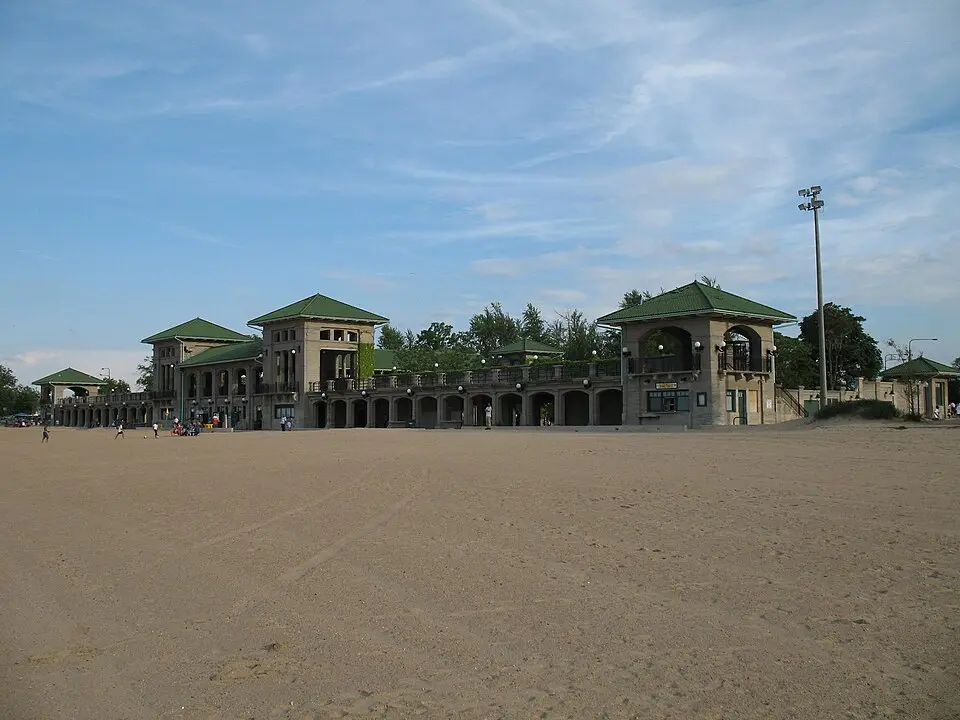
63rd Street Beach A generous beach and a Classical Revival pavilion bring a graceful sense of arrival to the southern shore.
Completed in 1919, the beach house has open-air galleries designed to catch lake breezes.
Check beach conditions and seasonal facility access before visiting.
Photo: User:TonyTheTiger · CC BY-SA 3.0 ↗
Via a connector
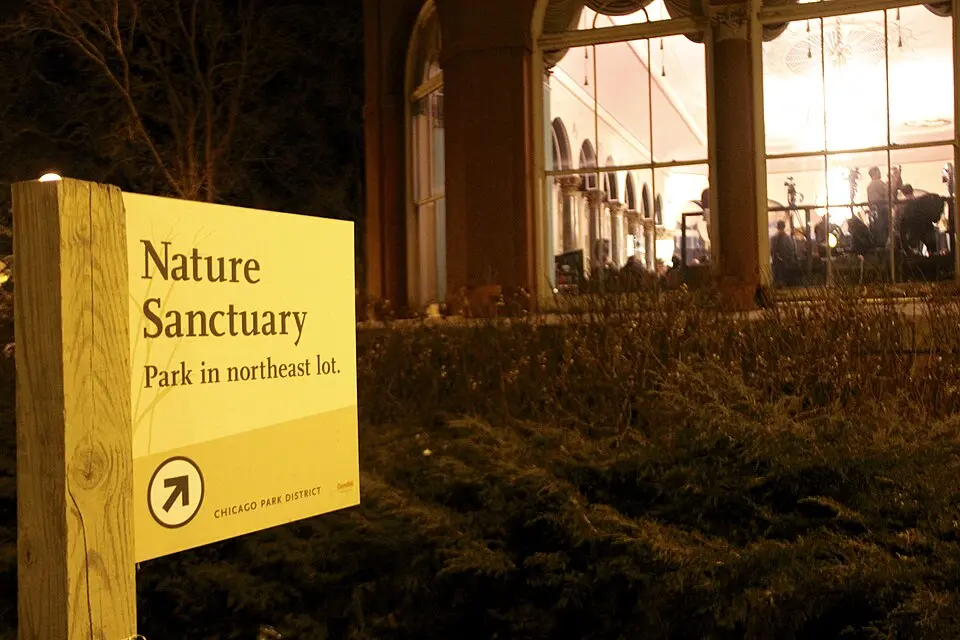
South Shore Beach A small swimming beach lies east of the South Shore Cultural Center, beside its nature sanctuary.
The beach belongs to the Cultural Center park, a separate place from the historic clubhouse.
Swimming is seasonal when lifeguards are on duty; follow current beach conditions and posted access.
NATURE
A quieter kind of Chicago. On the trail
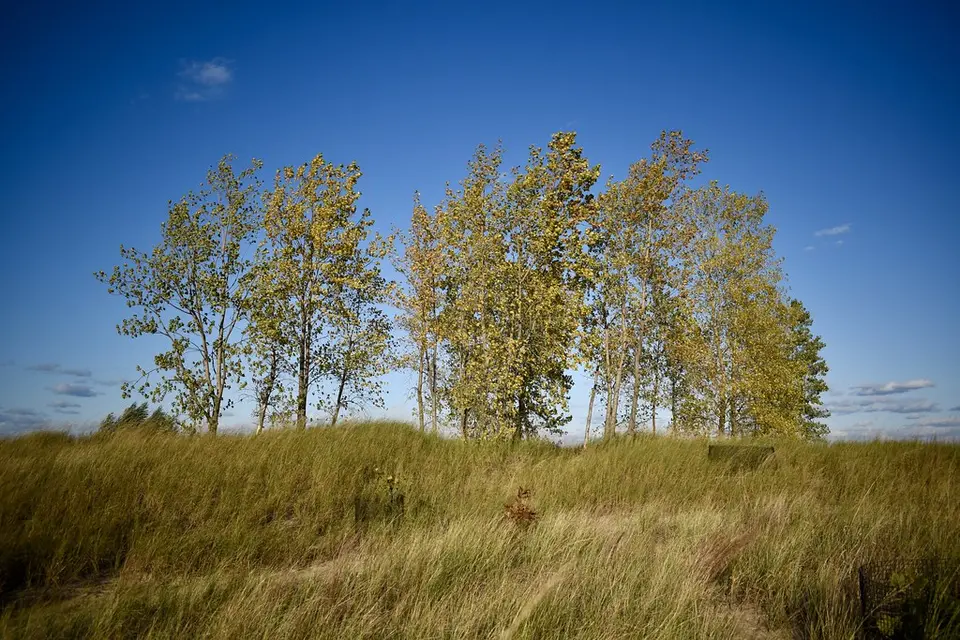
Osterman Beach Dunes Native dune grasses frame the northern end of the trail beside Osterman Beach.
Marram grass helps trap sand and stabilize this restored shoreline habitat.
Observe the dunes from bordering beach walks and trails; stay outside planted habitat.
On the trail
Foster Beach Dunes Small native plantings bring dune habitat into the paths around Foster Beach.
The Park District identifies marram grass and silverweed among the plantings.
Use the paved trail and designated soft-surface paths; avoid trampling the dune plants.
Nearby detour
Montrose Beach Dunes Dunes and low wetland habitat occupy the eastern end of Montrose Beach, beyond the open recreational sand.
The Park District stopped grooming this area in 2001, allowing dune and rare panne habitat to develop.
Follow posted protection zones; the paths are sandy, with paved viewing routes along the south edge and pier.
Photo: Raed Mansour · CC BY 2.0 ↗
Nearby detour
Cricket Hill A rare little rise in a famously flat city, with grass underfoot and wide sky overhead.
The grassy hill sits inland of Montrose Beach in Lincoln Park.
Reach it on local park paths; expect people enjoying the slopes.
Photo: FHKE · CC BY-SA 2.0 ↗
Nearby detour
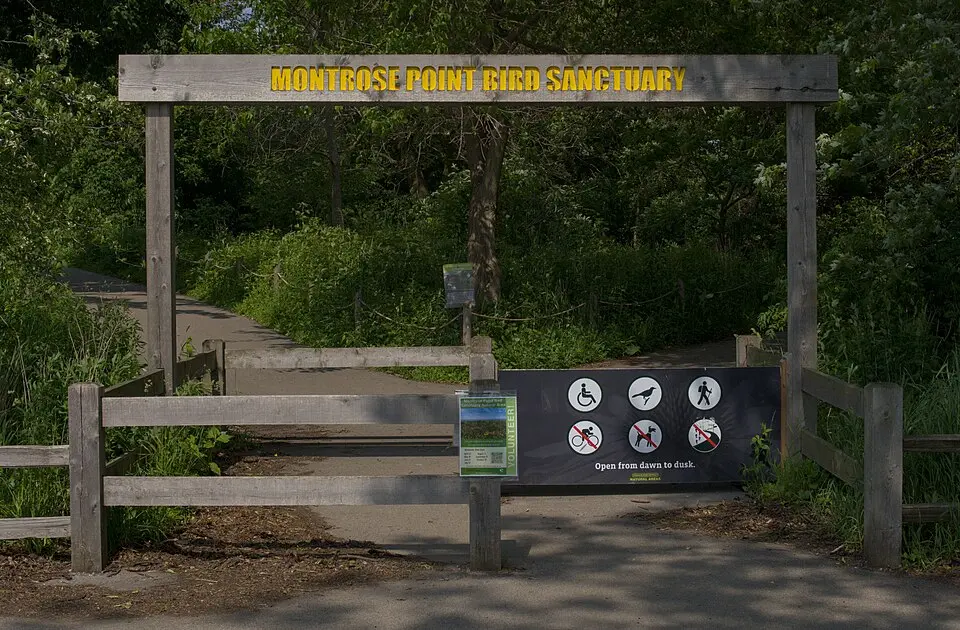
Montrose Point Bird Sanctuary Step into the Magic Hedge. The skyline recedes, and the smallest movement in the leaves becomes the main event.
More than 300 bird species have been recorded in the sanctuary and adjacent dunes.
Explore on foot, stay on marked paths, and observe birds at a distance.
Photo: Theemausoliam · CC BY-SA 4.0 ↗
Nearby detour
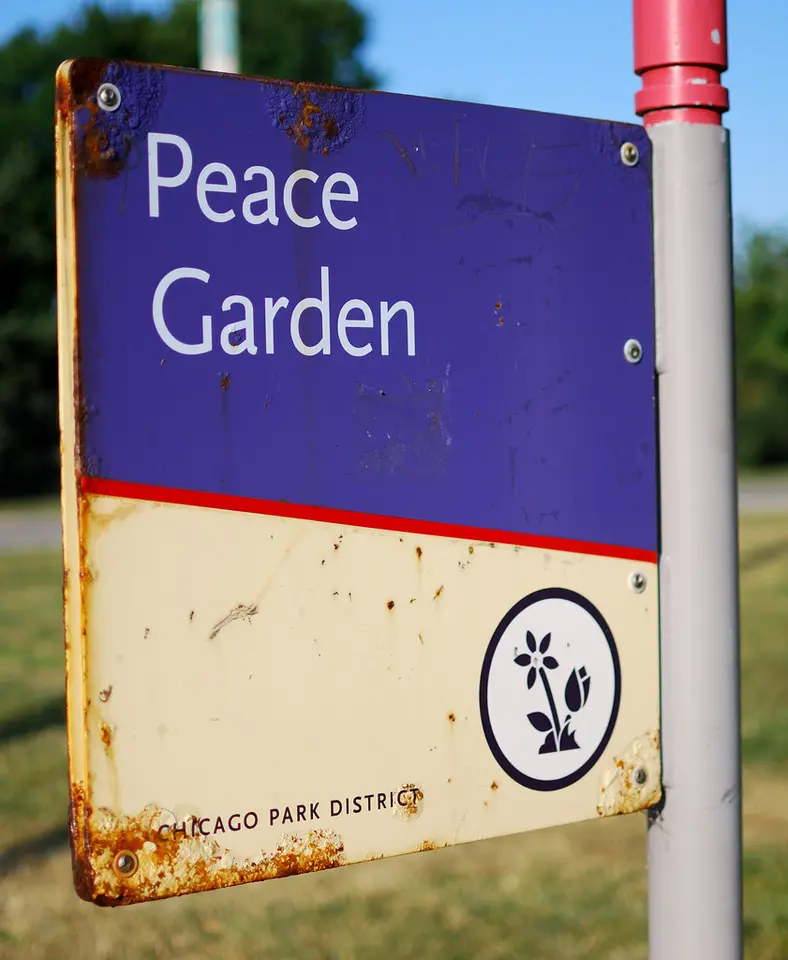
Lincoln Park Peace Garden A small garden of native plants offers a quiet break near the Buena Park lakefront.
The Park District, Greenpeace Great Lakes and Uptown residents renovated this former rock garden in the mid-1980s.
Explore on the garden paths without stepping into the native planting beds.
Chicago Park District sign at the Lincoln Park Peace Garden
Photo: uptowner · CC BY 2.0 ↗
Nearby detour
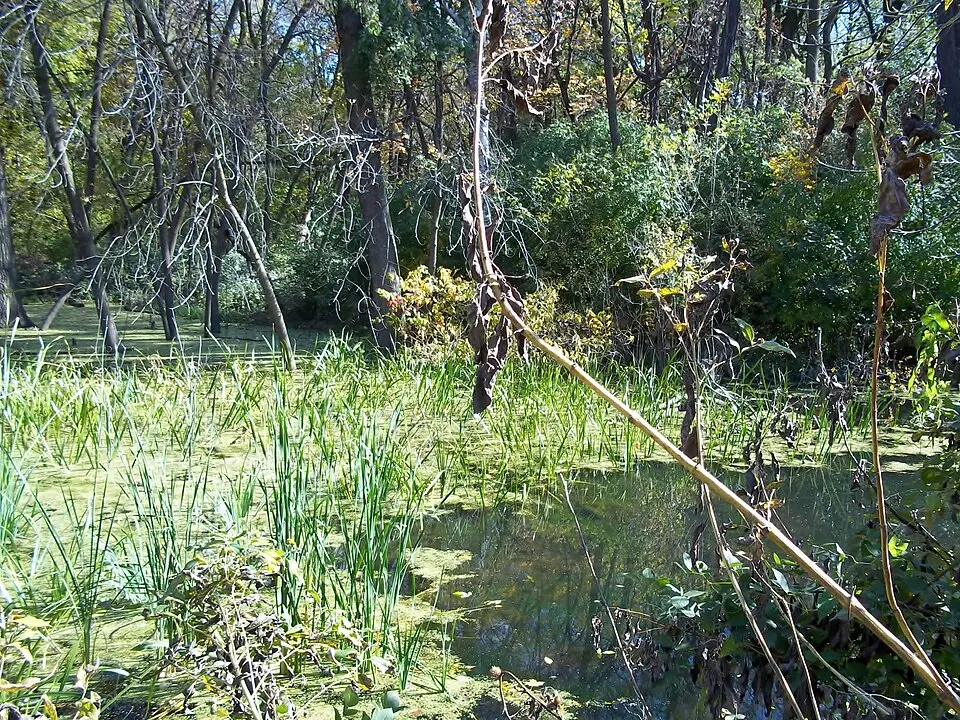
Bill Jarvis Migratory Bird Sanctuary A protected bird habitat between Belmont Harbor and the Waveland playing fields.
The sanctuary is one of the Park District sites where volunteers monitor purple martin nesting towers.
Use surrounding public paths and respect the sanctuary’s posted habitat boundaries.
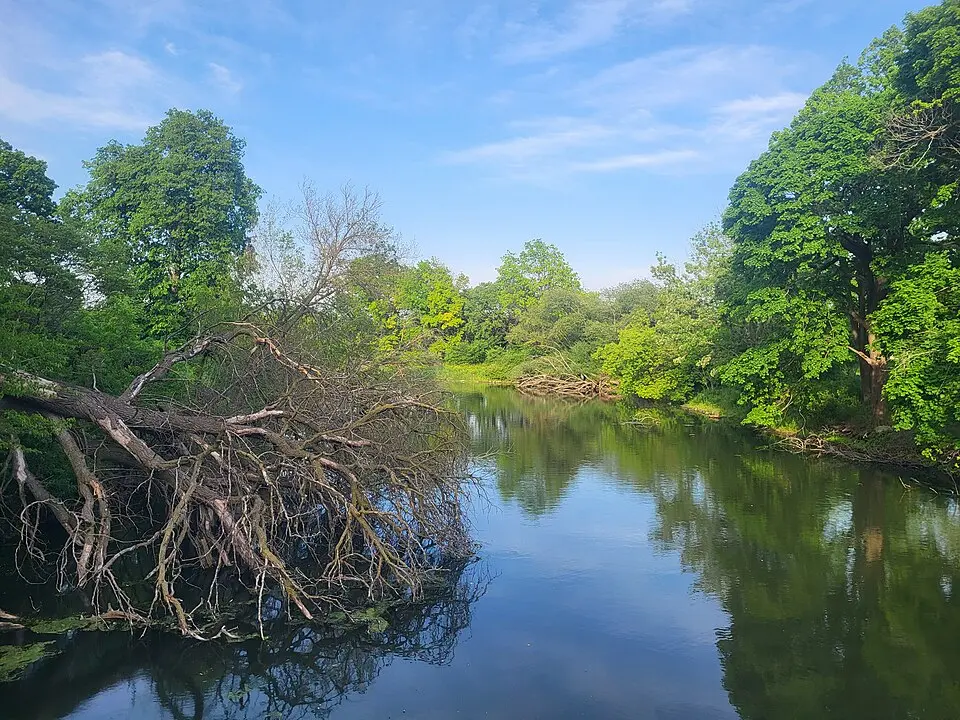
Wetland habitat at Bill Jarvis Migratory Bird Sanctuary · 2010
Photo: Alanscottwalker · CC BY-SA 3.0 ↗
On the trail
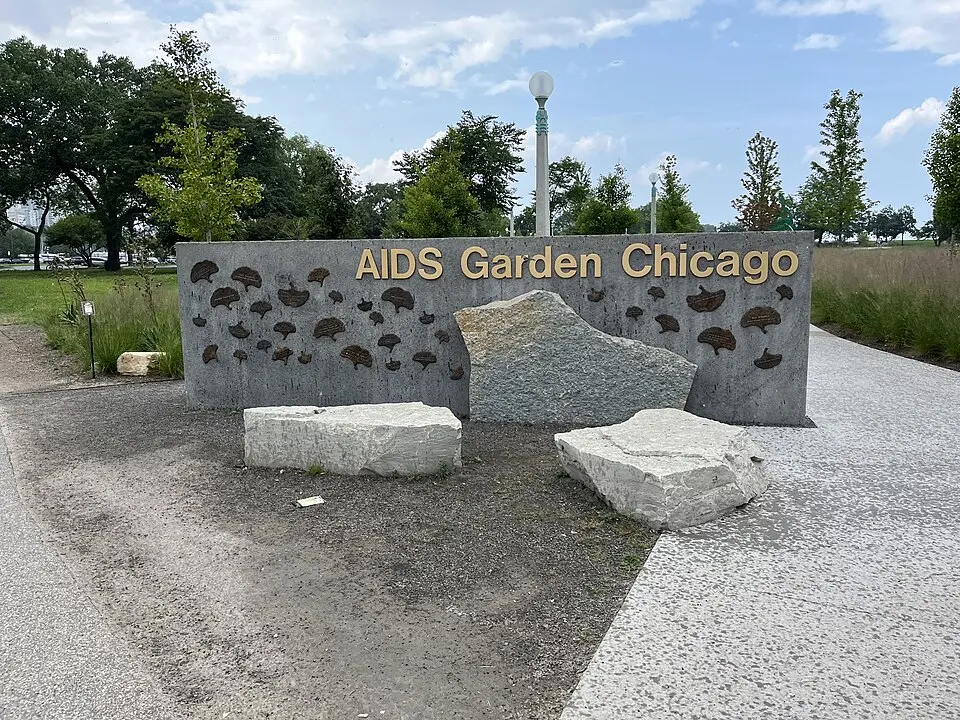
AIDS Garden Chicago A lakefront garden of remembrance south of Belmont Harbor, marked by Keith Haring’s vivid green Self-Portrait.
The garden occupies the former Belmont Rocks gathering place and honors those affected by Chicago’s HIV epidemic.
Walk through the garden on its paths and give people space for quiet reflection.
Signed benches and garden entrance at AIDS Garden Chicago
Photo: Another Believer · CC BY-SA 4.0 ↗
Nearby detour
Diversey Natural Area Native grasses and wetland plants fill a pocket of habitat just north of Diversey Harbor.
The Park District converted this often-flooded lawn into prairie, savanna and wetland habitat that also retains stormwater.
Use the paved path along the west side and respect posted habitat boundaries.
Nearby detour
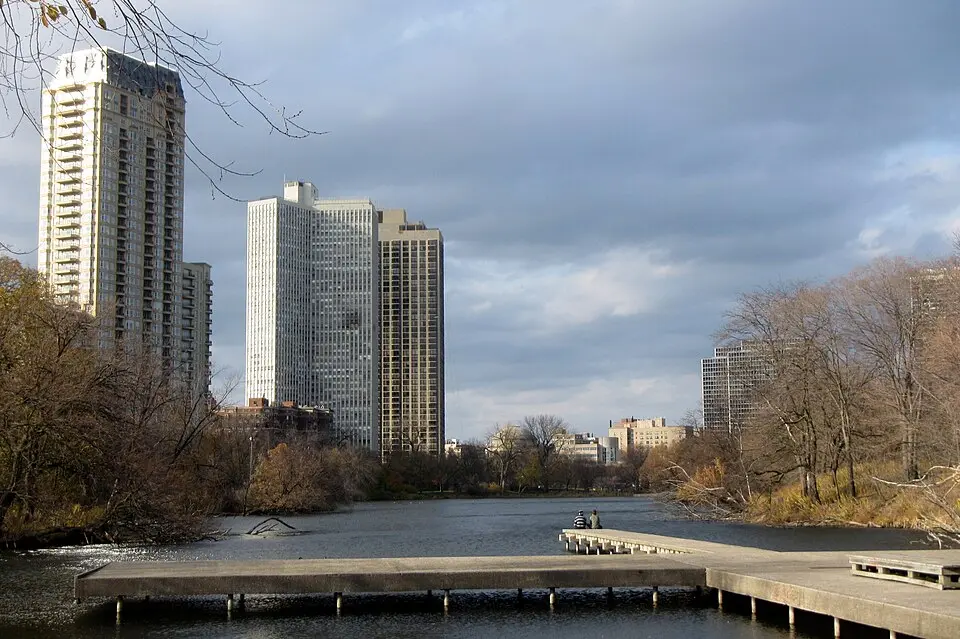
North Pond A quiet loop of water and reeds with neighborhood towers reflected among the trees.
The pond is inland in Lincoln Park, west of the lakefront route.
Use designated park paths and roadway crossings for this inland detour.
Photo: Bohao Zhao · CC BY 3.0 ↗
Nearby detour
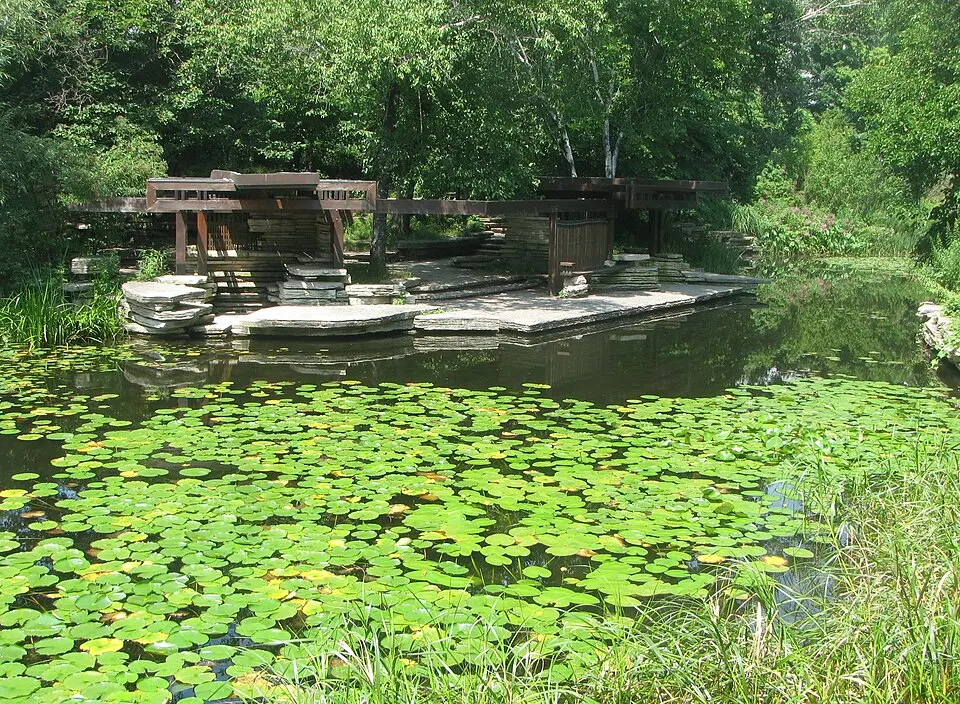
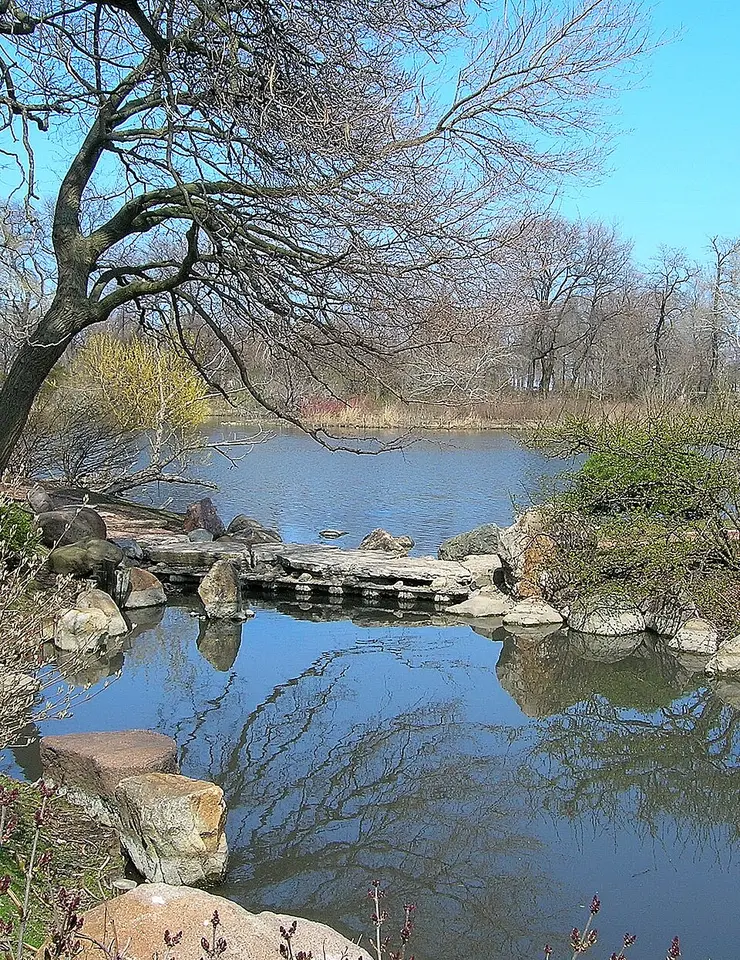
Alfred Caldwell Lily Pool Layered limestone, native planting, and a still pool make a small world within the city.
Alfred Caldwell’s Prairie-style landscape is a National Historic Landmark.
Check the Lincoln Park Conservancy’s current access information before your detour.
Photo: TonyTheTiger · CC BY-SA 3.0 ↗
Nearby detour
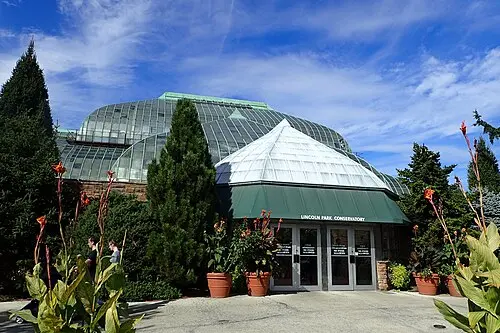
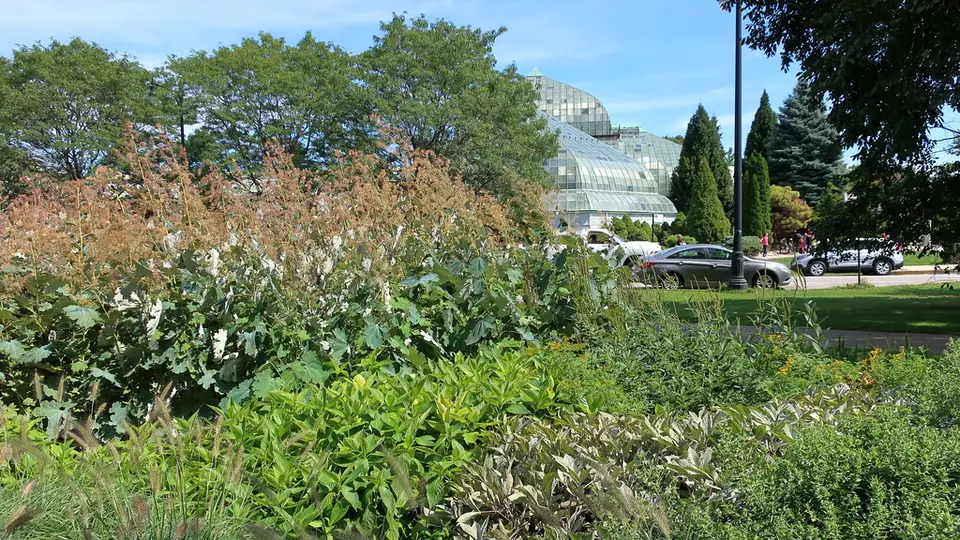
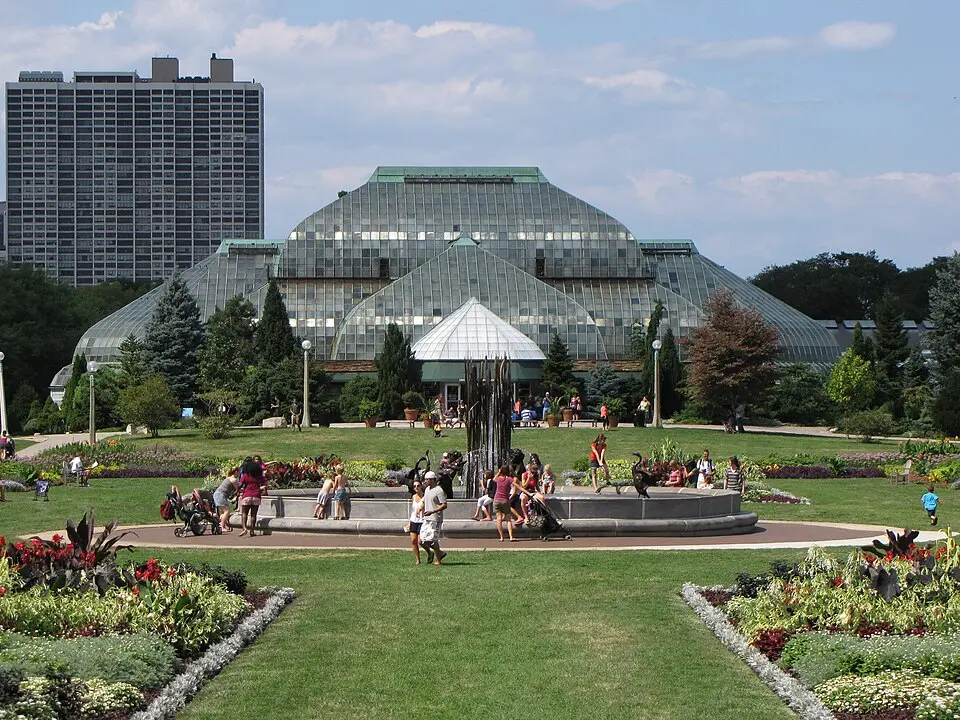
Lincoln Park Conservatory Step under glass into palms, ferns and changing flower displays in the middle of Lincoln Park.
The conservatory was built in stages from 1890 to 1895 and contains four display houses.
Check current reservations and opening hours before visiting the indoor gardens.
Photo: Krzysztof Ziarnek, Kenraiz · CC BY-SA 4.0 ↗
Nearby detour
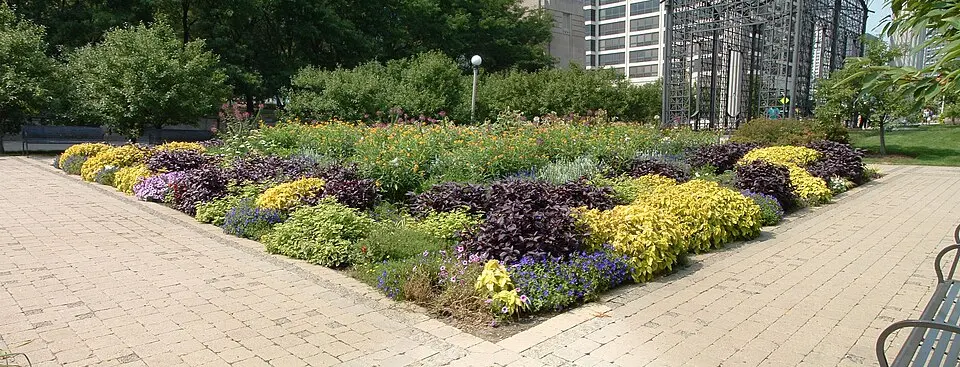
Grandmother’s Garden A long garden border along Stockton Drive invites a slower walk beside the conservatory grounds.
The Park District identifies this garden at Stockton Drive and Webster Avenue, extending across three blocks.
Stay on the garden paths and allow room for other visitors stopping to look at the planting.
Grandmother’s Garden, looking across Stockton Drive toward the conservatory · 2019
Photo: cultivar413 · CC BY 2.0 ↗
Nearby detour
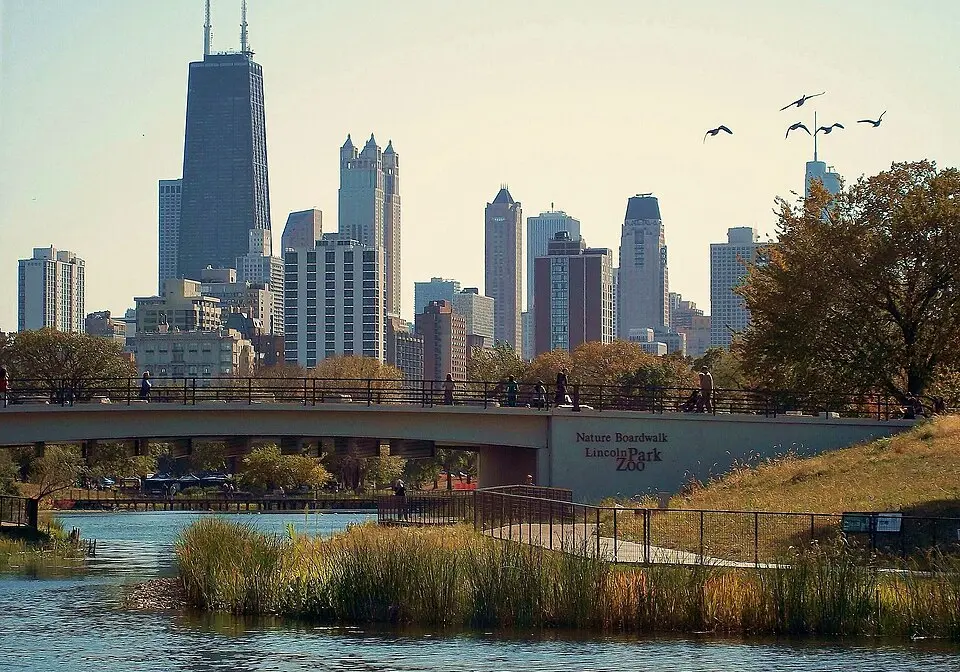
South Pond · Nature Boardwalk A boardwalk circuit through prairie and wetland planting, with the city skyline reflected in South Pond.
Lincoln Park Zoo opened the restored Nature Boardwalk habitat in 2010.
Follow the boardwalk and park paths; keep wildlife and shoreline planting undisturbed.
Photo: Alanscottwalker · CC BY-SA 3.0 ↗
On the trail
North Avenue Beach Dunes Native beach grasses form a narrow dune habitat beside the northern part of North Avenue Beach.
About 13,000 marram-grass plants were added in 2018 to encourage dunes and reduce drifting sand.
Enjoy the habitat from the adjacent paved trail and keep off the planted dunes.
Nearby detour
Milton Lee Olive Park Lakeside lawns and paths north of Navy Pier offer a broad view back toward Chicago’s towers.
The park is named in honor of Milton Lee Olive, a Chicago-born Medal of Honor recipient.
Enter from the Ohio Street Beach side and check posted gate hours.
Photo: Bgutenschwager · CC BY-SA 4.0 ↗
On the trail
Jane Addams Memorial Natural Area A pocket of native prairie sits just south of Ohio Street Beach, close to Navy Pier.
Interpretive signs introduce nature in the city beside the prairie plantings.
View the prairie from the park’s paved paths and keep out of planted habitat.
On the trail
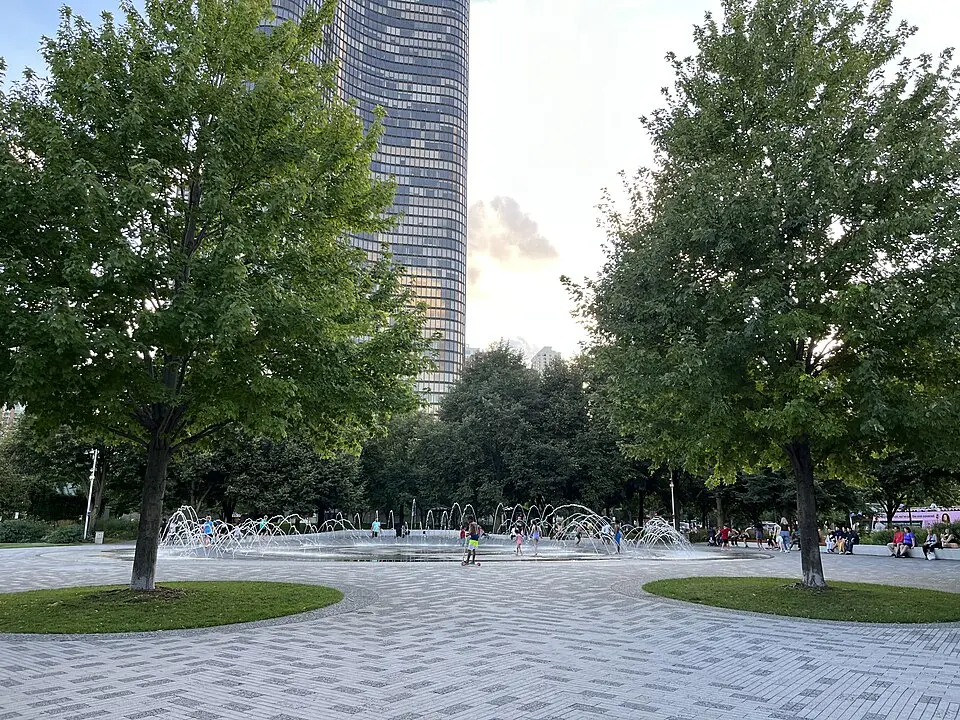
Polk Bros Park Lawns, paths and a fountain form Navy Pier’s green front door.
This 13-acre public space includes outdoor performance lawns and was transformed through the Polk family’s 2014 gift.
Check Navy Pier’s current program and fountain information when planning a visit.
Photo: Another Believer · CC BY-SA 4.0 ↗
Via a connector
Cancer Survivors’ Garden A contemplative garden occupies the eastern edge of Maggie Daley Park beneath tall granite columns.
Completed in 1996, its garden rooms express acceptance, support and celebration.
The garden is public but may close for private events; check current access.
Photo: Kelly Martin · CC BY-SA 3.0 ↗
Via a connector
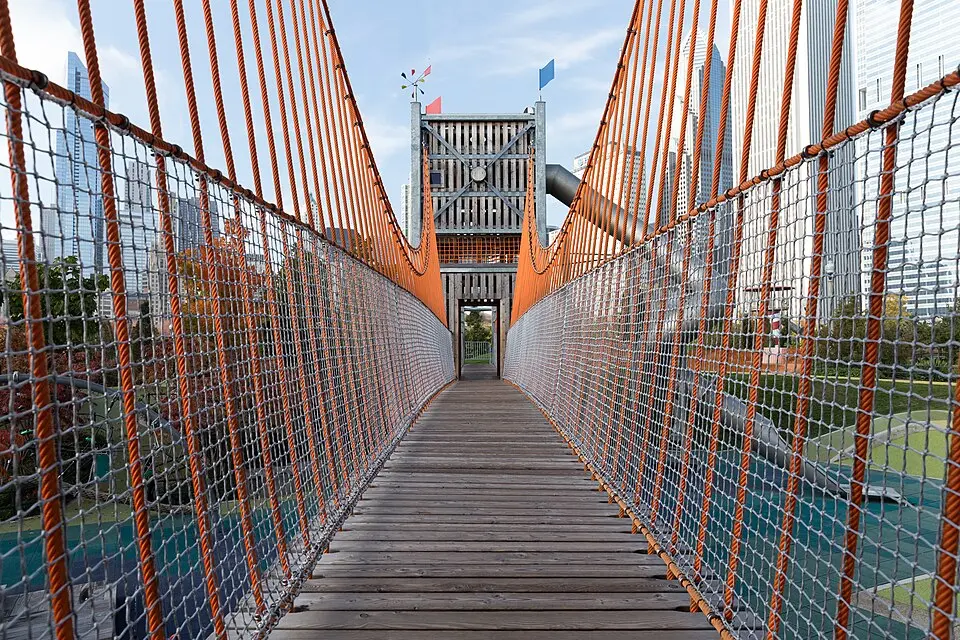
Maggie Daley Park A playful downtown landscape of climbing, skating, and paths that rise and turn among the lawns.
The curving BP Pedestrian Bridge connects this park to Millennium Park.
Activities have their own hours, reservations, and age requirements.
The play garden’s suspension bridge.
Photo: Mack Male from Edmonton, AB, Canada · CC BY-SA 2.0 ↗
Nearby detour
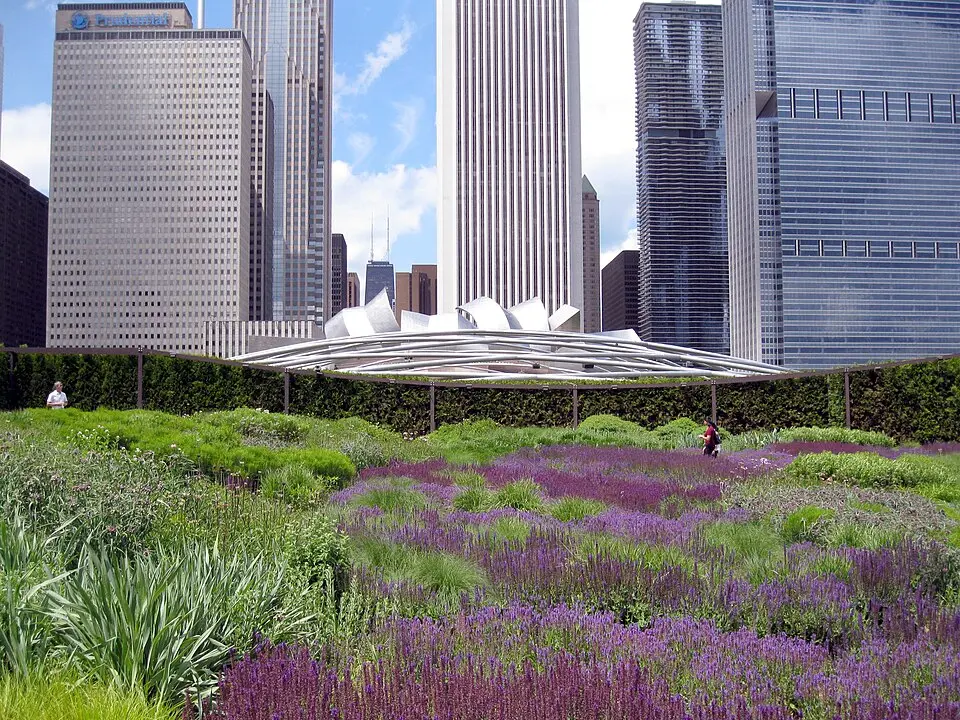
Lurie Garden Perennial flowers, grasses, and a sheltering hedge create a quieter garden beneath the downtown skyline.
The garden uses naturalistic planting and ecologically sensitive maintenance to support urban wildlife.
Remain on garden paths and check current notices for walkway closures.
Photo: Ruhrfisch · CC BY-SA 4.0 ↗
Nearby detour
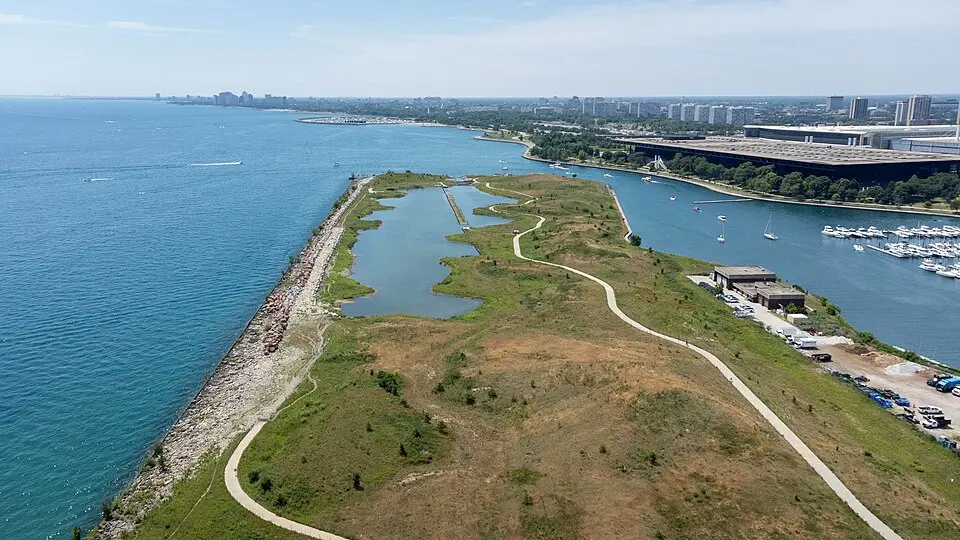
Northerly Island Prairie planting, water on both sides, and a skyline that grows quieter as you head south.
This peninsula formerly held Meigs Field airport.
This is an out-and-back detour, not the through trail. Follow current park and event access signs.
Photo: Sea Cow · CC BY-SA 4.0 ↗
On the trail
McCormick Bird Sanctuary Native prairie and woodland create a bird habitat beside McCormick Place and the lakefront.
Part of its prairie grows above an underground parking garage.
Use the overlook off the trail and designated paths; stay outside fenced habitat.
McCormick Bird Sanctuary, looking southwest · 2017
Photo: Richard Bartlaga · CC BY-ND 2.0 ↗
On the trail
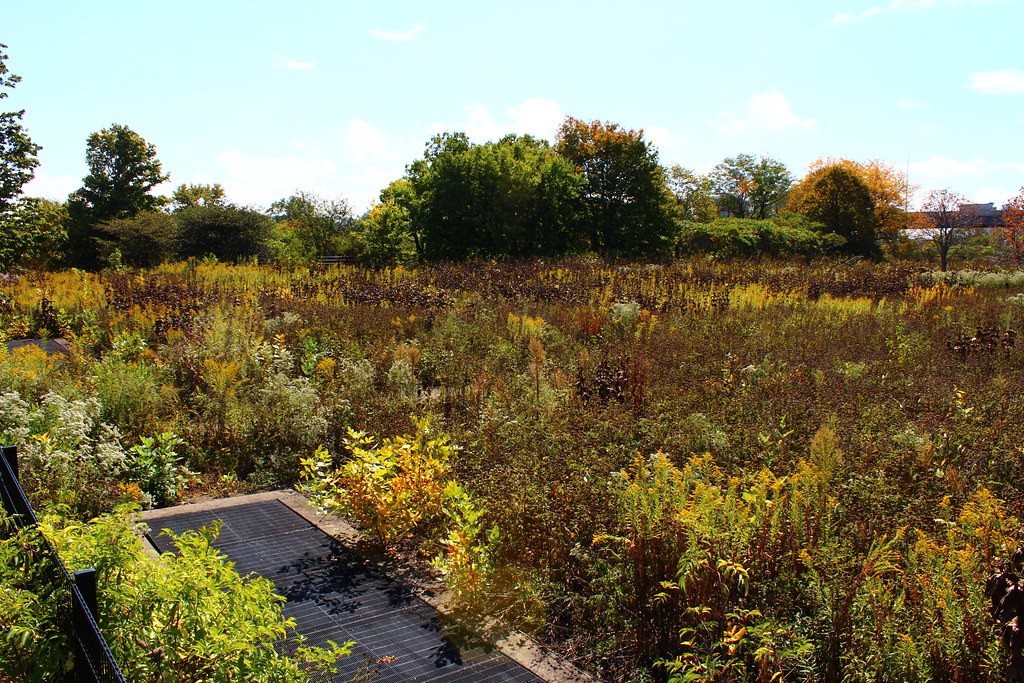
Burnham Centennial Prairie Prairie grasses and wildflowers occupy a long stretch of the Burnham Wildlife Corridor south of McCormick Place.
The Park District describes more than 50 acres of restored prairie habitat along this part of the lakefront.
Explore from the paved Lakefront Trail or designated mulch paths. Natural areas are open dawn to dusk.
Nearby detour
Burnham Nature Sanctuary A prairie, wooded edge and butterfly habitat occupy the inland side of the lakefront near 47th Street.
A paved loop and boardwalk provide close views of the restored habitat.
Use the designated road and rail crossings; the sanctuary is west of DuSable Lake Shore Drive.
On the trail
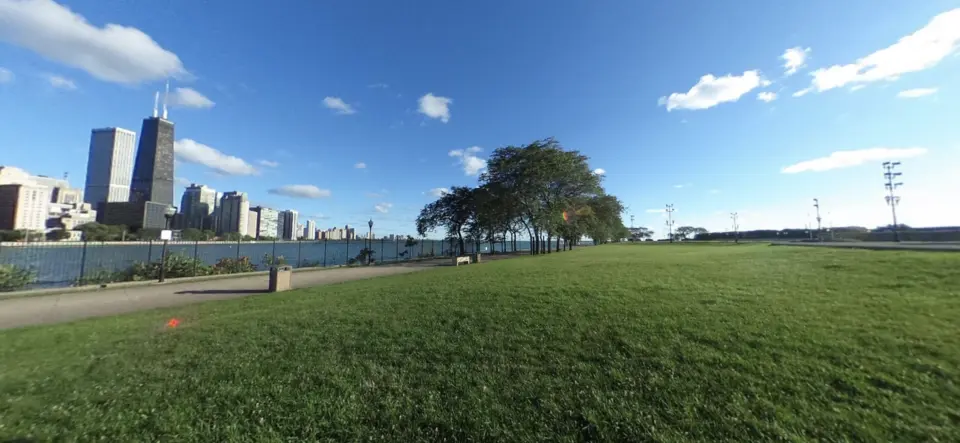
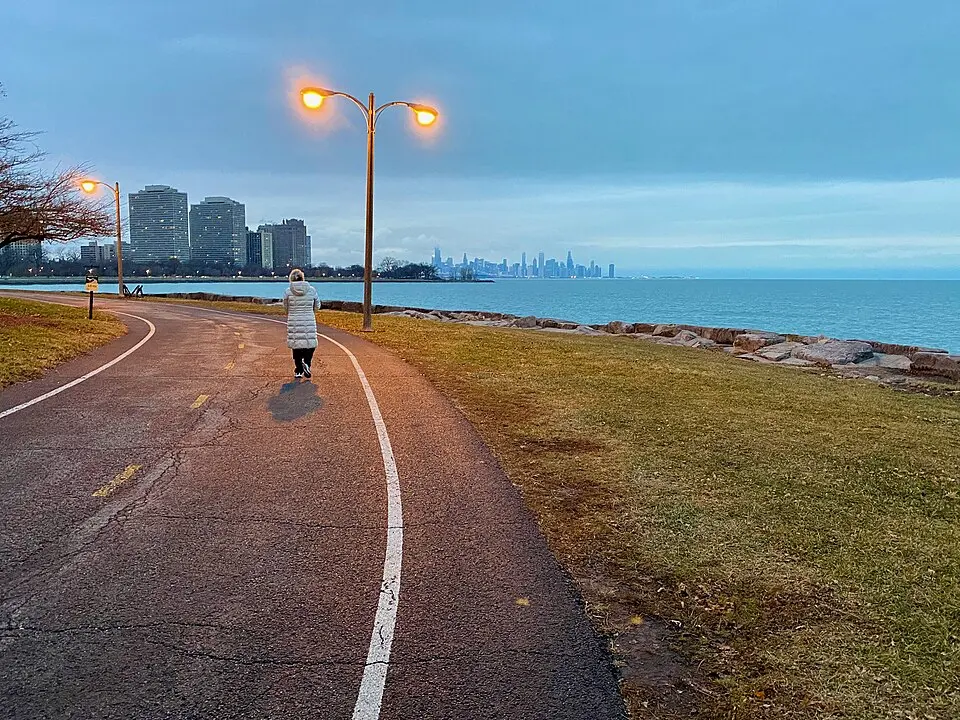
Burnham Park Long lawns, lake breezes, and an uninterrupted sense of the city stretching south.
Much of this lakefront park was created through landfill and successive public works projects.
Bring water and plan your access point before choosing a longer section.
Lakefront promenade near McCormick Place Bird Sanctuary.
Photo: DimiTalen · CC0 ↗
Nearby detour
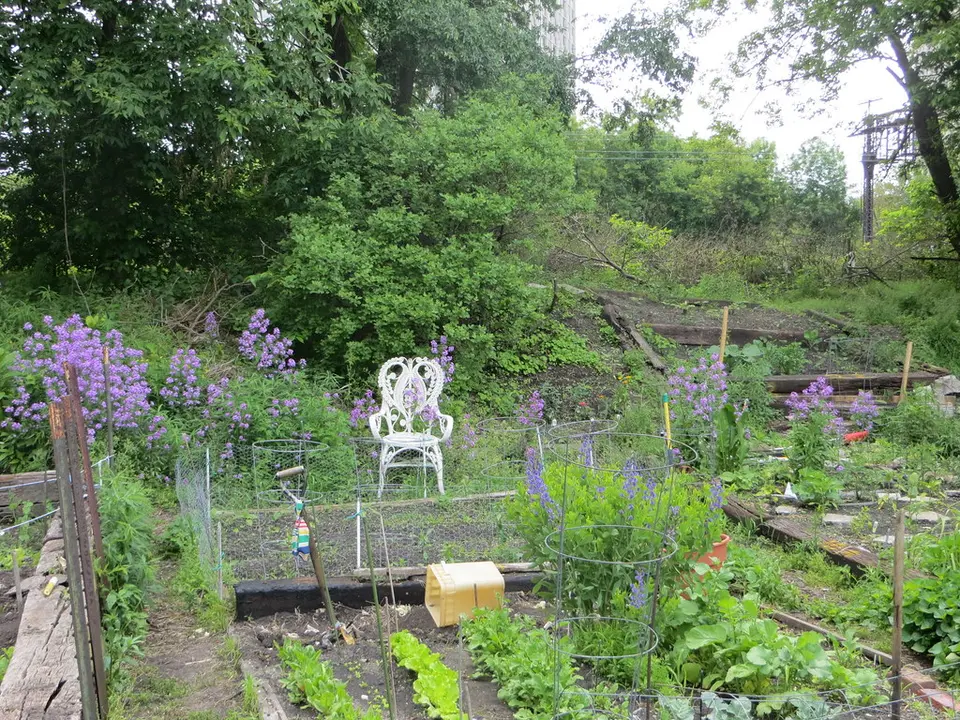
Cornell Garden Oasis A woodland path opens into a community garden near 48th Street and Cornell Drive.
The garden combines vegetable plots with native wildflowers and ferns.
Stay on visitor paths, respect the growing plots and check community-garden access arrangements.
Cornell Garden Oasis · 2013
Photo: David Wilson · CC BY 2.0 ↗
Via a connector
Promontory Point A peninsula of mature trees and limestone steps, with the city a distant silhouette across the lake.
Alfred Caldwell designed the Point’s Prairie-style landscape in 1937.
The outer stone edge is uneven and exposed to waves. Stay on open paths and follow signs.
Photo: Danielbv~enwiki · CC BY-SA 4.0 ↗
Nearby detour
Osaka Garden · Garden of the Phoenix A Japanese garden on Wooded Island brings stone, water, trees, and carefully framed views into a small space.
The garden’s story is connected to Japan’s presence at the 1893 World’s Columbian Exposition.
Check the Park District’s current garden hours; leave bicycles outside and remain on the paths.
Photo: zooey from Chicago, Illinois USA · CC BY 2.0 ↗
Nearby detour
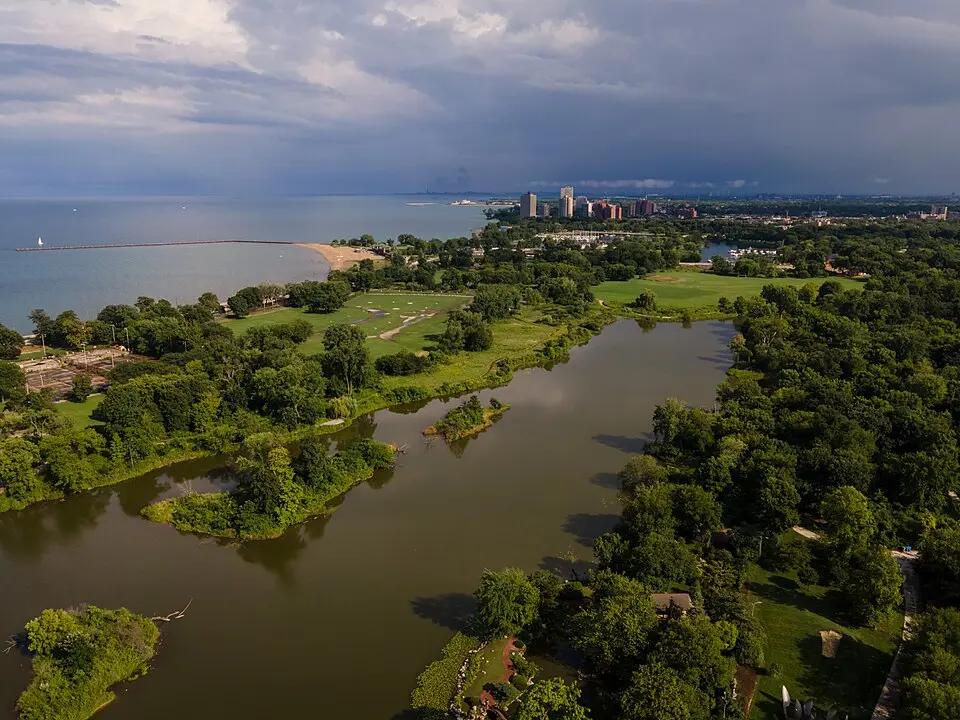
Bobolink Meadow Prairie and wooded edges lie east of Wooded Island across Jackson Park’s lagoon.
The Park District maintains Bobolink Meadow as a natural area with community stewardship.
Reach the meadow by designated park paths; the official steward meeting point is at its south entrance.
Bobolink Meadow on the east (left) bank of Jackson Park’s lagoon · aerial view, 2022
Photo: Jules Verne Times Two / julesvernex2.com · CC BY-SA 4.0 ↗
Nearby detour
Jackson Park & Wooded Island Lagoons, birdsong, and the Garden of the Phoenix reveal a quieter, inland chapter of the lakefront.
Jackson Park was a principal site of the 1893 World’s Columbian Exposition.
Osaka Garden is an inland detour. Follow designated crossings and posted garden access rules.
Photo: JulDer Wiki · CC BY 4.0 ↗
On the trail
63rd Street Beach Dunes Native grasses and shoreline plants form habitat on either side of the swimming beach.
The natural area supports migrating birds along the southern lakefront.
Observe from paved paths and stay out of planted dunes.
The beach and planted dunes at right · 63rd Street Beach, 2013
Photo: Natalia Wilson · CC BY-SA 2.0 ↗
Via a connector
South Shore Nature Sanctuary A small peninsula gathers dunes, wetland, woodland, and prairie into a final quiet lakeside detour.
The sanctuary opened in 2002 and includes more than six acres of varied native habitats.
Stay on the designated paths, which include pavement, boardwalk, and crushed gravel.
The sanctuary entrance is signed at the South Shore Cultural Center.
Photo: Daniel X. O'Neil from USA · CC BY 2.0 ↗
Nearby detour
South Shore Formal Garden Ordered beds and a formal approach lead toward the cultural center, offering a different landscape from the nearby sanctuary.
The formal garden occupies the boulevard entrance in front of the South Shore Cultural Center’s main building.
Use the garden paths at the main approach and respect event arrangements.
HARBOR
Follow the masts. Nearby detour
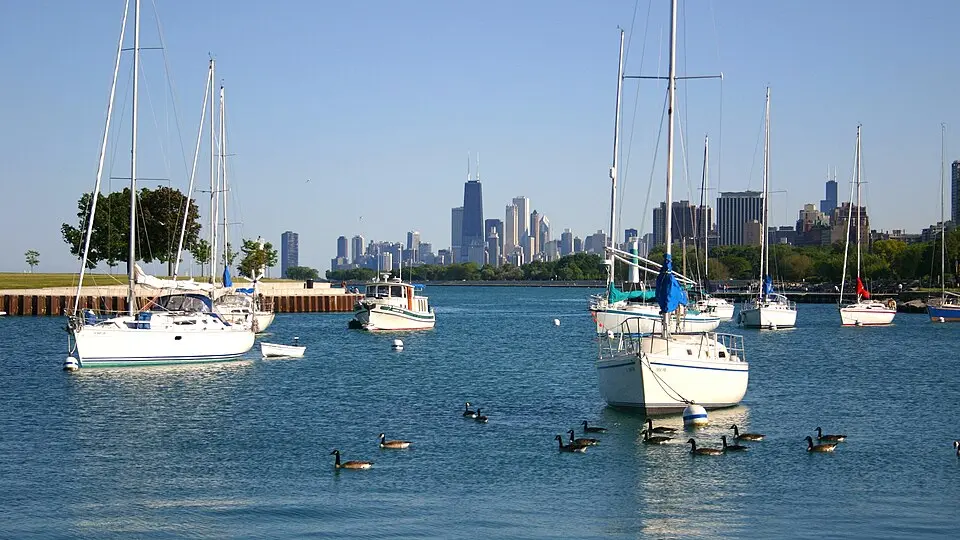
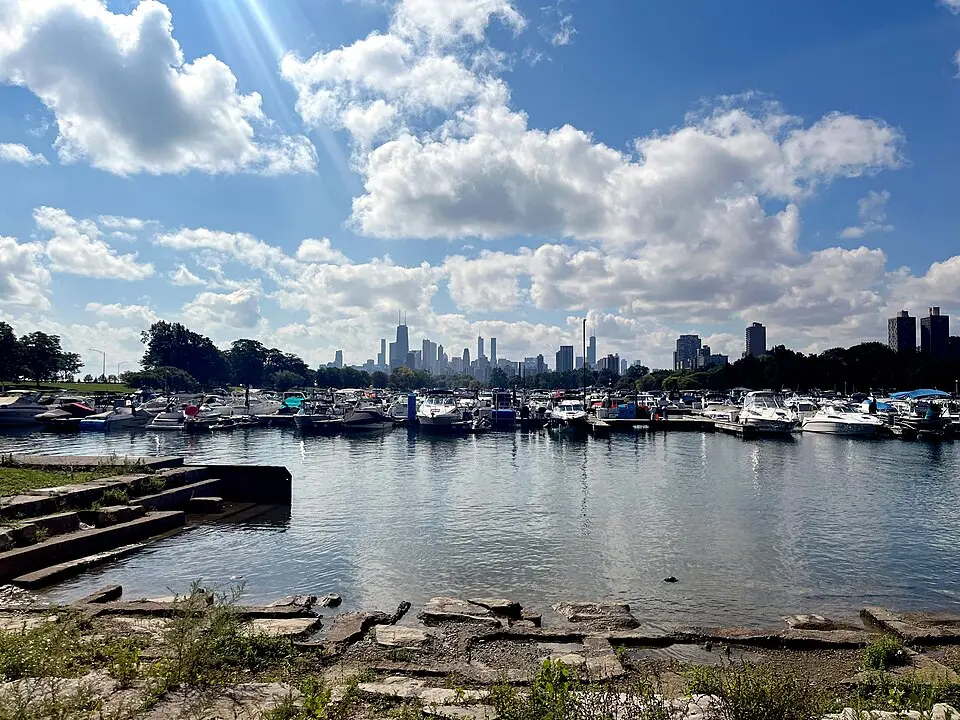
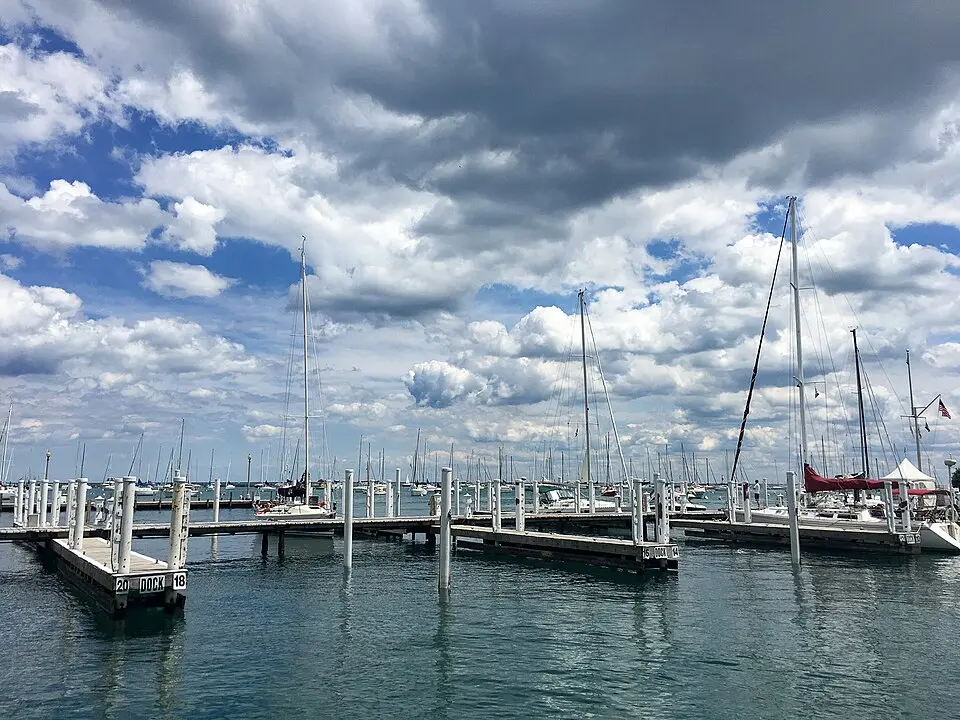
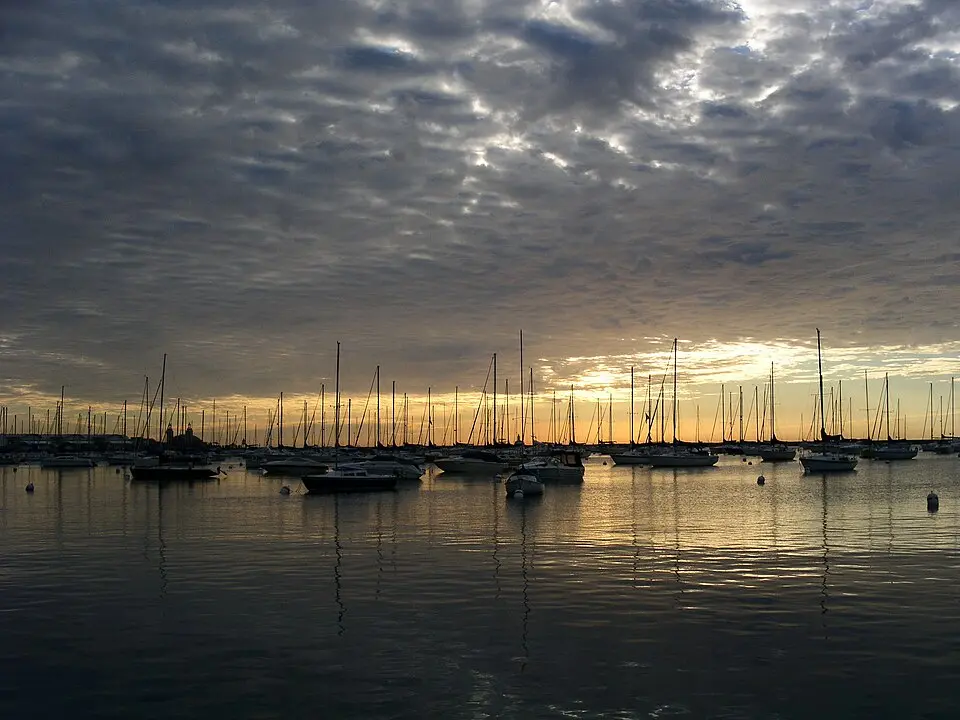
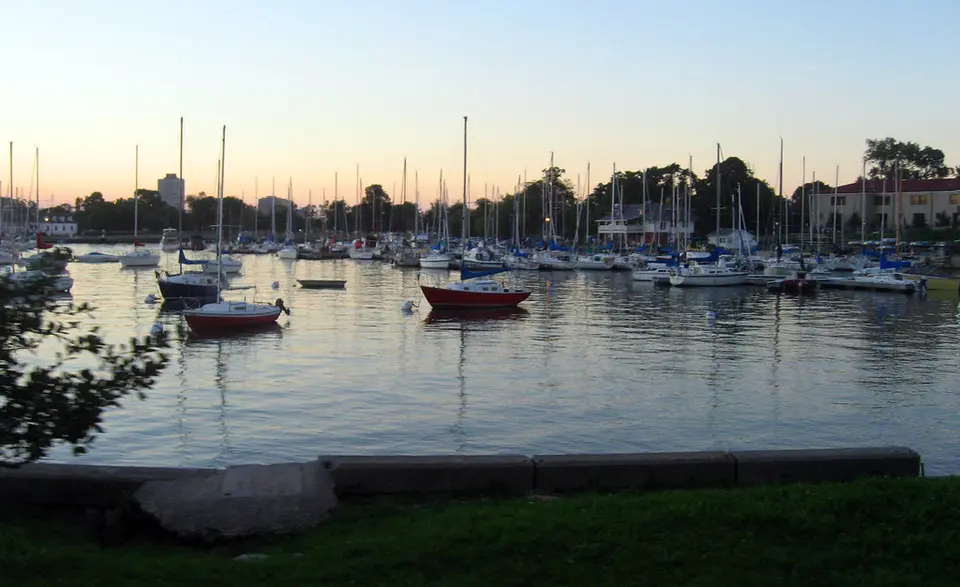
Montrose Harbor A sheltered curl of water, a forest of masts, and an ever-changing view of boats slipping out to the lake.
The harbor sits on the sheltered side of the Montrose peninsula.
Use the public paths; marina docks have separate access rules.
Photo: J. Crocker · Attribution ↗
On the trail
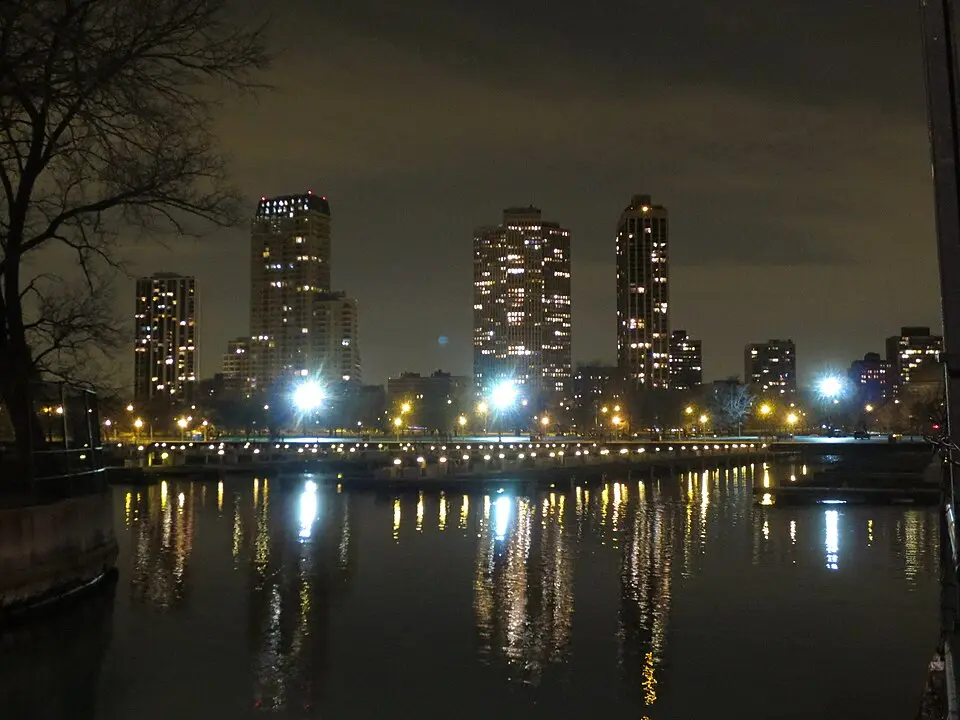
Belmont Harbor Follow the long curve of the harbor past sailboats, lawns, and the towers of Lakeview.
Belmont is one of the harbors in Chicago’s public lakefront harbor system.
Keep trail crossings and dock entrances clear when stopping for the view.
Photo: TheWxResearcher · CC BY-SA 4.0 ↗
On the trail
Diversey Harbor An inland basin threaded with boats and framed by Lincoln Park’s green canopy.
A narrow channel connects the harbor to Lake Michigan.
Follow signed paths around the channel and bridges. Dock access is restricted.
Photo: edward stojakovic from Portland, OR, United States · CC BY 2.0 ↗
On the trail
DuSable Harbor Just south of the river mouth, sailboat masts make a delicate foreground for the downtown towers.
The harbor is named for Jean Baptiste Point DuSable.
Follow the signed downtown trail connections; docks are separate from public paths.
Photo: piet theisohn from Leverkusen, Germany · CC BY 2.0 ↗
On the trail
Monroe Harbor A broad mooring field turns the lake into a scattering of white sails beside Grant Park.
Monroe’s boats use a mooring-field layout rather than rows of continuous docks.
Enjoy the view from the public shoreline and leave harbor service access clear.
Photo: Yoo Chung · CC BY-SA 3.0 ↗
On the trail
Burnham Harbor A long sheltered basin between the museums, Northerly Island, and the South Side lakefront.
Burnham Harbor forms part of Chicago’s public harbor system.
Use public shoreline routes and follow event-day directions around Museum Campus.
Photo: Robert Rice (Canoehead72) · Public domain ↗
On the trail
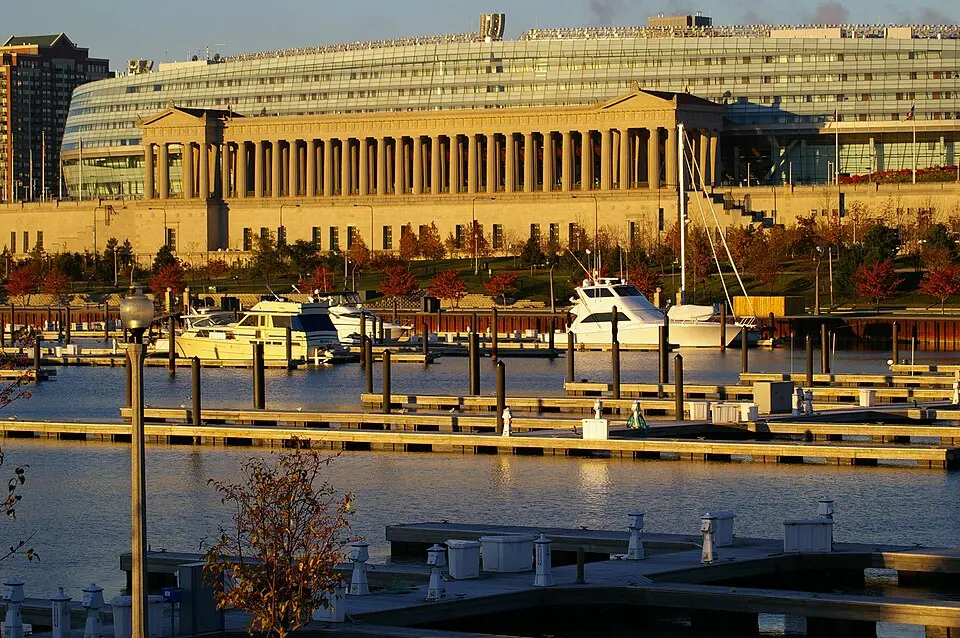
31st Street Harbor A modern marina brings boats, promenades, and a fresh perspective on the southern skyline.
The harbor opened in 2012 as an addition to Chicago’s lakefront harbor system.
Use public promenades and keep marina gates and access routes clear.
Via a connector
59th Street Harbor A small protected harbor occupies a lagoon in Jackson Park near the Griffin Museum.
Museum Shores Yacht Club calls the harbor home.
View from public park paths; marina services are seasonal and dock access is controlled.
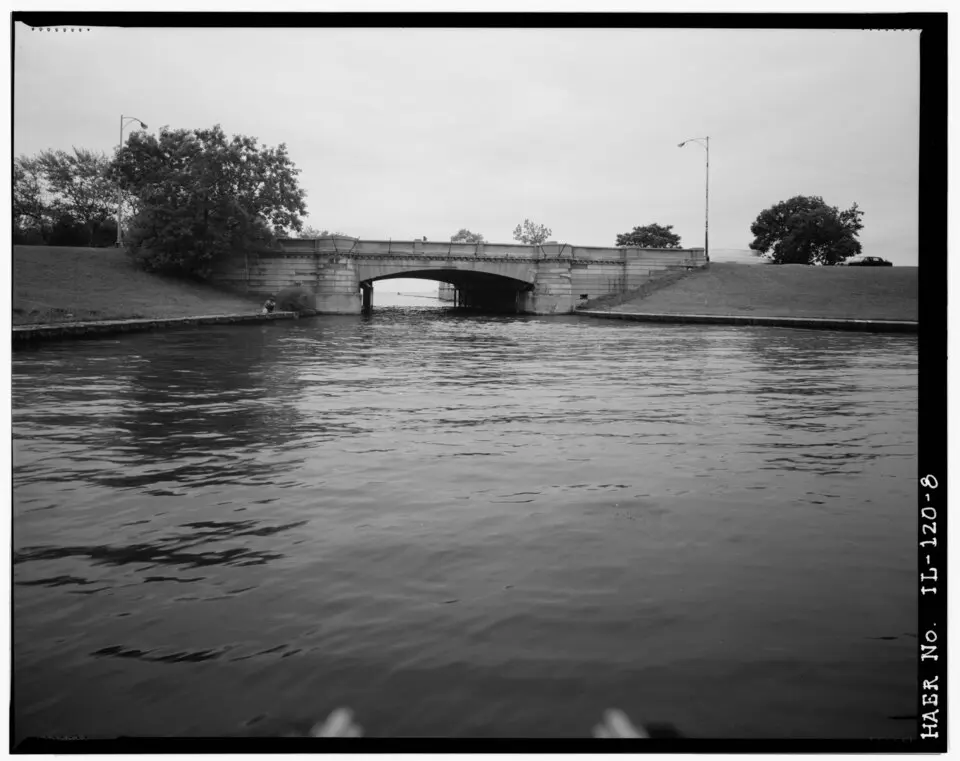
Historic view of the harbor’s North Inlet Bridge · Library of Congress
Photo: Historic American Engineering Record / Library of Congress · Public domain ↗
Nearby detour
Jackson Park Inner Harbor A sheltered harbor sits west of Lake Shore Drive among Jackson Park’s lagoons and lawns.
Bridge clearances limit the inner harbor to powerboats.
Use designated park crossings and public paths; marina services and dock access are restricted seasonally.
Via a connector
Jackson Park Outer Harbor Boats shelter east of Lake Shore Drive near the old Coast Guard station and Jackson Park’s shore.
Jackson Park Yacht Club is based at the outer harbor.
Observe from public shore paths; check seasonal marina operations and respect dock gates.
Jackson Park Outer Harbor · 2007
Photo: David B. Gleason · CC BY-SA 2.0 ↗
LANDMARK
Stories written in the skyline. On the trail
Ardmore Avenue Your north-to-south journey begins where Edgewater meets Lake Michigan. The whole shoreline lies ahead.
The official northern end of the Lakefront Trail is Ardmore Avenue.
Find the signed walking and cycling paths at the beach approach.
Photo: AlphaBeta135 · CC BY-SA 4.0 ↗
On the trail
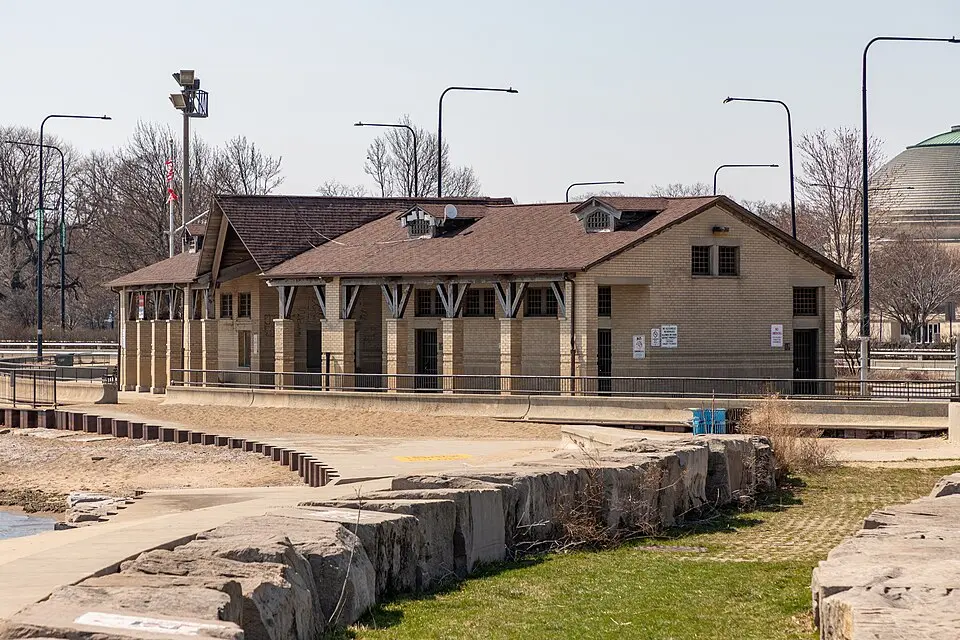
Come to Light Glittering tile and glass wrap the old Osterman Beach comfort station in images of planets, water and wildlife.
Andy Bellomo led the community mosaic project, completed in 2011.
View the mosaic from the surrounding paths; the artwork is on the old comfort station, not the newer beach house.
Nearby detour
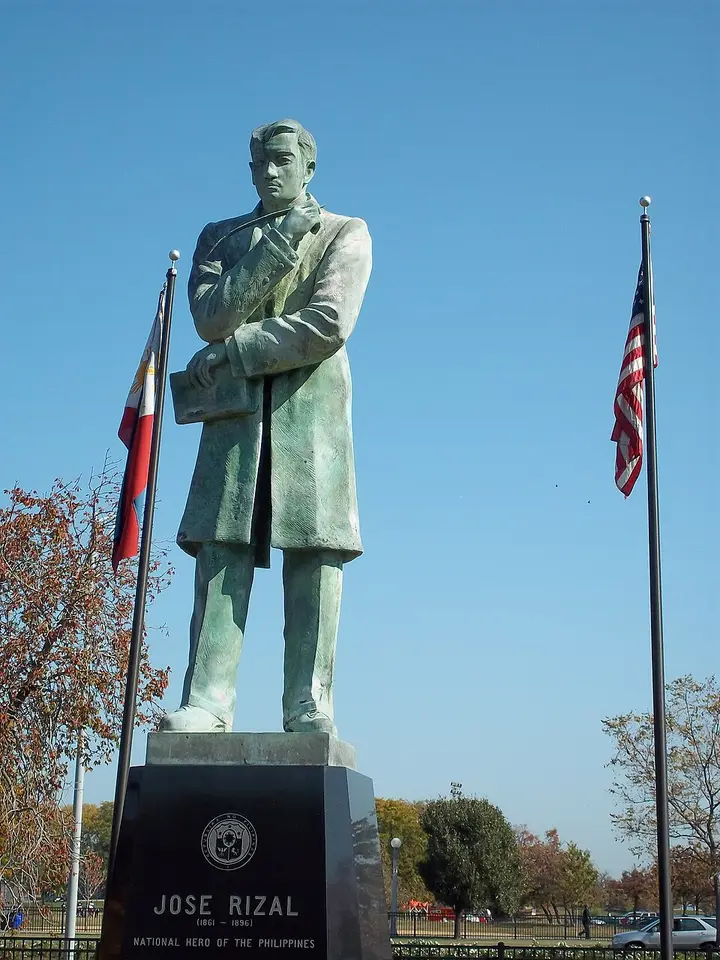
Dr. José Rizal Monument A bronze memorial beside Marine Drive honors the Filipino writer, physician and independence figure.
Antonio T. Mondejar’s Chicago sculpture was unveiled in 1999 as a replica of his monument in Dapitan, Philippines.
This is west of DuSable Lake Shore Drive near Leland Avenue; use park paths and marked crossings.
Photo: Alanscottwalker · CC BY-SA 3.0 ↗
On the trail
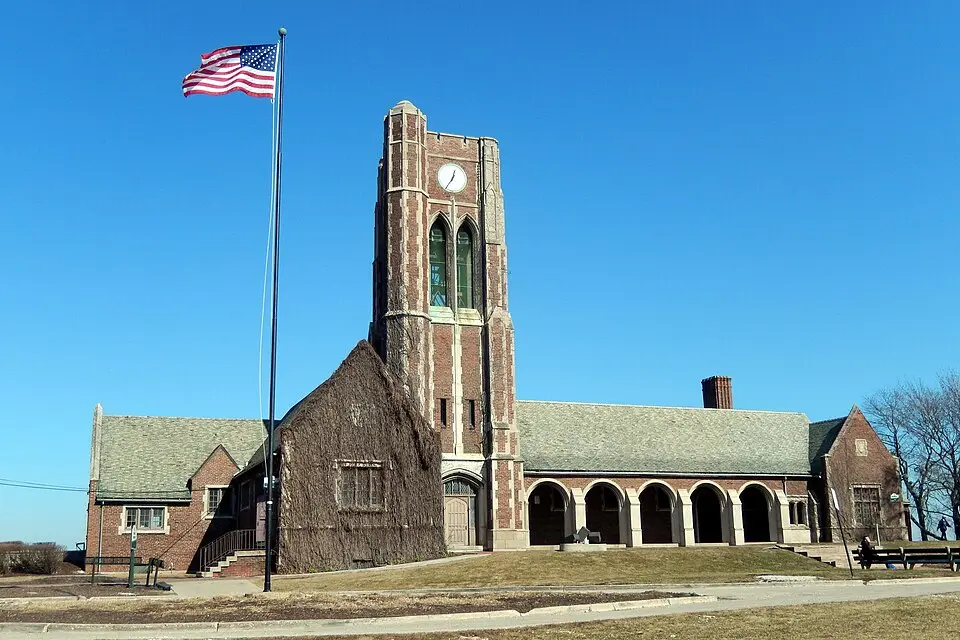
Waveland Clock Tower A distinctive clock tower gives the open north lakefront a recognizable meeting point.
The Park District’s Lincoln Park map locates the tower beside Sydney R. Marovitz Golf Course.
Meet on the public paths around the building; stay outside the active golf course.
Photo: Bohao Zhao · CC BY 3.0 ↗
Nearby detour
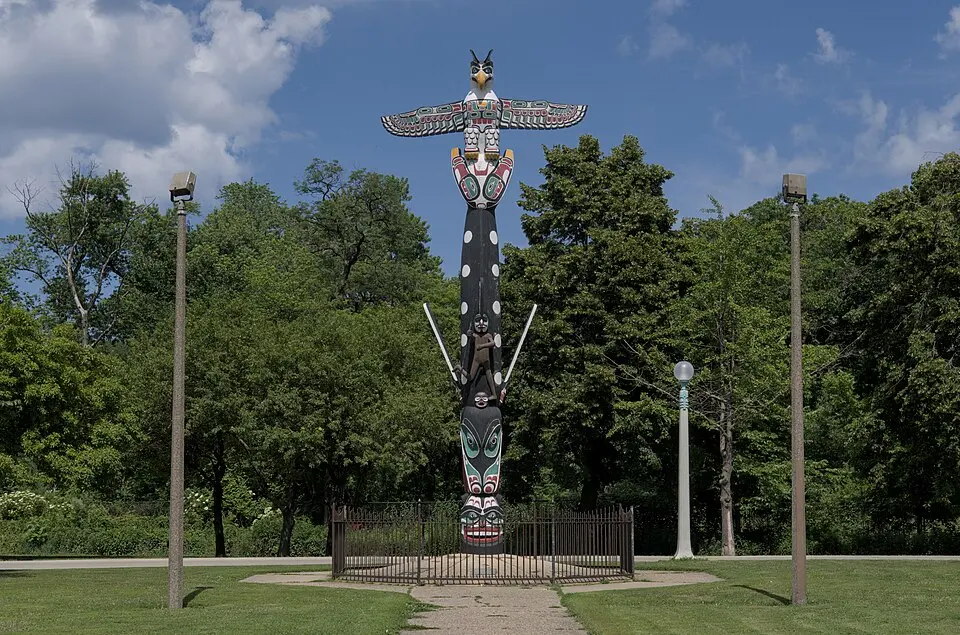
Kwa-Ma-Rolas · Kwanusila A carved cedar totem pole stands beside the park paths west of the Bill Jarvis bird sanctuary.
Tony Hunt carved the replica after the original pole was returned to British Columbia.
View the pole from the neighboring park paths east of DuSable Lake Shore Drive.
Historical photograph of the lakefront pole, before its 2025 rededication as Kwa-Ma-Rolas
Photo: Theemausoliam · CC BY-SA 3.0 ↗
Nearby detour
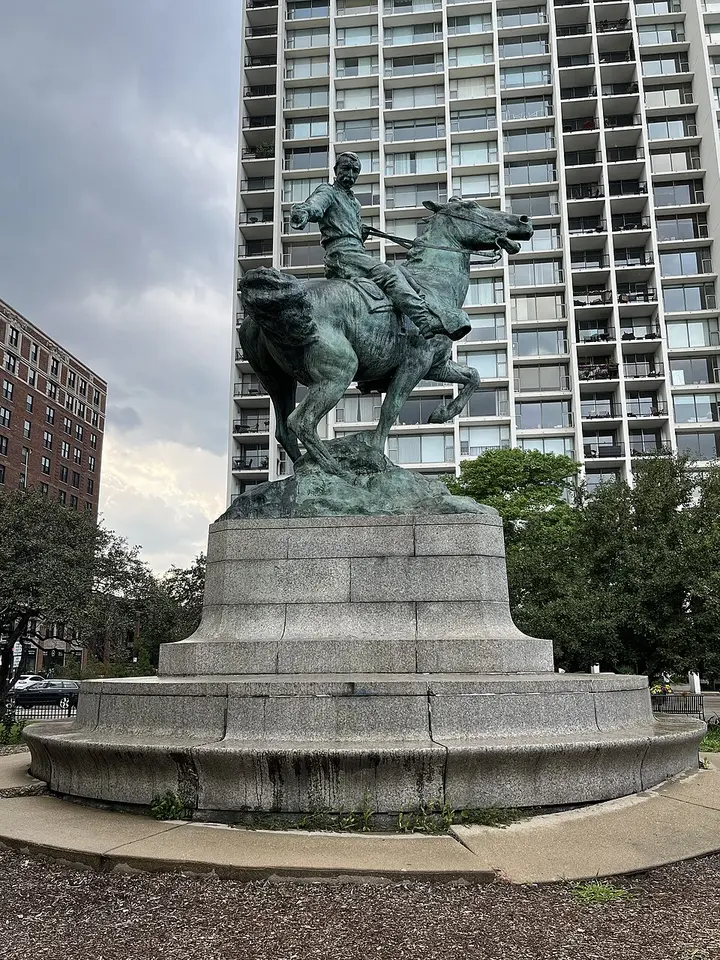
General Philip Sheridan Monument An equestrian bronze marks the park edge at Belmont Avenue.
Gutzon Borglum’s Sheridan monument was installed here in 1923.
Use marked crossings and the park-side paths around Belmont and DuSable Lake Shore Drive.
Photo: Another Believer · CC BY-SA 4.0 ↗
Nearby detour
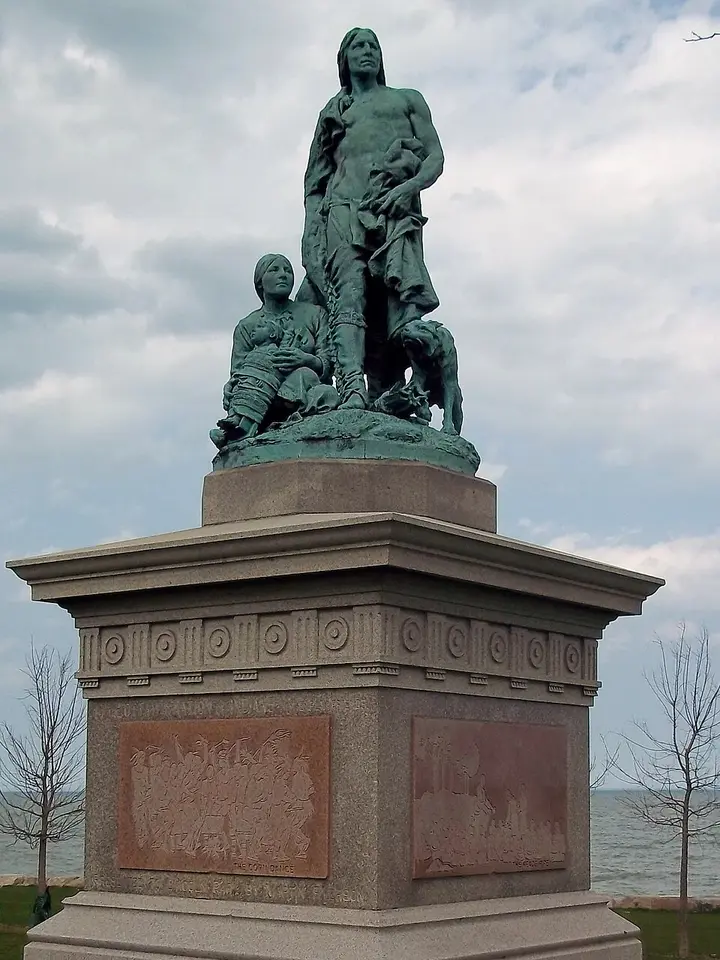
The Alarm A detailed bronze family group beside the lakefront rewards a closer look at its figures and reliefs.
John J. Boyle created the sculpture, and it was moved to its current lakefront setting in 1974.
Use the linked Park District history for context while looking at the sculpture.
Photo: Alanscottwalker · CC BY-SA 3.0 ↗
On the trail
Chevron Angular blue steel rises near the north side of the Diversey Harbor inlet.
John Henry created Chevron in 2007.
View from the park paths. The Park District lists this as a temporary artwork, so check current display information.
Nearby detour
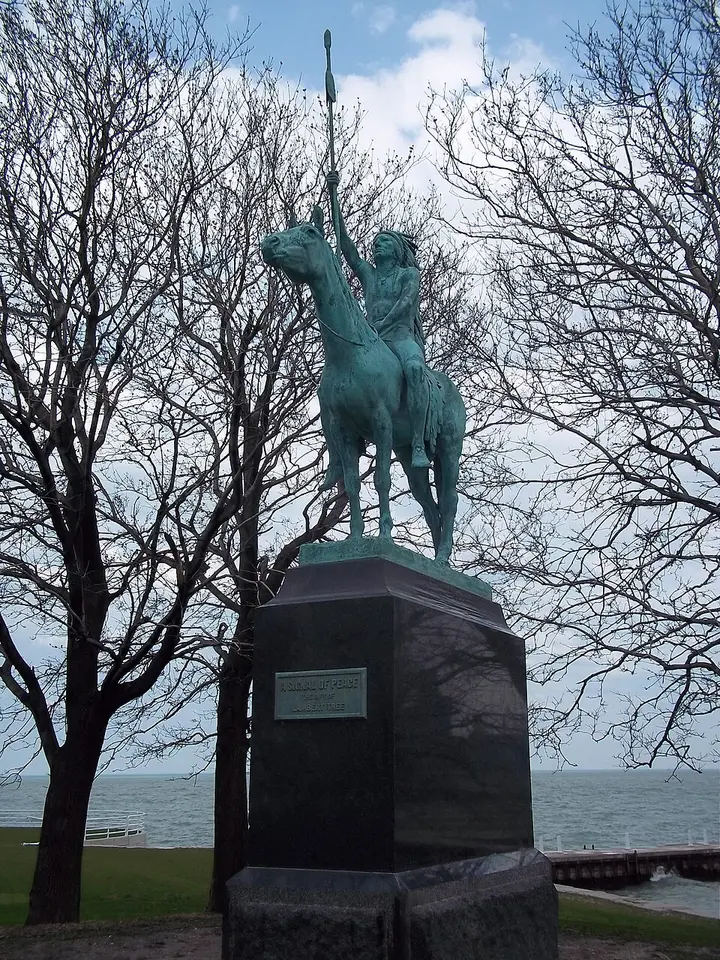
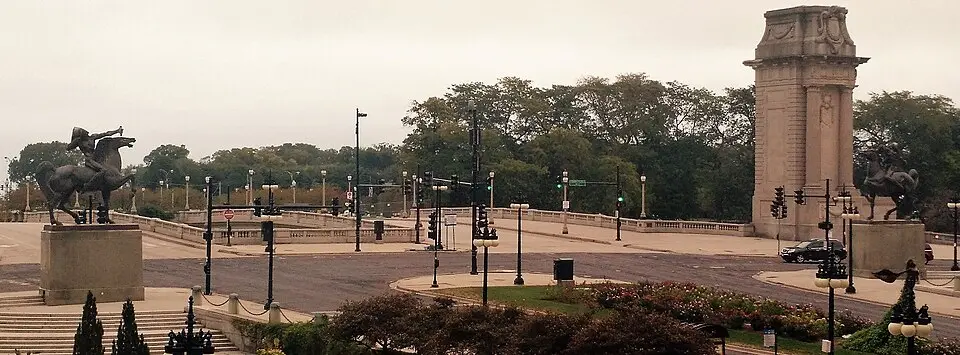
A Signal of Peace A bronze rider holding a feathered staff stands in the lakeside park near Diversey.
Cyrus Edwin Dallin’s sculpture appeared at the 1893 World’s Columbian Exposition before moving to Lincoln Park.
View the rider and pedestal from the adjoining park paths.
Photo: Alanscottwalker · CC BY-SA 3.0 ↗
Nearby detour
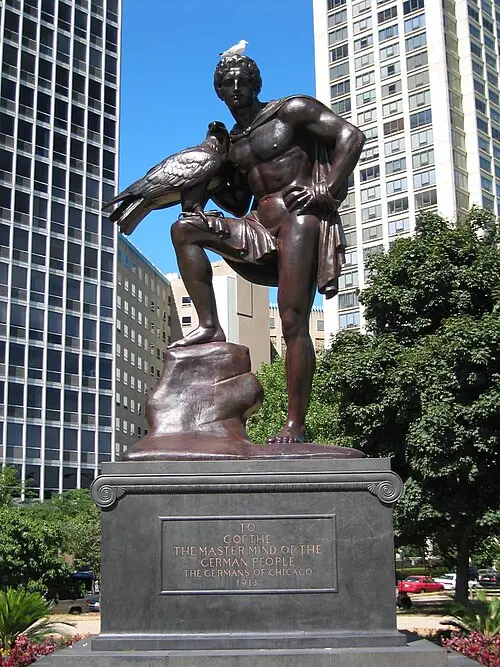
Goethe Monument An enormous figure and eagle stand in a garden setting near Diversey and Stockton.
Herman Hahn’s 1913 monument represents Goethe’s creative spirit rather than a literal portrait of the writer.
Walk in from the neighboring park paths to inspect the figure and relief panels.
Photo: Wildcat Dunny / Greg Dunham from Kirkland, WA, USA · CC BY 2.0 ↗
Nearby detour
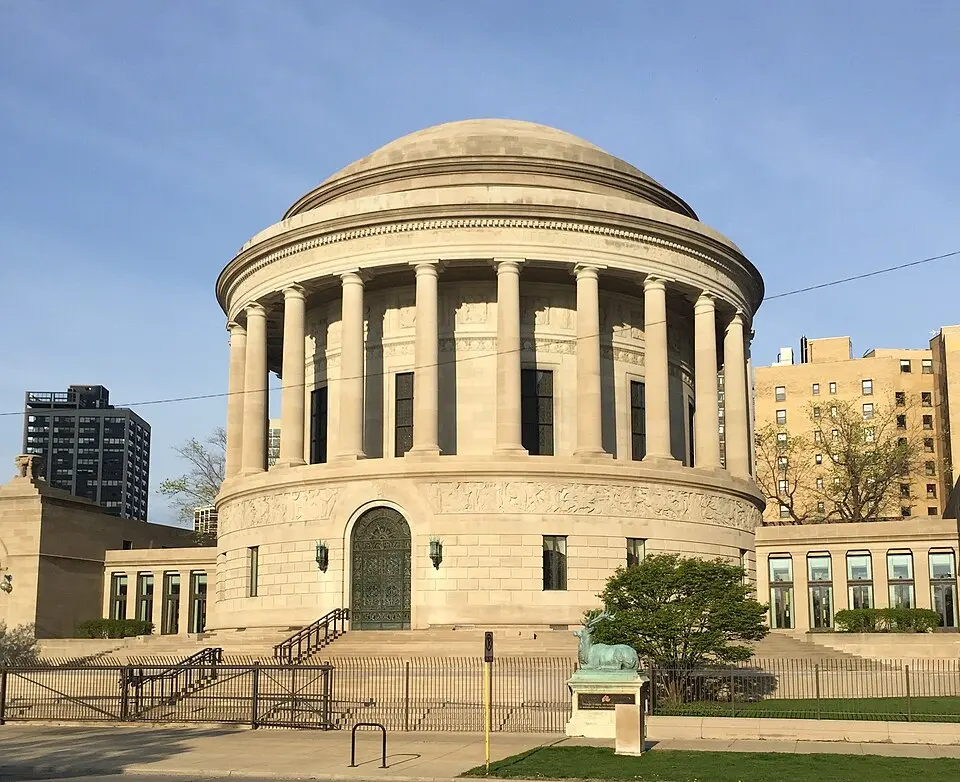
Elks National Memorial A domed memorial faces Lincoln Park, with monumental sculpture and a richly decorated interior.
The memorial was built in 1926 to honor Americans who served and sacrificed.
Use the neighborhood sidewalks west of the park and check the memorial’s current visiting schedule before entering.
Photo: Marilyn Engwall · CC BY-SA 4.0 ↗
Nearby detour
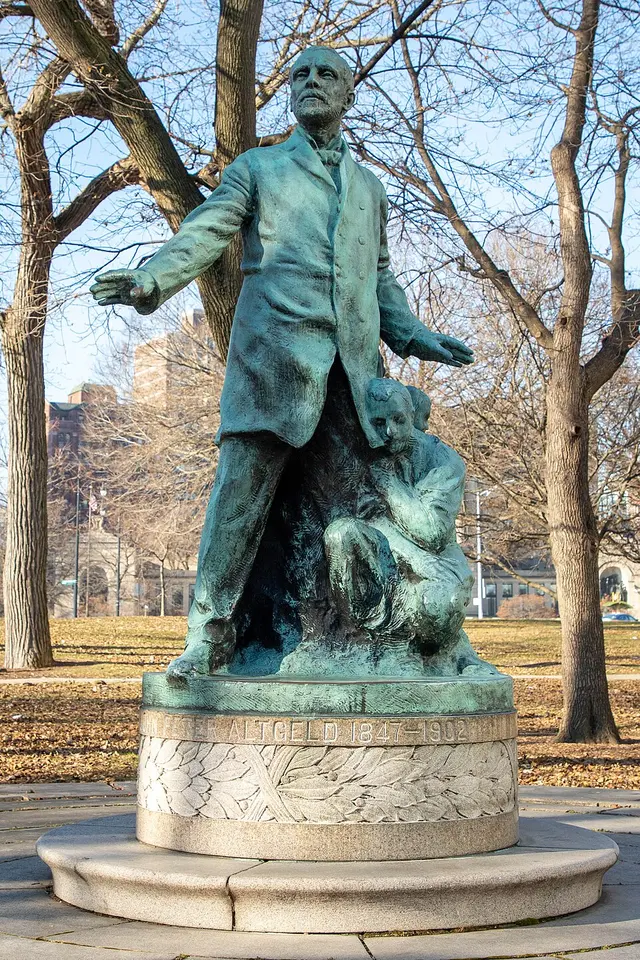
John Peter Altgeld Monument A sculptural tribute to an Illinois governor among the paths near North Pond.
Gutzon Borglum created the Altgeld monument, installed in 1915.
Follow the park paths south of Diversey Parkway to the sculpture.
Photo: Paul R. Burley · CC BY-SA 4.0 ↗
Nearby detour
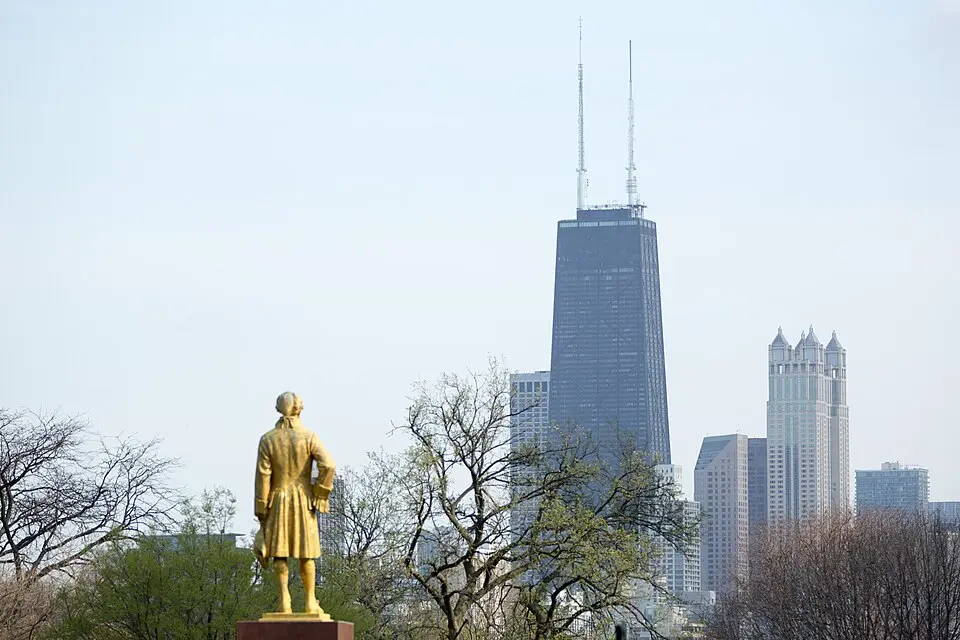
Alexander Hamilton Monument A tall standing bronze surrounded by planting, just south of Diversey Parkway.
Kate Sturges Buckingham commissioned John Angel’s statue of Alexander Hamilton for Lincoln Park.
Approach through the park paths around the garden and read the monument’s inscriptions.
Photo: Victorgrigas · CC BY-SA 3.0 ↗
Nearby detour
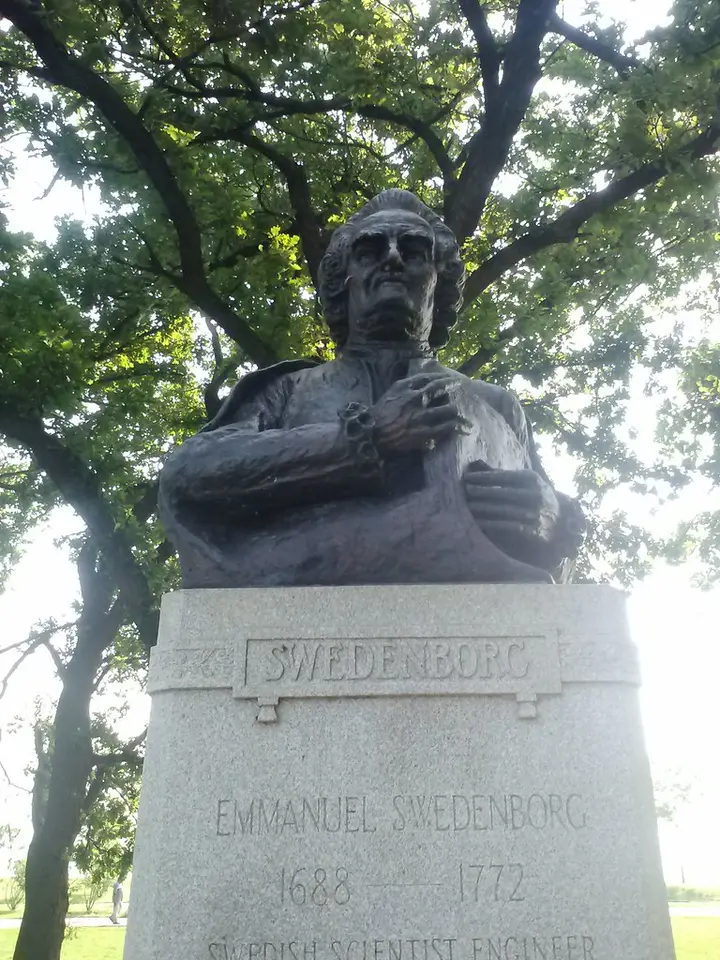
Emanuel Swedenborg Monument A small portrait monument near the lakefront recalls the Swedish scientist and religious thinker.
The original monument was installed in 1924; its missing bust was recreated in 2012.
Find it along the park paths east of the harbor area, and keep the adjacent trail clear.
Photo: srboisvert · CC BY 2.0 ↗
Nearby detour
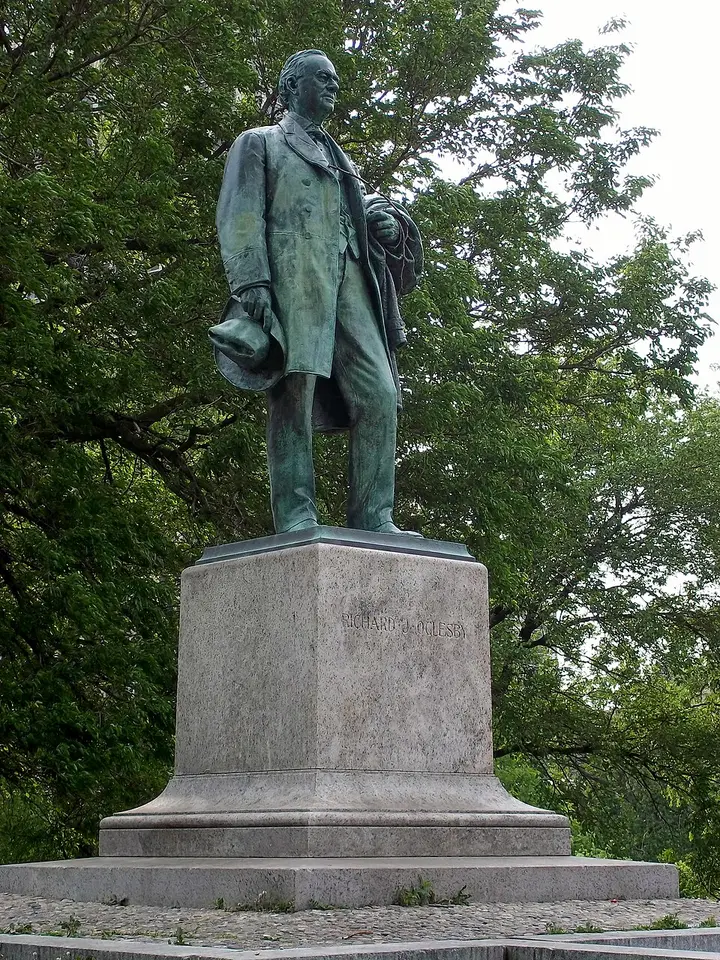
Richard Oglesby Monument A standing bronze on a gentle rise east of North Pond, with space to look back across the park.
Leonard Crunelle’s 1919 sculpture stands on Mount Prospect, a manmade hill in Lincoln Park.
Approach on park paths; the monument’s setting rises above the surrounding lawn.
Photo: Alanscottwalker · CC BY-SA 3.0 ↗
On the trail
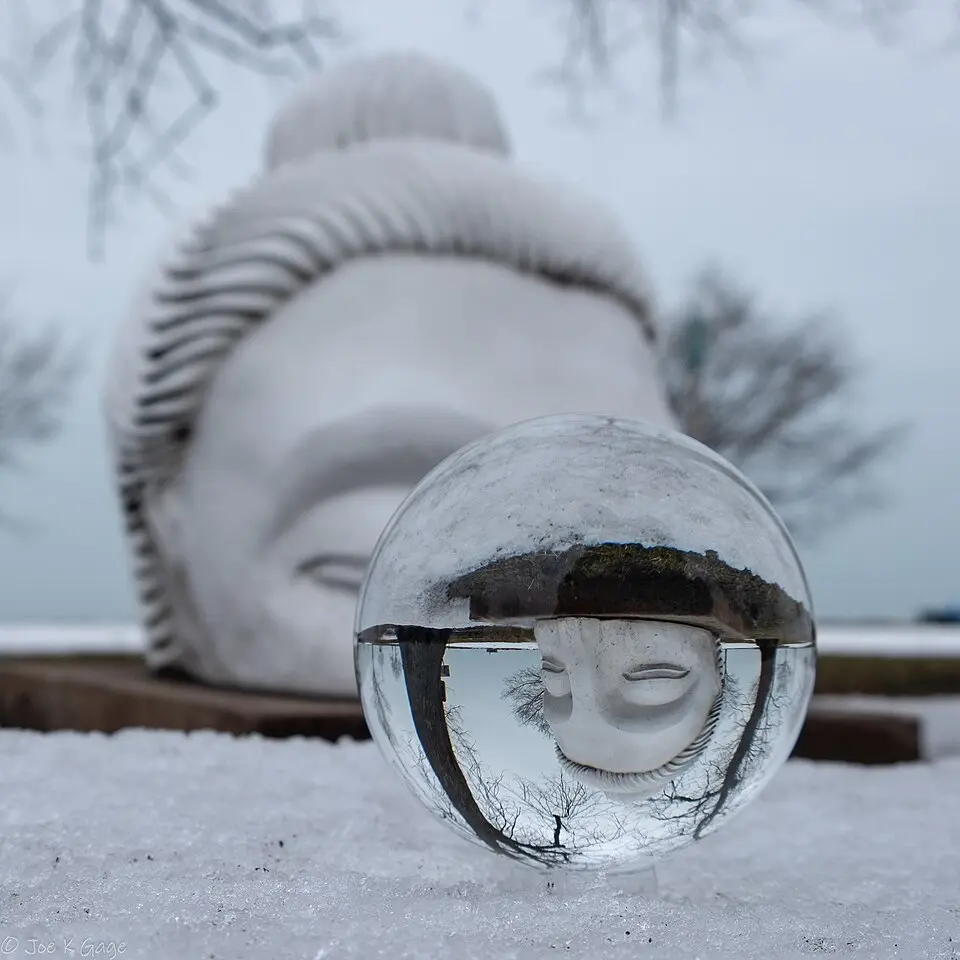
Ten Thousand Ripples White Buddha heads emerge from the grass beside the lakefront path south of Diversey Harbor.
Indira Johnson’s installation forms part of a citywide public-art project about peace and nonviolence.
The Park District lists this as a temporary installation; view it from the surrounding paths.
Lens-ball view of Ten Thousand Ripples near North Pond · 2021
Photo: Joseph Gage · CC BY-SA 2.0 ↗
On the trail
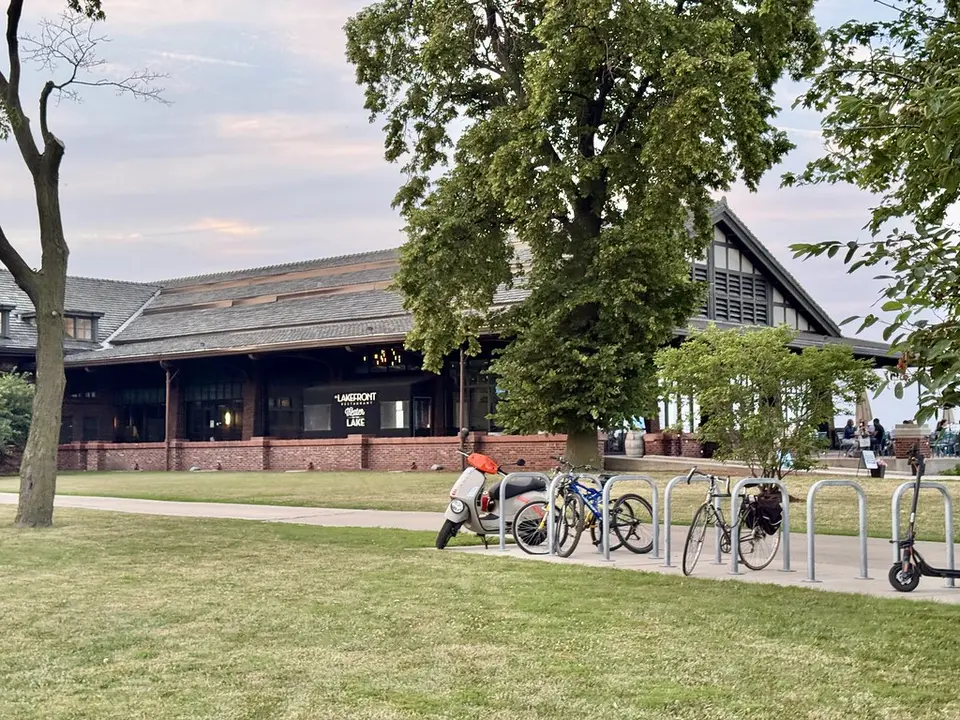
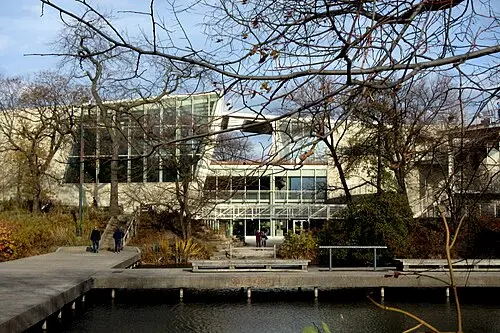
Theater on the Lake A Prairie-style lakefront building at Fullerton, with a terrace looking out across Lake Michigan.
Dwight Perkins designed the building; the Park District converted it into a theater in 1953.
Check the venue’s current performance and restaurant information before planning an indoor visit.
Photo: Warren LeMay · CC BY-SA 4.0 ↗
Nearby detour
Peggy Notebaert Nature Museum A nature and science stop beside the park’s ponds, with exhibits connecting Chicago to the living world around it.
The museum is part of the Chicago Academy of Sciences and combines public exhibits with conservation research.
Check current admission, exhibits and hours on the museum’s website.
Photo: Bohao Zhao · CC BY 3.0 ↗
On the trail
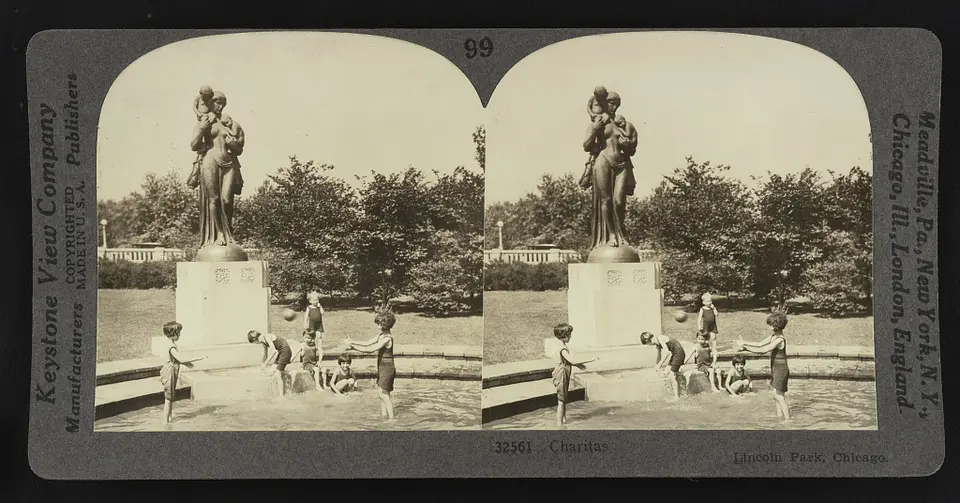
Charitas A bronze woman carrying two children stands just south of Theater on the Lake.
Ida McClelland Stout designed it for the former children’s sanitarium in 1922. It returned to Lincoln Park in 2016.
View the restored sculpture from the lakefront paths beside the theater.
Historic view: Charitas in its original fountain setting · c. 1930
Photo: Keystone View Company / Library of Congress · No known restrictions on publication ↗
Nearby detour
American Bison A life-size steel bison stands near the entrance to the Peggy Notebaert Nature Museum.
Chris Williams created the sculpture in 1999; it was installed here in 2012.
Look for the outdoor sculpture near Cannon Drive; museum admission is separate.
Nearby detour
Curve XXII · I Will A slender stainless-steel curve rises above the lawns near Fullerton and Cannon Drive.
Ellsworth Kelly’s first major outdoor commission is widely nicknamed I Will.
Reach it on Lincoln Park’s inland paths, using designated crossings from the lakefront.
Nearby detour
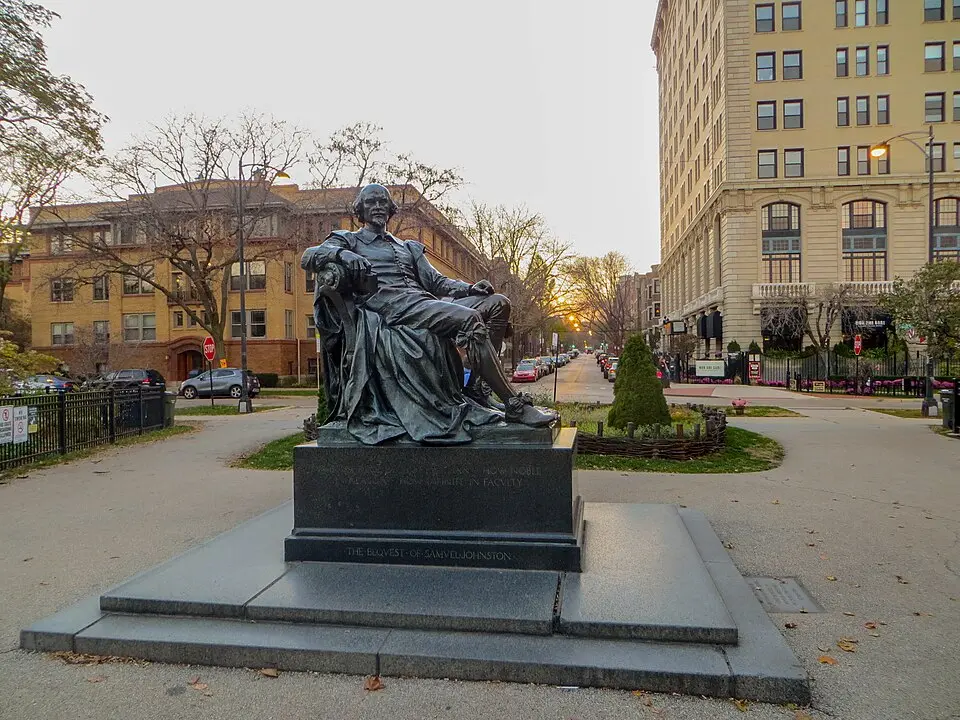
William Shakespeare Monument A seated Shakespeare looks across the garden paths near Stockton Drive.
William Ordway Partridge’s bronze sculpture was unveiled in Lincoln Park in 1894.
Look for the monument beside Grandmother’s Garden; this is separate from the Shakespeare bust on Navy Pier.
Photo: David Wilson from Oak Park, Illinois, USA · CC BY 2.0 ↗
Nearby detour
Eli Bates Fountain Playful bronze birds and fountain figures form the centerpiece of the formal conservatory garden.
Augustus Saint-Gaudens and Frederick MacMonnies collaborated on this 1887 fountain, also called Storks at Play.
View the sculpture from the formal garden paths south of the conservatory.
Eli Bates Fountain in the formal garden before Lincoln Park Conservatory
Photo: Ben Schumin from Montgomery Village, Maryland, USA · CC BY-SA 2.0 ↗
Nearby detour
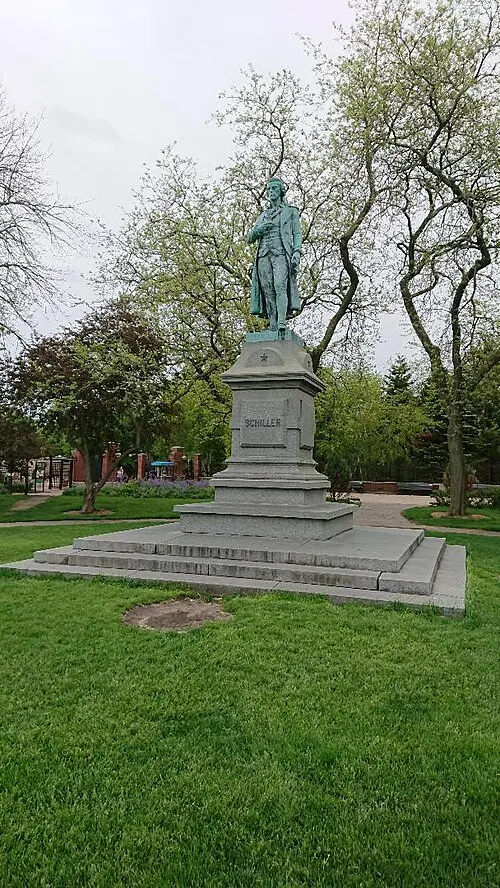
Schiller Monument A standing bronze poet marks the southern approach to the conservatory’s formal garden.
Chicago’s German community helped fund this Schiller monument, unveiled in 1886.
Combine a stop here with the nearby fountain and conservatory gardens.
Photo: Saalebaer · CC0 ↗
Nearby detour
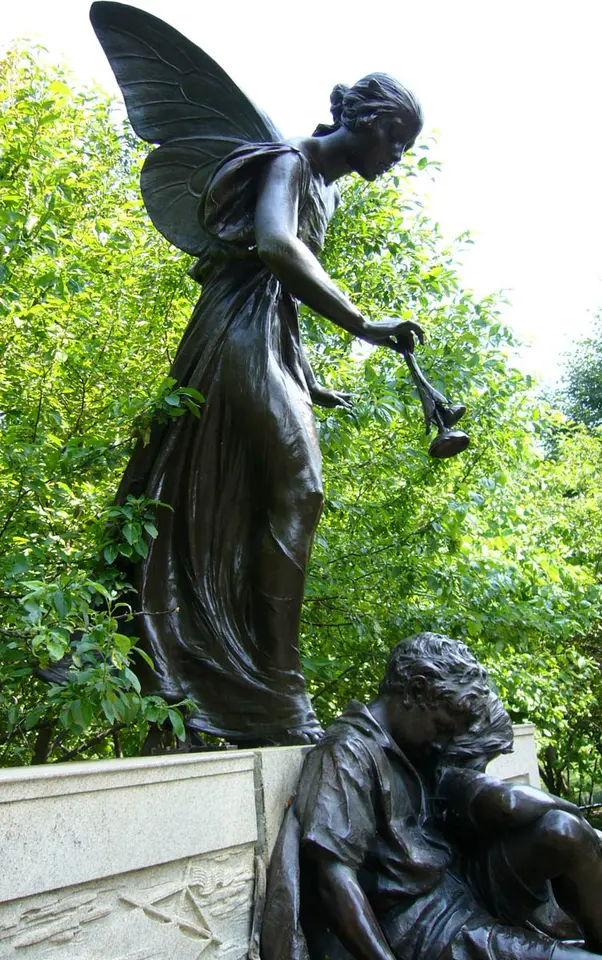
Eugene Field Memorial A bronze dream lady hovers over sleeping children in a memorial inspired by Eugene Field’s poems.
Edward McCartan’s memorial was installed in 1922; scenes and lines from Field’s writing appear on its stone base.
Look northeast of the Helen Brach Primate House inside Lincoln Park Zoo; check the zoo’s current visiting hours.
The Dream Lady at Lincoln Park Zoo’s Eugene Field Memorial
Photo: Mountshang · CC BY-SA 3.0 ↗
Nearby detour
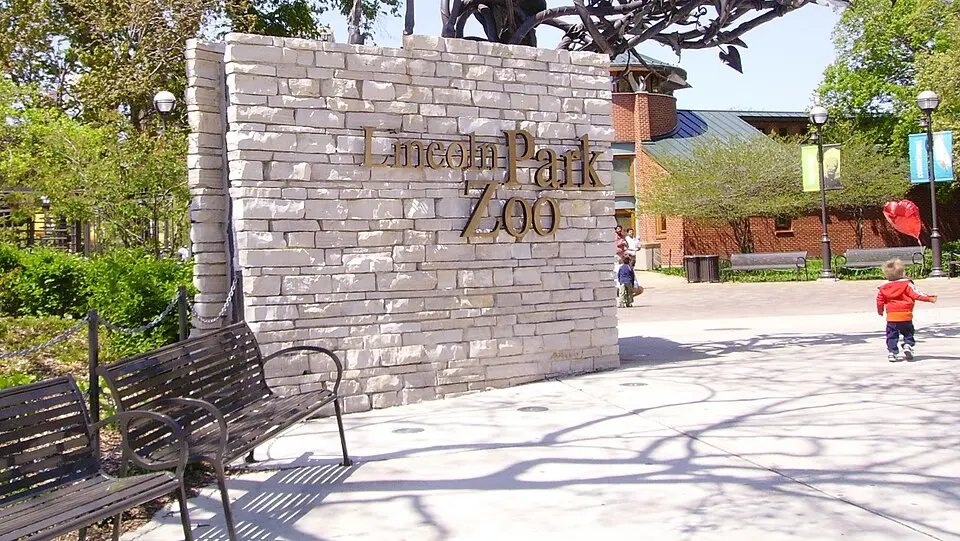
Lincoln Park Zoo Trade the long horizon for an afternoon among the zoo’s historic grounds and animal habitats.
General admission to Lincoln Park Zoo is free.
Check official hours and visitor policies. Reach the zoo using designated inland connections.
Photo: chascarper from Chicago, U.S.A. · CC BY 2.0 ↗
Nearby detour
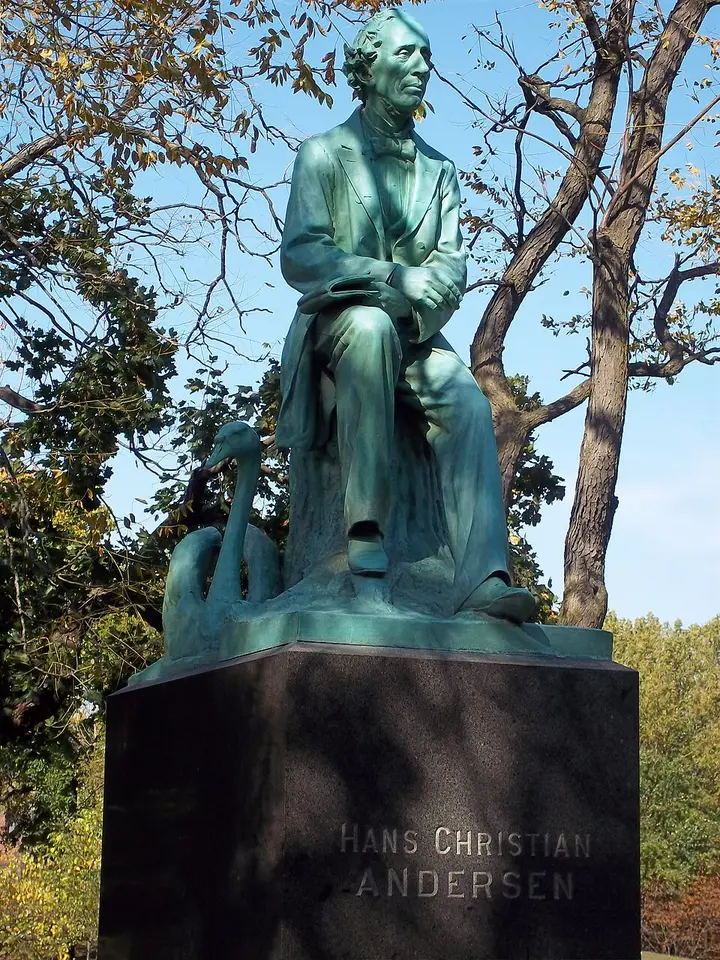
Hans Christian Andersen Monument A storyteller in bronze brings a literary pause to the paths west of the zoo.
Johannes Gelert’s monument to the Danish author was installed in 1896.
Use the park path near Stockton Drive; leave space for people continuing toward the zoo.
Photo: Alanscottwalker · CC BY-SA 3.0 ↗
Nearby detour
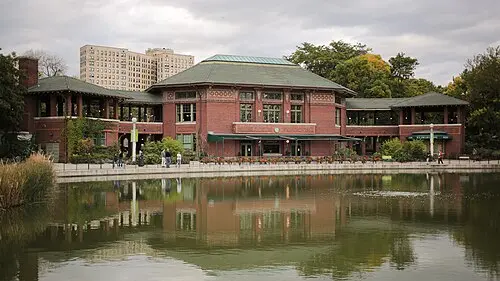
Café Brauer A richly detailed Prairie-style building overlooking South Pond, with brick, tile and tall windows.
Dwight Perkins designed the 1908 South Pond Refectory, now commonly called Café Brauer.
Enjoy the exterior from the pond paths; indoor access depends on events and venue operations.
Photo: Victorgrigas · CC BY-SA 3.0 ↗
Nearby detour
City Hall Relic A limestone rooftop ornament from an earlier Chicago City Hall rests among Lincoln Park’s paths.
The finial survived the Great Chicago Fire of 1871.
Look southwest of the Lincoln Park Cultural Center; this is separate from the Chicago Fire Relic farther south.
Nearby detour
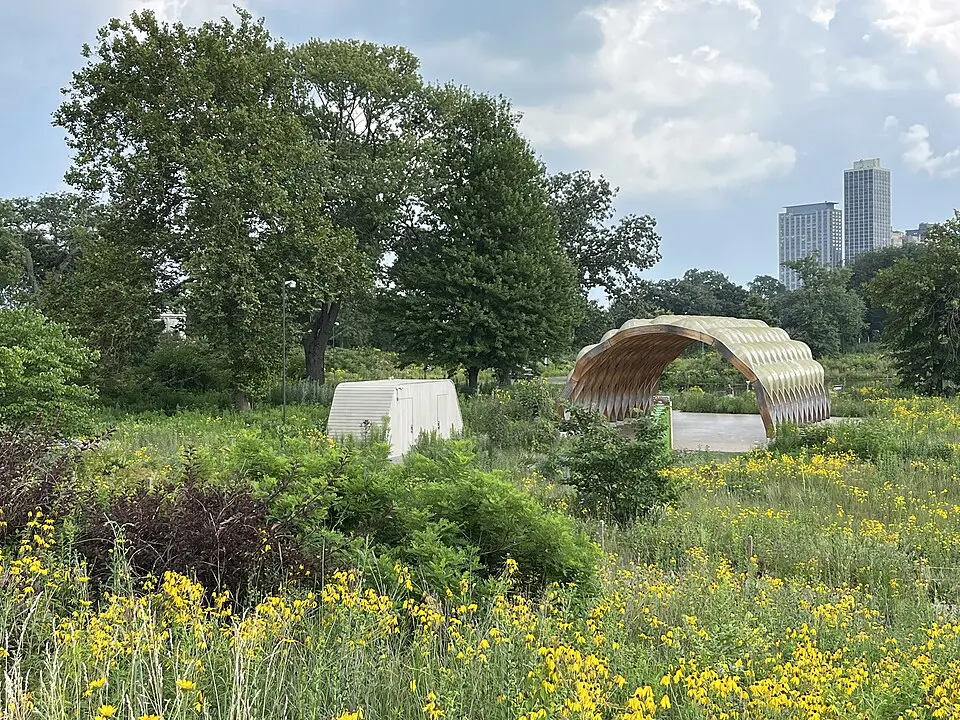
Peoples Gas Education Pavilion A curved, open lattice shelter frames the skyline beside South Pond.
Studio Gang designed the pavilion as part of Lincoln Park Zoo’s Nature Boardwalk.
Follow Nature Boardwalk to the pavilion; it may be in use for classes or private events.
Peoples Gas Pavilion beside the Nature Boardwalk’s native planting
Photo: Another Believer · CC BY-SA 4.0 ↗
Nearby detour
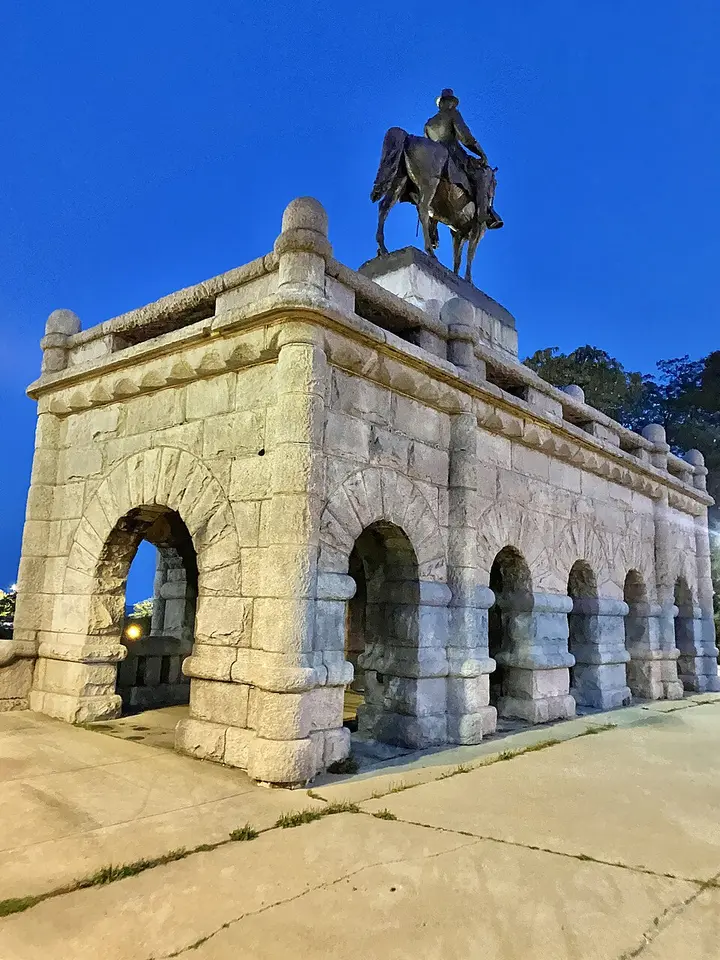
Ulysses S. Grant Monument A bronze rider rises above a broad stone arch near the park’s southern lagoon.
Louis T. Rebisso’s equestrian Grant monument was dedicated in 1891.
Use the surrounding park paths to see both the sculpture and its arched base.
Photo: Warren LeMay from Chicago, IL, United States · CC BY-SA 2.0 ↗
Nearby detour
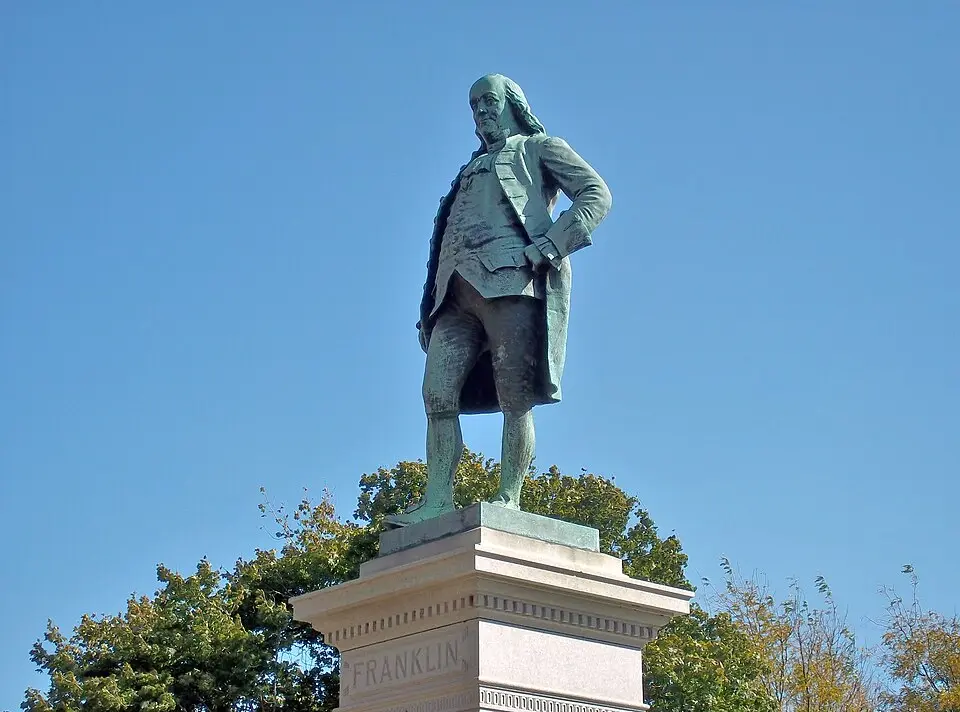
Benjamin Franklin Monument A bronze Franklin stands within a circular lawn in the southern part of Lincoln Park.
Richard Henry Park created this monument with support from newspaper publisher Joseph Medill and Chicago printers.
Reach the circular setting from nearby park paths, north of the Chicago History Museum.
Photo: Alanscottwalker · CC BY-SA 3.0 ↗
On the trail
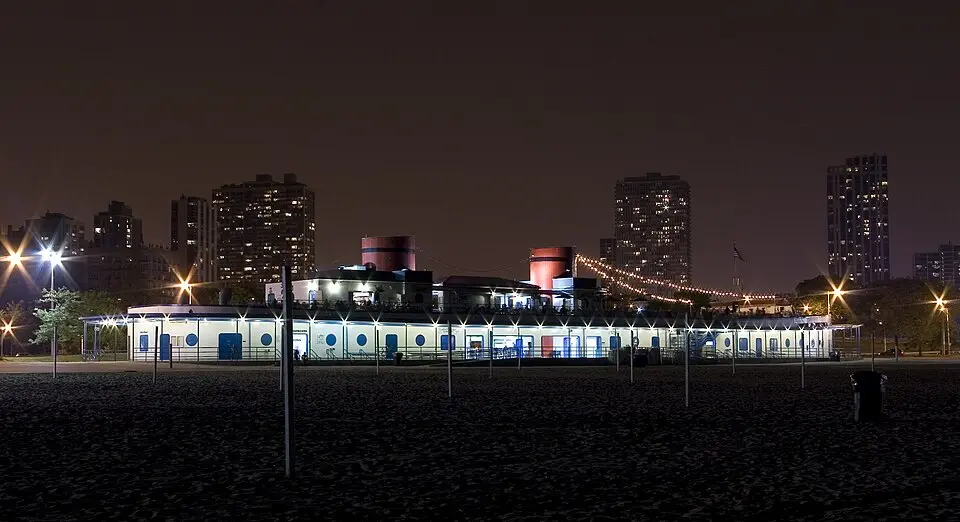
North Avenue Beach House A blue-and-white building shaped like an ocean liner appears permanently docked beside the sand.
The present beach house was dedicated in 2000 and echoes the ship-like design of the earlier 1940 building.
Check seasonal beach-house facilities and concessions before relying on them during a visit.
Photo: User:JeremyA · CC BY-SA 2.5 ↗
Nearby detour
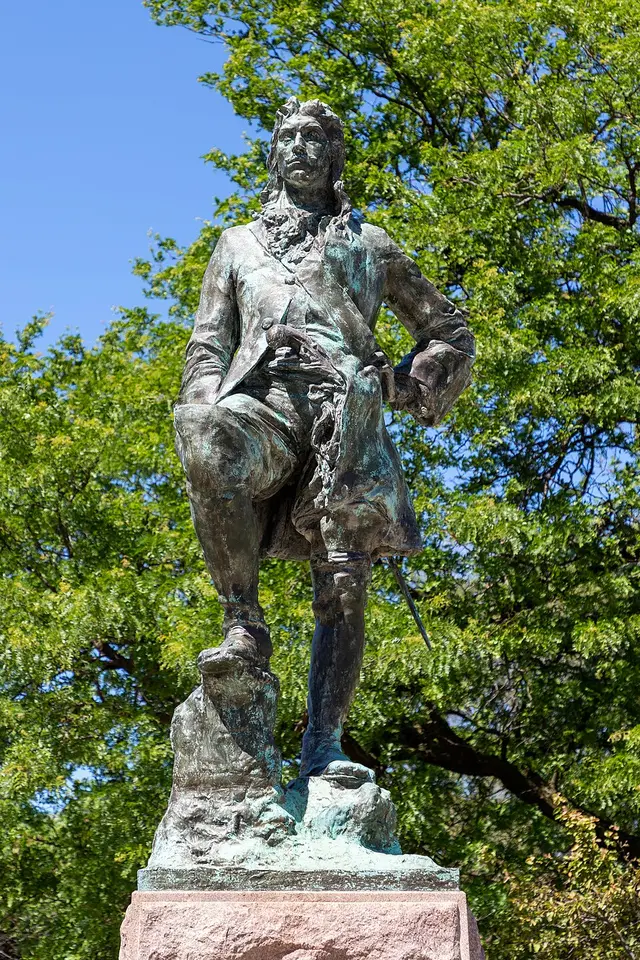
Robert Cavelier de La Salle Monument A bronze explorer stands near Clark Street at the southwest edge of Lincoln Park.
Belgian sculptor Count Jacques de La Laing cast the monument in Belgium before it was shipped to Chicago.
Approach from the park side using established crossings at nearby streets.
Photo: Paul R. Burley · CC BY-SA 4.0 ↗
Nearby detour
Chicago Fire Relic A fused mass of metal, brick and stone makes the force of the Great Chicago Fire tangible.
Workers found the relic in 1890 while excavating the site of a new Masonic Temple at State and Randolph.
Find it outdoors near the Chicago History Museum’s Jaffee History Trail.
Nearby detour
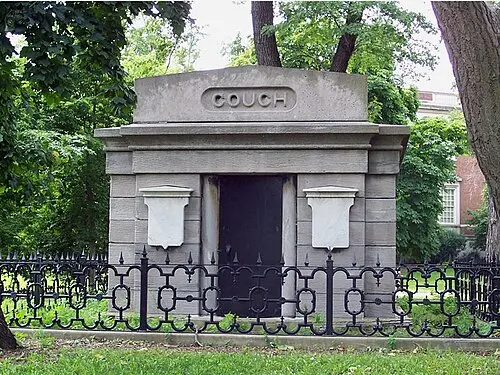
Couch Tomb A small stone mausoleum offers an unexpected reminder of what this park once was.
The 1858 tomb is the last above-ground reminder of Lincoln Park’s former public cemetery.
View the tomb from outside its ornamental fence.
Photo: Jmp2web · CC BY-SA 3.0 ↗
Nearby detour
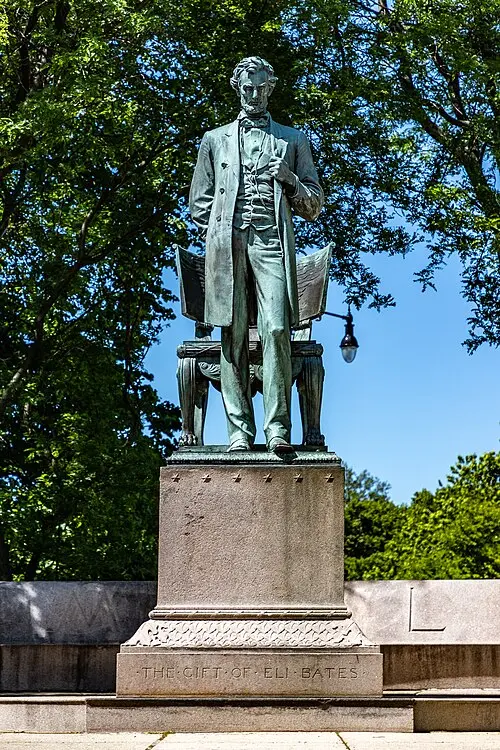
Abraham Lincoln: The Man A thoughtful standing Lincoln in a landscaped setting beside the Chicago History Museum.
Augustus Saint-Gaudens created this Lincoln monument, installed in Lincoln Park in 1887.
Approach on the park paths east of the museum and leave the monument’s base clear.
Photo: Paul R. Burley · CC BY-SA 4.0 ↗
Nearby detour
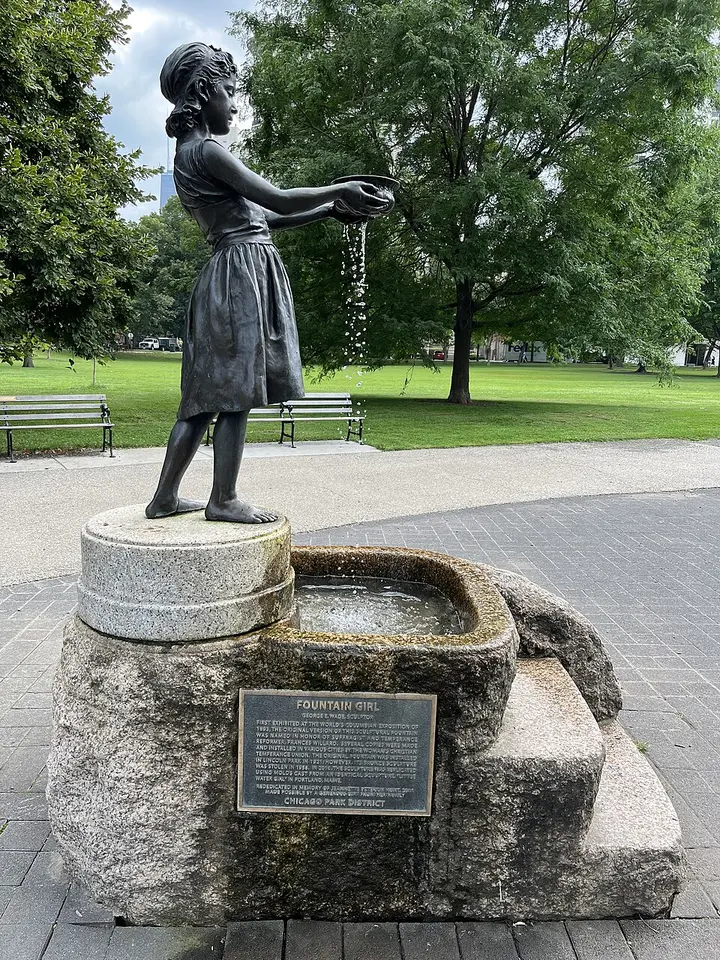
Fountain Girl A small bronze girl and basin bring an intimate scale to the park near the Chicago History Museum.
George Wade designed the figure for a temperance fountain displayed at the 1893 World’s Columbian Exposition.
Look for the figure just south of LaSalle Drive, east of the Chicago History Museum.
Photo: Another Believer · CC BY-SA 4.0 ↗
Nearby detour
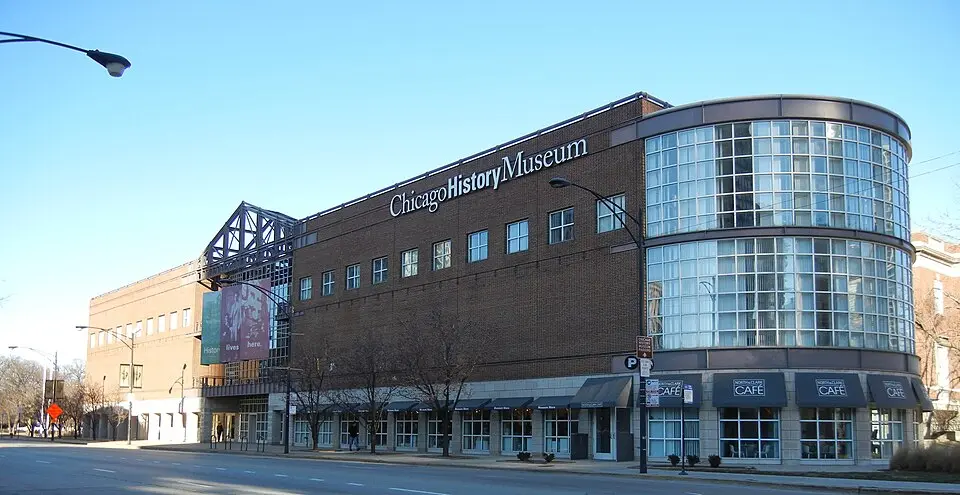
Chicago History Museum A red-brick museum at the south end of Lincoln Park explores the city behind the skyline.
The museum’s building at Clark Street and North Avenue opened in 1932.
Check current admission and hours; the outdoor history trail is a separate way to explore the grounds.
Photo: Goldnpuppy · CC BY-SA 3.0 ↗
Nearby detour
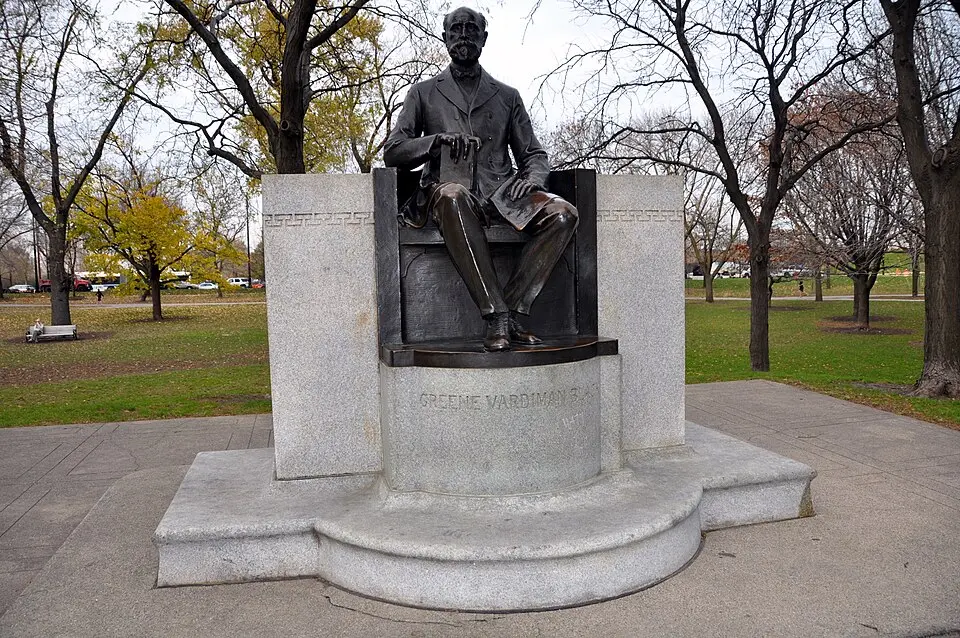
Greene Vardiman Black Memorial A seated bronze figure with a book occupies a quieter corner near North Avenue.
The National Dental Association donated Frederick Cleveland Hibbard’s 1918 memorial to dentist G. V. Black.
Reach the memorial by the park paths west of DuSable Lake Shore Drive.
Photo: AndrewHorne · CC BY-SA 3.0 ↗
On the trail
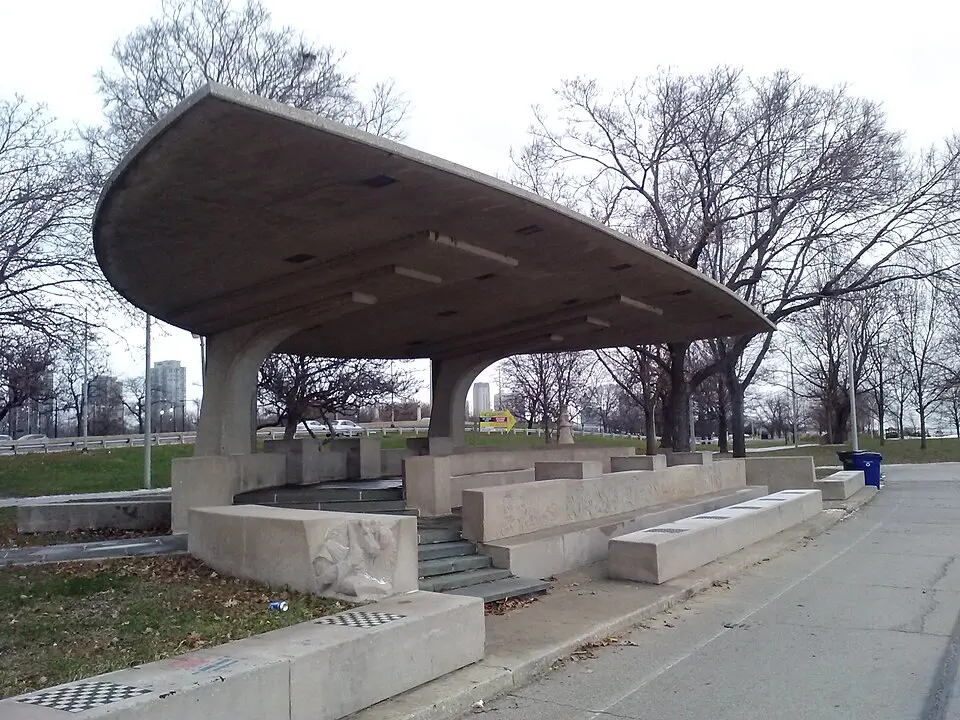
Chess Pavilion Chess boards and carved pieces sit beneath a wing-like lakeside shelter near North Avenue.
The 1957 pavilion combines architect Maurice Webster’s design with sculptural work by Boris Gilbertson.
Bring a chess set if you want to play, and keep the neighboring trail open for passing walkers and cyclists.
Photo: stephen boisvert from Chicago, United States · CC BY 2.0 ↗
Nearby detour
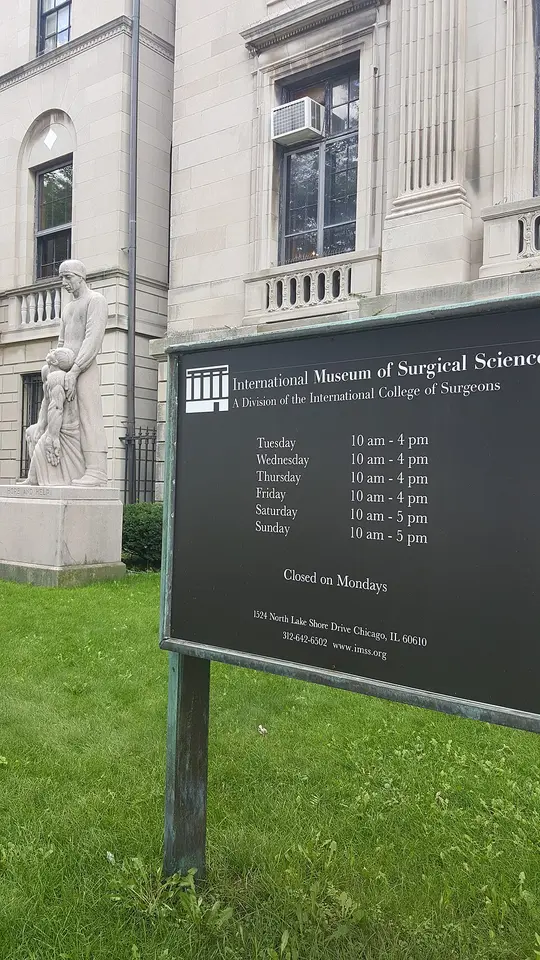
International Museum of Surgical Science A historic mansion on Lake Shore Drive houses exhibits about medicine, surgery and the people who changed them.
The museum occupies the former Eleanor Robinson Countiss house.
Museum admission and hours apply. Reach the local street through a designated lakefront crossing.
Photo: Ciphers · CC BY-SA 4.0 ↗
Nearby detour
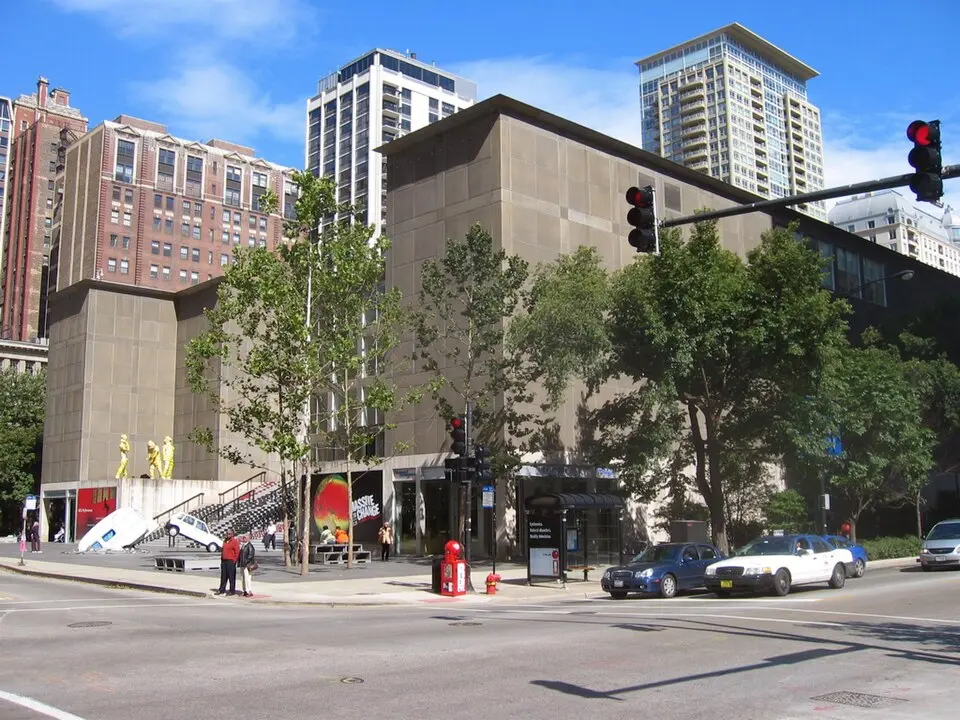
Museum of Contemporary Art Chicago Changing exhibitions, performances and contemporary art offer an indoor detour from the Streeterville lakefront.
The museum stands on East Chicago Avenue near the eastern end of the Magnificent Mile.
Check current exhibitions, admission and performance tickets; use designated crossings to reach Streeterville.
Photo: User:JeremyA · CC BY-SA 2.5 ↗
Nearby detour
The Butterfly House at Navy Pier A seasonal walk-through butterfly habitat occupies Navy Pier’s north lawn.
Visitors can observe free-flying butterflies in an enclosed garden.
Closed for the season as of November 2026; the operator announces a return in 2027. Check reopening dates and admission before visiting.
Nearby detour
Flyover Chicago An indoor motion ride at Navy Pier combines panoramic film with movement, sound and sensory effects.
Flyover’s Chicago experience explores the city through an immersive simulated flight.
Book with the operator and review ride requirements and accessibility before visiting.
Nearby detour
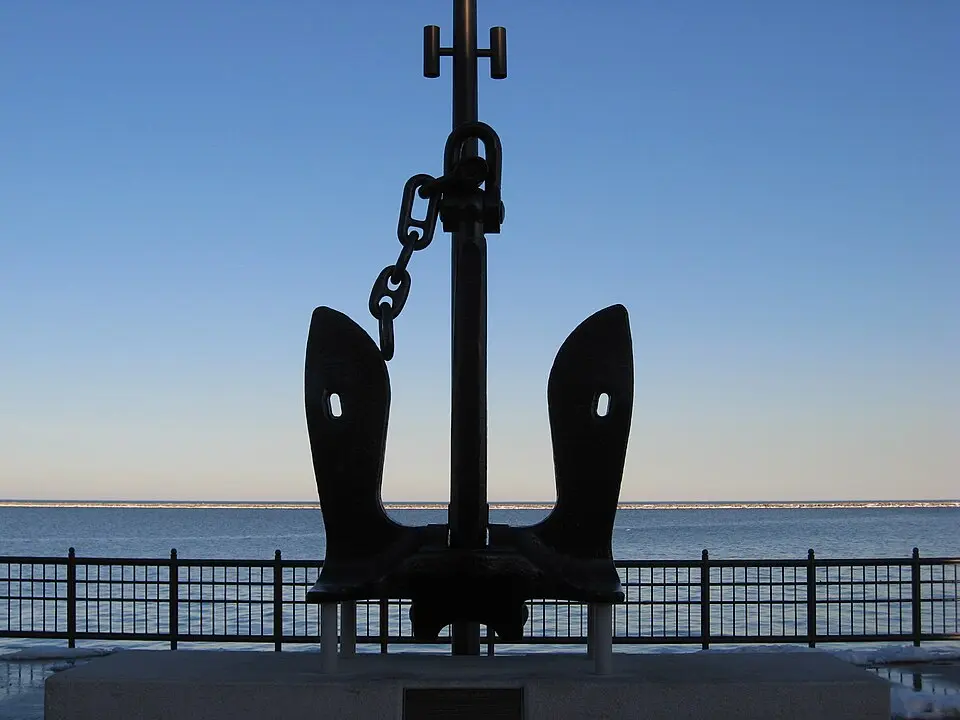
USS Chicago Anchor A massive ship’s anchor rests near the eastern end of Navy Pier.
The anchor came from the third USS Chicago and was installed here in 1995.
Continue along the pier’s public promenade toward the east end.
USS Chicago Anchor at Navy Pier · winter 2010
Photo: Zol87 · CC BY-SA 2.0 ↗
Nearby detour
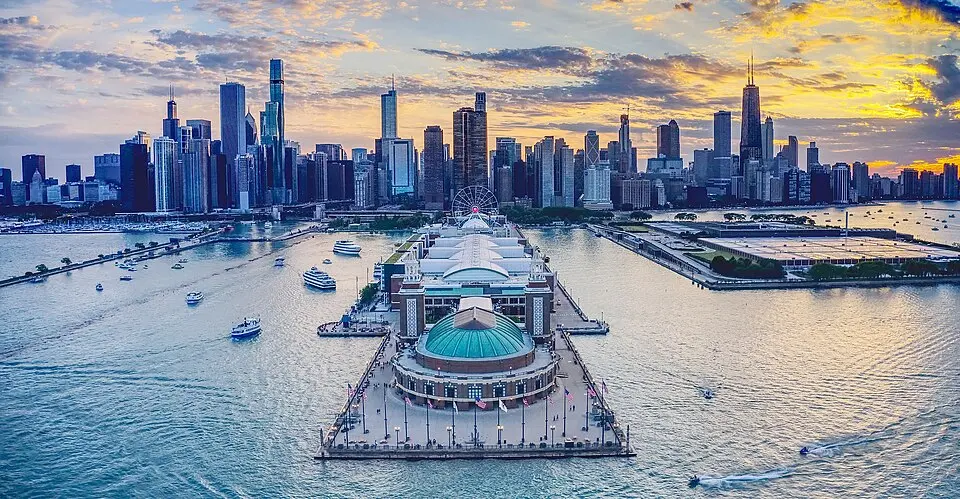
Navy Pier Follow the pier east and watch the city become a skyline. A Ferris wheel, gardens, and cultural spaces line the way.
Opened in 1916 as Municipal Pier, this 3,300-foot structure was renamed Navy Pier in 1927.
The through trail passes the landward side. Check venue hours, tickets, and bicycle rules separately.
Photo: Moses8910 · CC BY-SA 4.0 ↗
Nearby detour
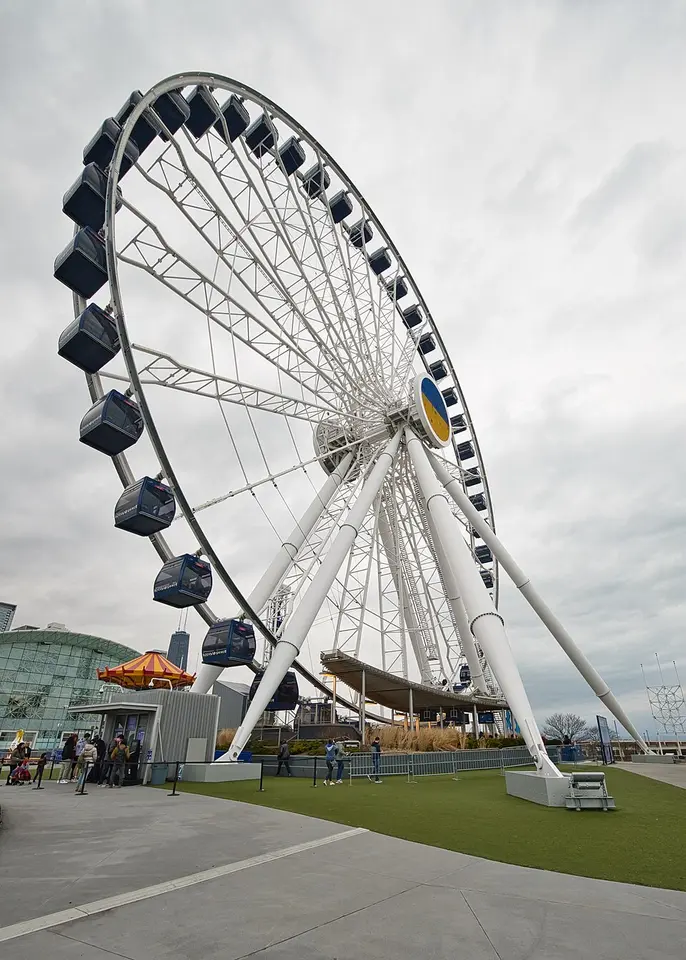
Centennial Wheel Enclosed gondolas lift visitors above Navy Pier for broad views of the lake and skyline.
The wheel rises nearly 200 feet above the pier.
A separate ride ticket is required. Check current operation because weather can interrupt rides.
Photo: Chris Rycroft from Madison, Wisconsin, United States · CC BY 2.0 ↗
Nearby detour
Bob Newhart Statue & Couch A bronze Bob Newhart and an empty therapy couch invite a playful pause near the far end of Navy Pier.
Studio EIS created the tribute to his television character, psychologist Bob Hartley.
Find the sculpture near the pier’s southeast corner.
Nearby detour
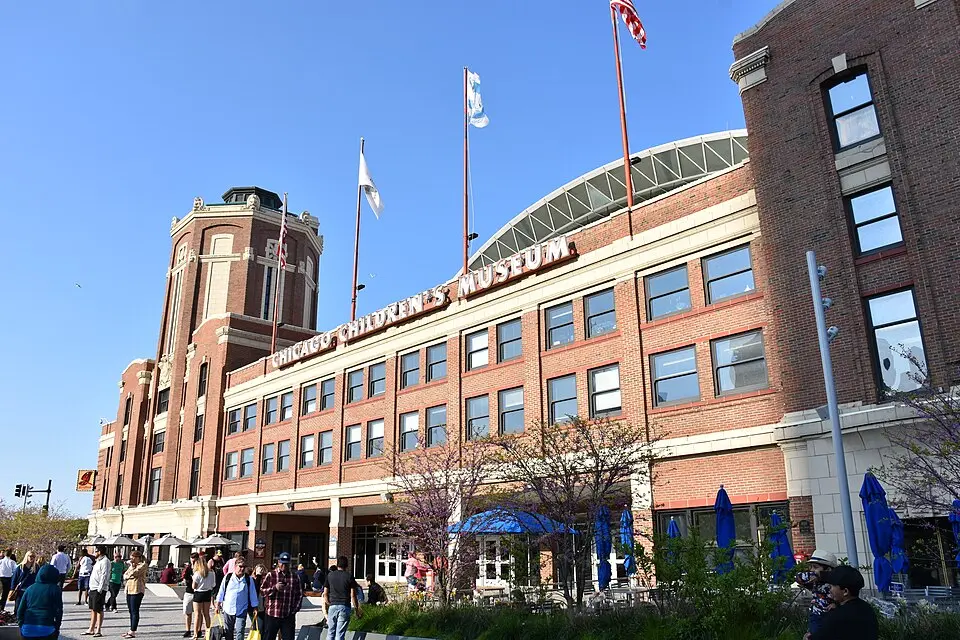
Chicago Children’s Museum Hands-on exhibits inside Navy Pier invite children to climb, build, experiment and play.
The museum occupies three floors at the western end of the pier.
Plan for museum admission and current family programs; individual workshops may require a pass.
Photo: MusikAnimal · CC BY-SA 4.0 ↗
Nearby detour
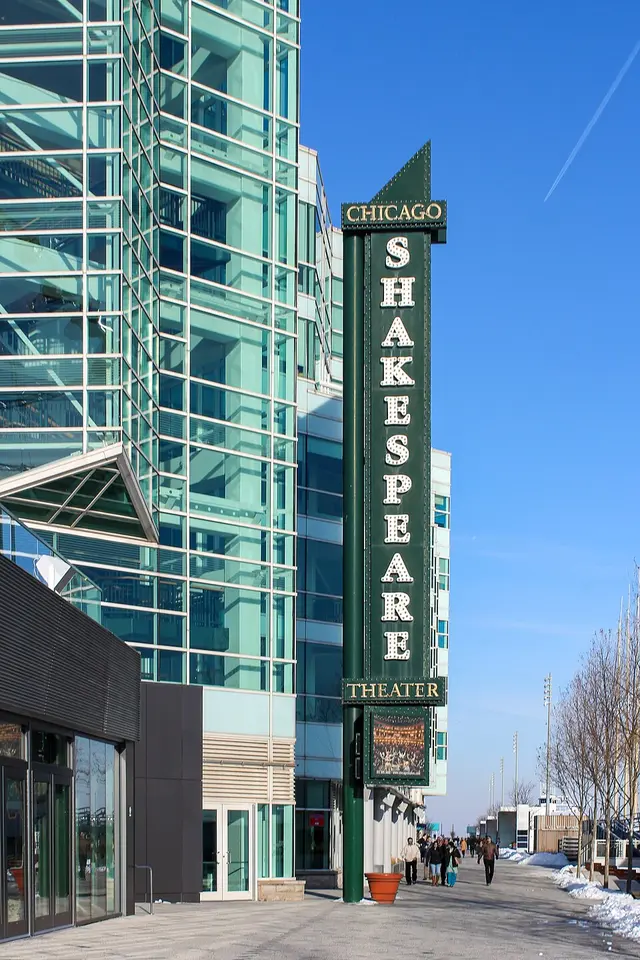
Chicago Shakespeare Theater A working theater on Navy Pier adds an evening destination to the lakefront walk.
The company’s Navy Pier address is 800 East Grand Avenue, with Shakespeare and other productions on its stages.
Check performance times, ticket availability and accessibility information before visiting.
Photo: Jason Zhang · CC BY-SA 3.0 ↗
Nearby detour
Crack the Whip Bronze children play a hand-in-hand running game near Navy Pier’s entrance.
J. Seward Johnson Jr.’s sculpture was installed in 1996.
Find it outside near the west end of the pier.
Nearby detour
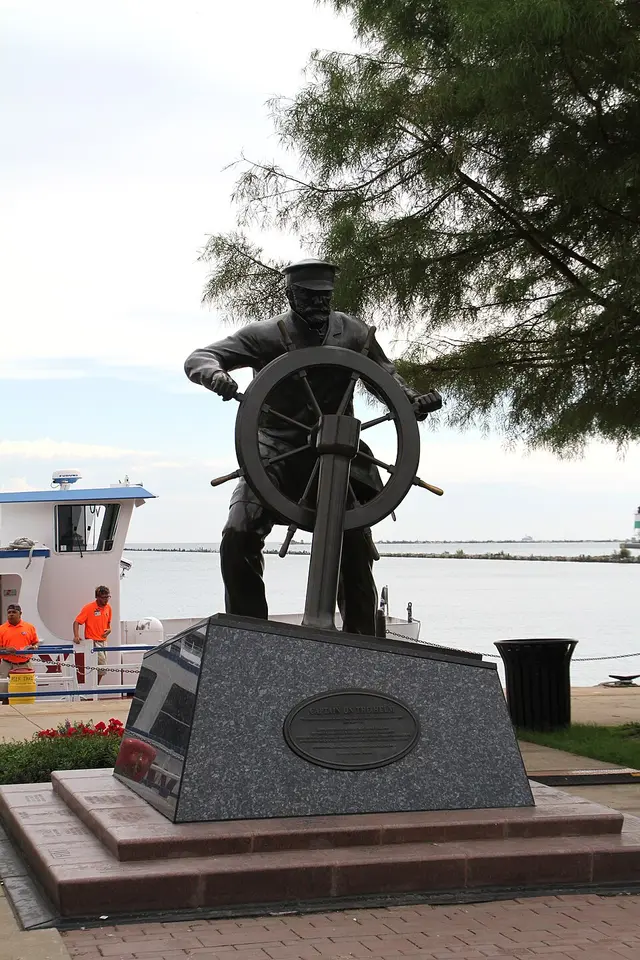
Captain on the Helm A bronze ship’s captain stands at the helm beside Navy Pier’s south entrance.
Michael Martino’s sculpture was dedicated in 2000 as a tribute to mariners.
Pause on the public promenade without blocking pedestrian traffic.
Photo: HaSt · CC BY-SA 4.0 ↗
Offshore sight
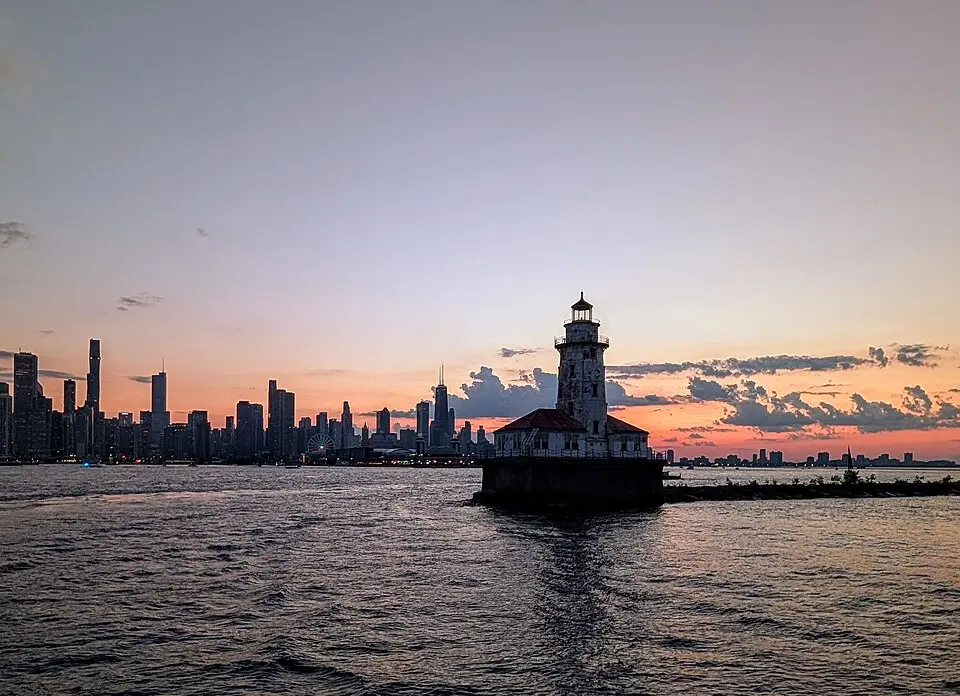
Chicago Harbor Lighthouse A white lighthouse with red-roofed adjoining buildings stands on the offshore breakwater east of Navy Pier.
Its conical tower dates to 1893; the lighthouse became a Chicago Landmark in 2003.
An offshore sight, with no public land access. Look across the harbor from Navy Pier; this dot marks the lighthouse itself.
Chicago Harbor Lighthouse at dusk · 2025
Photo: Dicklyon · CC BY-SA 4.0 ↗
Nearby detour
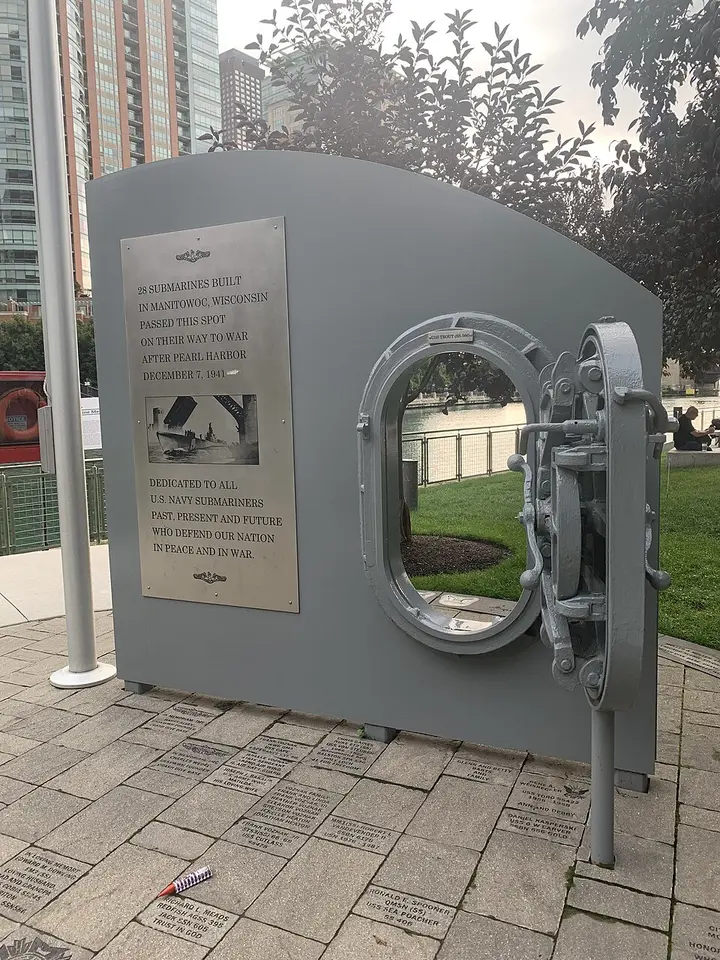
U.S. Navy Submarine Memorial A steel submarine-bulkhead memorial stands beside the Chicago River on the lower Riverwalk.
It recalls 28 Wisconsin-built submarines that passed through Chicago on their way to World War II service.
Follow the south-bank Riverwalk west from the lakefront, between Lake Shore Drive and Columbus Drive.
U.S. Navy Submarine Memorial beside the Chicago River · 2024
Photo: Aschbren · CC0 ↗
On the trail
Riverwalk Gateway Murals Painted ceramic panels fill the passage where the Chicago Riverwalk meets the Lakefront Trail beneath DuSable Lake Shore Drive.
Ellen Lanyon’s 28 panels follow the river’s history through scenes of people, engineering and wildlife.
The murals are at river level on the south bank, underneath the road bridge.
Nearby detour
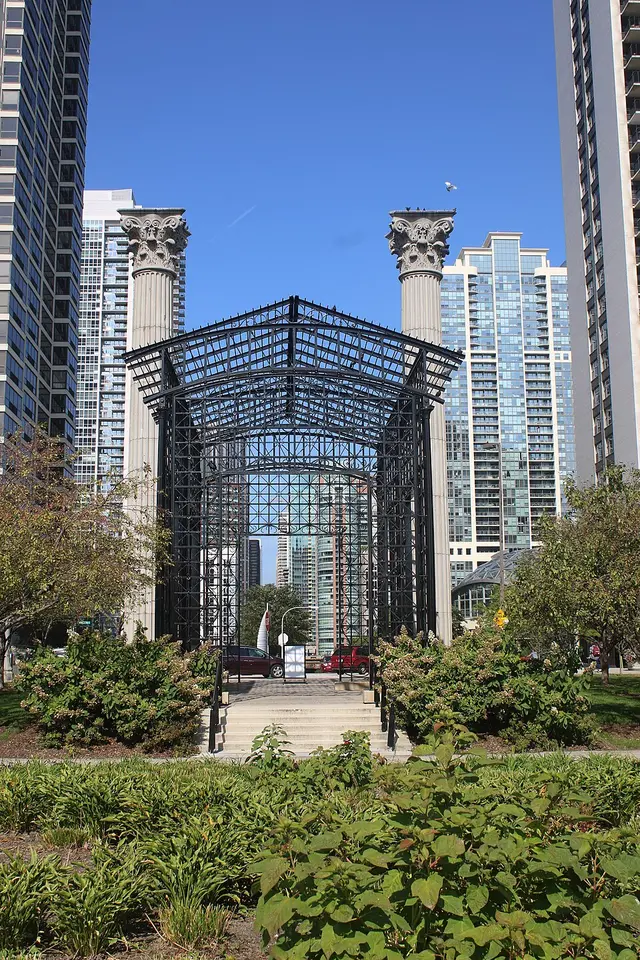
Federal Building Columns Two monumental columns mark the north entrance to the Cancer Survivors’ Garden beside Maggie Daley Park.
The columns were salvaged from Chicago’s 1905 Federal Building and installed here in 1996.
Approach from Randolph Street or the garden’s walking paths.
Photo: TonyTheTiger · CC BY-SA 4.0 ↗
Nearby detour
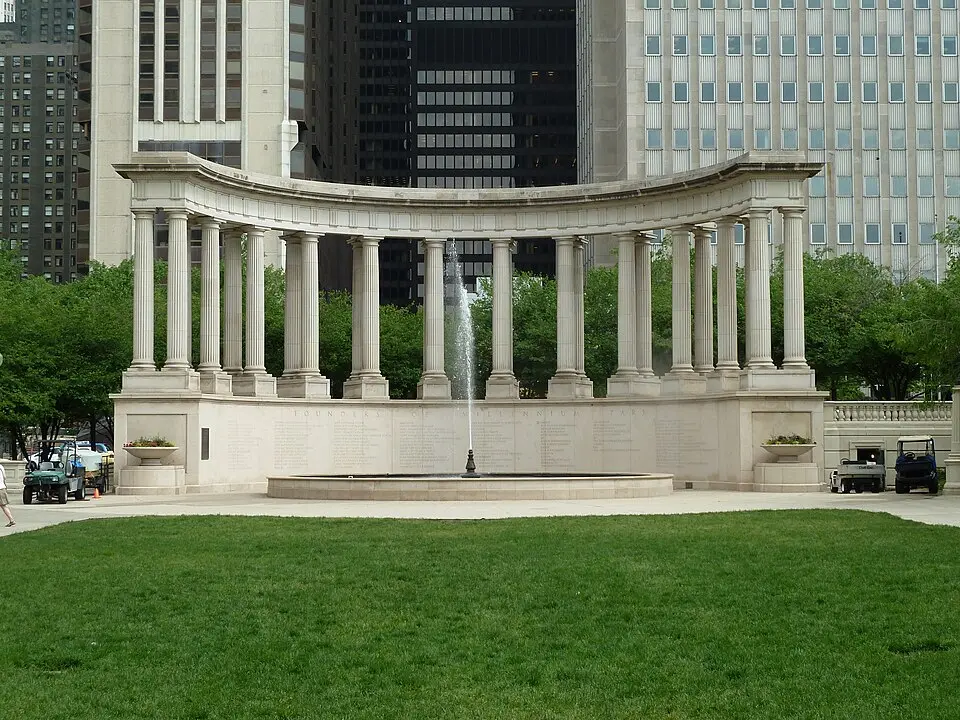
Millennium Monument at Wrigley Square A semicircle of columns frames Wrigley Square at Millennium Park’s northwest corner.
The monument recalls a peristyle that stood here between 1917 and 1953.
Enter through the park’s open public approaches and follow event access signs.
Photo: Rob Young from United Kingdom · CC BY 2.0 ↗
Nearby detour
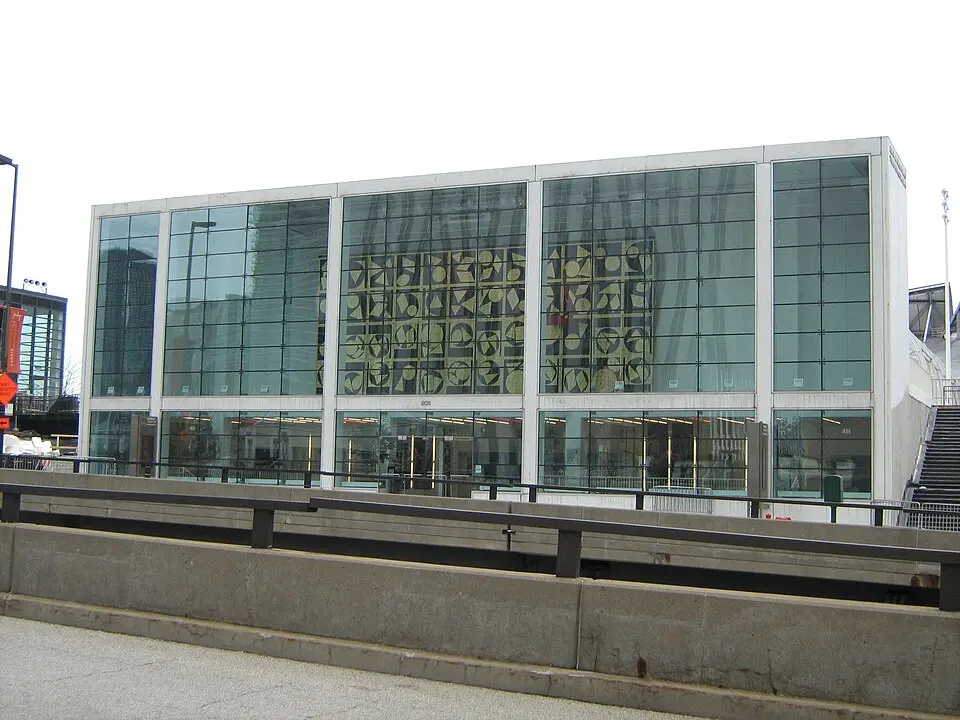
Harris Theater for Music and Dance An indoor performance venue tucked into the north edge of Millennium Park, with a life that continues after a lakefront walk.
The Harris opened in 2003 as a shared home for Chicago performing arts organizations.
Use the theater’s Randolph Street entrance information; performances and tickets are separate from park access.
Photo: Zol87 · CC BY-SA 2.0 ↗
Nearby detour
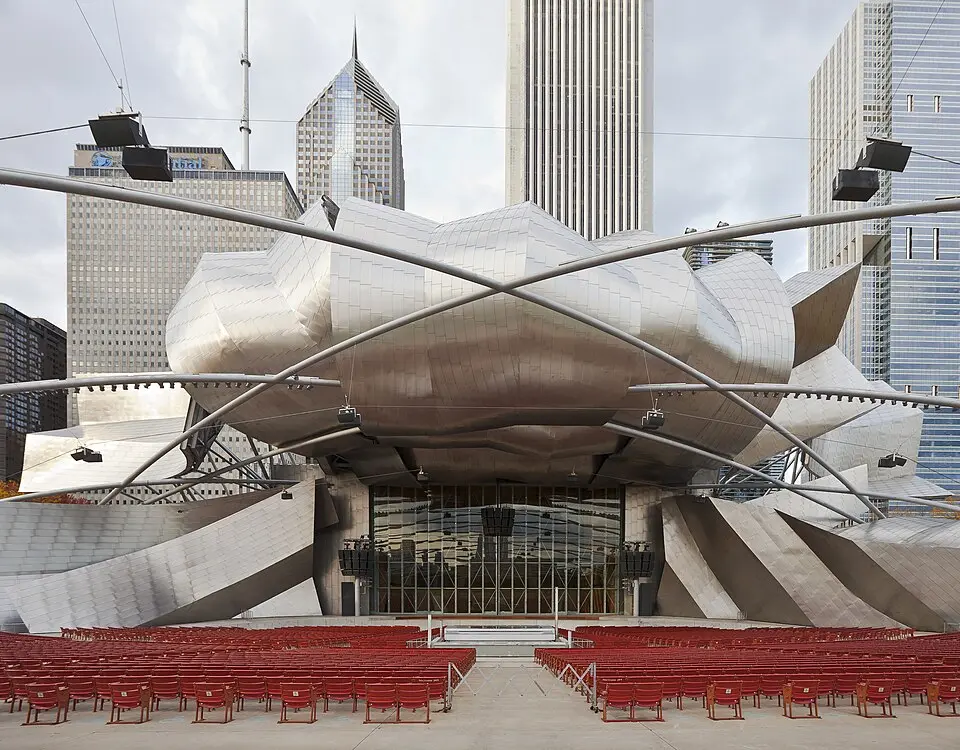
Jay Pritzker Pavilion A sculptural canopy and sweeping trellis make a dramatic outdoor room for music, films, and a pause on the lawn.
Frank Gehry designed the pavilion, a central venue for Millennium Park performances.
Consult the official event calendar for admission, lawn access, and event-specific rules.
Photo: Diego Delso · CC BY-SA 3.0 ↗
Nearby detour
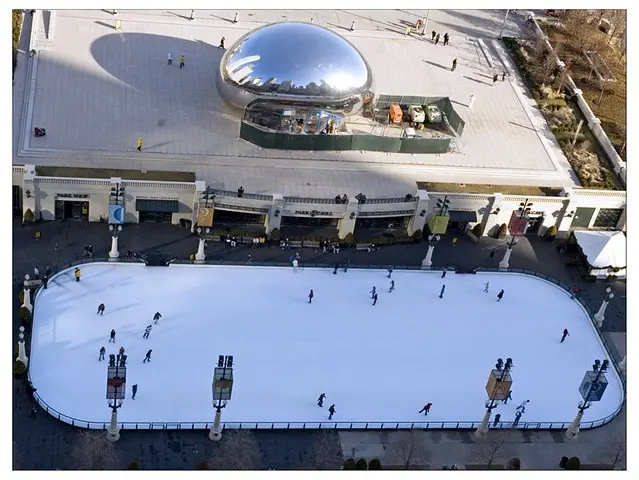
Cloud Gate · The Bean The skyline bends around a polished steel surface, with a second, stranger city reflected beneath the arch.
Anish Kapoor created Cloud Gate, the Millennium Park sculpture widely known as The Bean.
Reach the plaza through Millennium Park; check park notices for access changes.
Cloud Gate and the McCormick Tribune ice rink · winter 2006
Photo: swanksalot · CC BY-SA 2.0 ↗
Via a connector
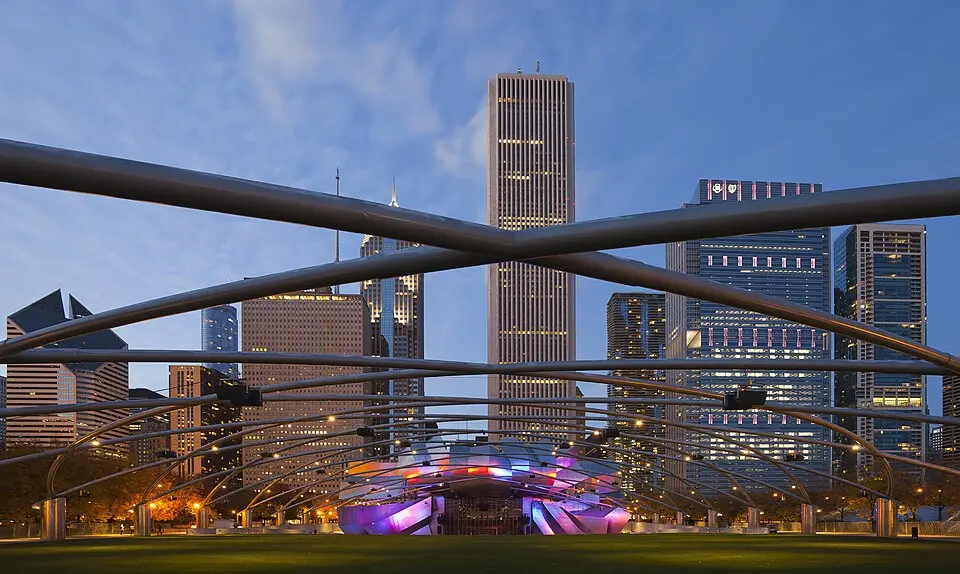
Millennium Park Cloud Gate, the Pritzker Pavilion, and Lurie Garden bring art and landscape into the heart of downtown.
Millennium Park is an inland destination, connected to Maggie Daley Park by the BP Bridge.
Allow time for the detour and designated crossings; park entrances can be busy.
Photo: Diego Delso · CC BY-SA 3.0 ↗
Via a connector
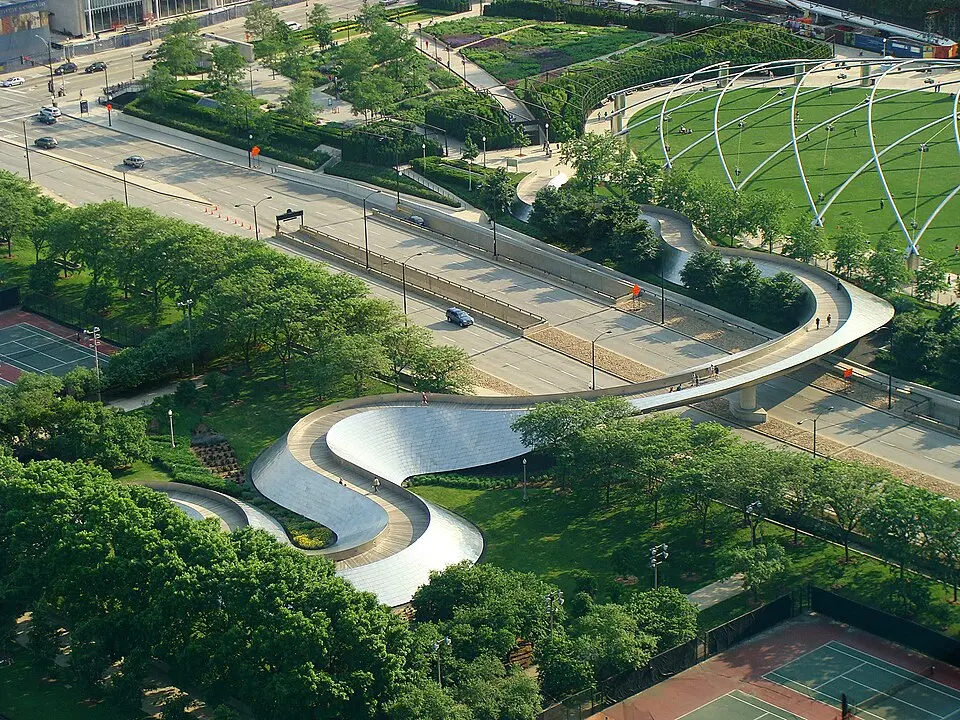
BP Pedestrian Bridge A winding, steel-clad pedestrian bridge links Millennium Park with Maggie Daley Park above Columbus Drive.
Frank Gehry designed the bridge’s serpentine route.
Use the bridge’s pedestrian route and follow posted park access rules.
Photo: Torsodog · CC BY-SA 3.0 ↗
Nearby detour
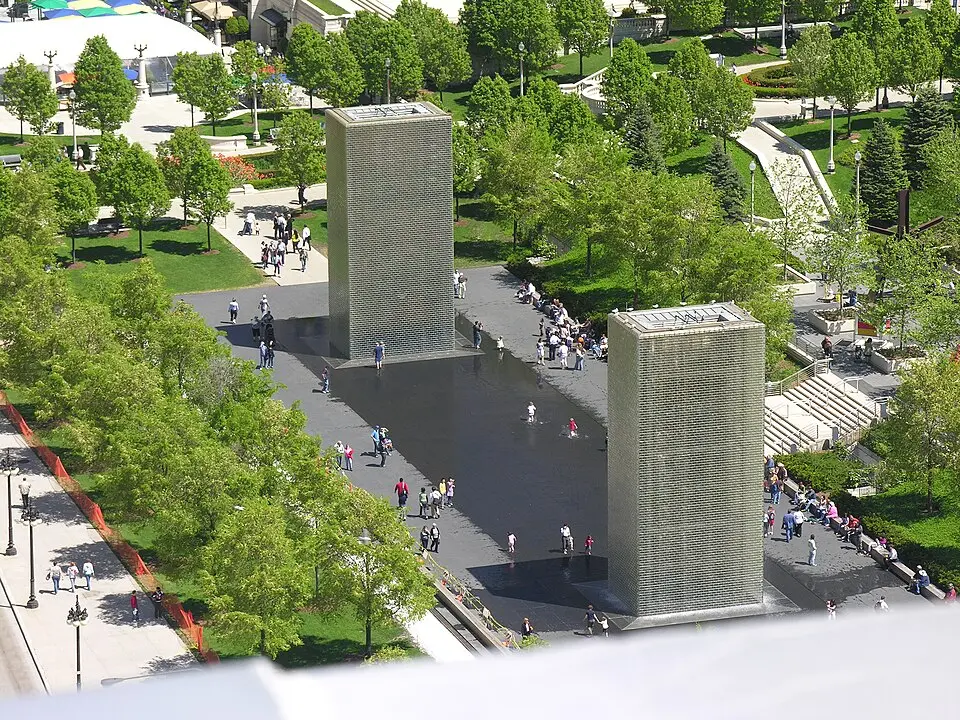
Crown Fountain Two glass towers face one another across a shallow plaza, bringing faces, light, and seasonal water into the park.
Jaume Plensa designed Crown Fountain with water, light, and glass as central elements.
Water operation is seasonal; follow posted plaza rules and keep the surrounding paths clear.
Photo: www.flickr.com user jjlthree · CC BY 2.0 ↗
Nearby detour
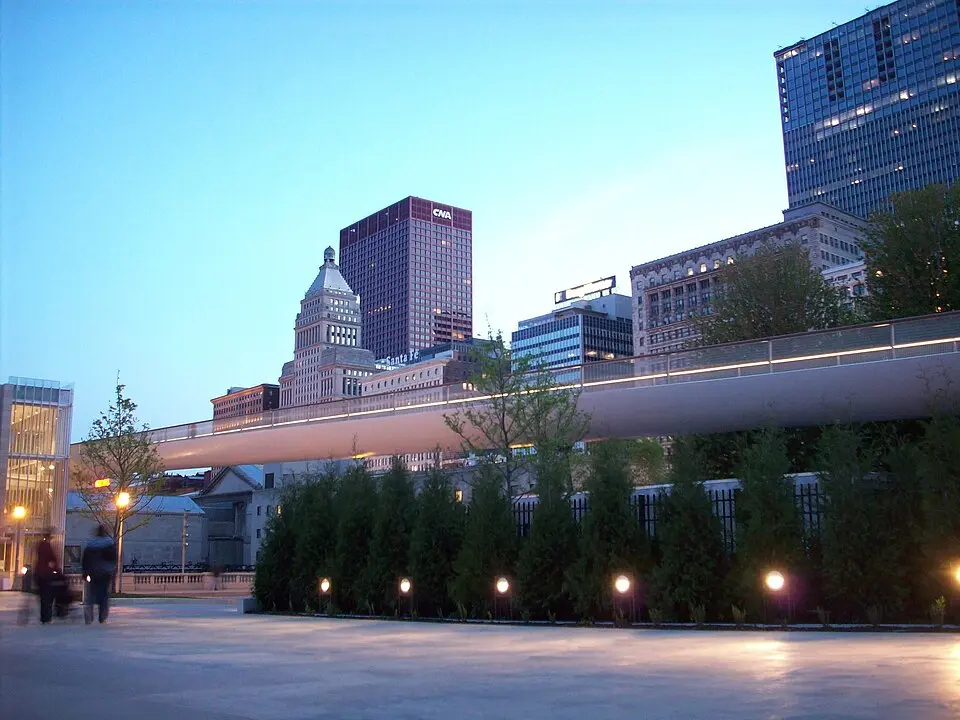
Nichols Bridgeway A gently rising footbridge crosses Monroe Street between Millennium Park and the Art Institute’s Modern Wing.
Renzo Piano designed the 625-foot bridge as part of the Modern Wing.
Check current museum and bridge access. This pedestrian connection is inland from the Lakefront Trail.
Photo: Chadbailey · CC BY-SA 3.0 ↗
Nearby detour
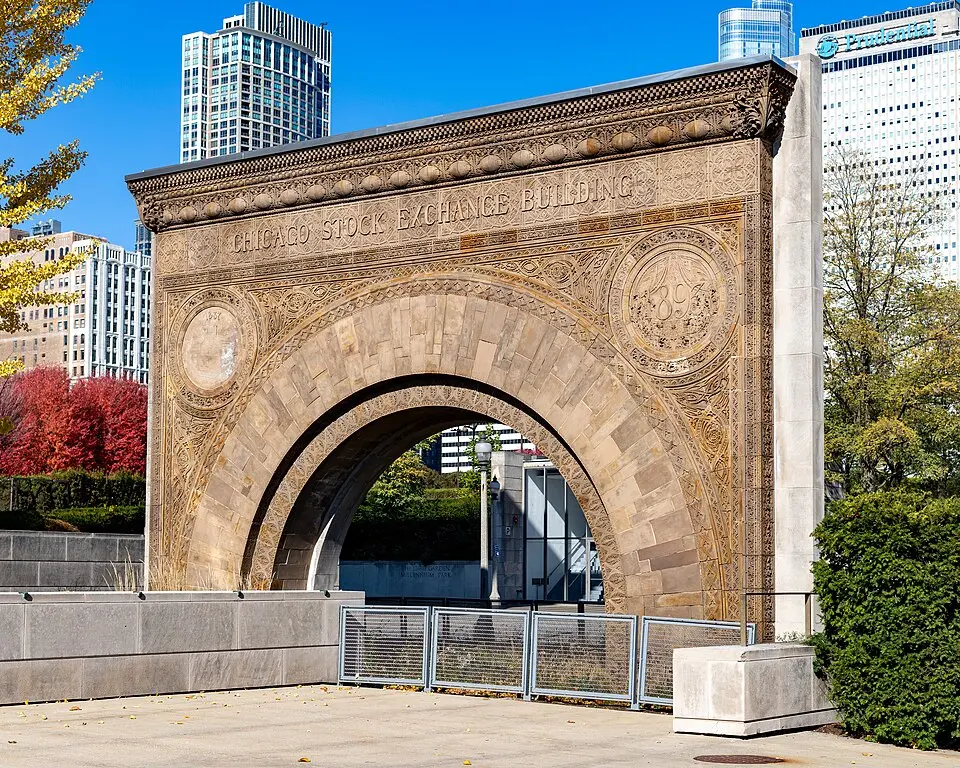
Chicago Stock Exchange Arch An ornate stone arch stands near Columbus Drive, preserving a fragment of one of Chicago’s lost buildings.
The entrance arch from Adler and Sullivan’s Stock Exchange was installed in the Art Institute’s East Garden in 1977.
Find the freestanding arch near Monroe Street and Columbus Drive; it is separate from the indoor Trading Room.
Photo: Paul R. Burley · CC BY-SA 4.0 ↗
Nearby detour
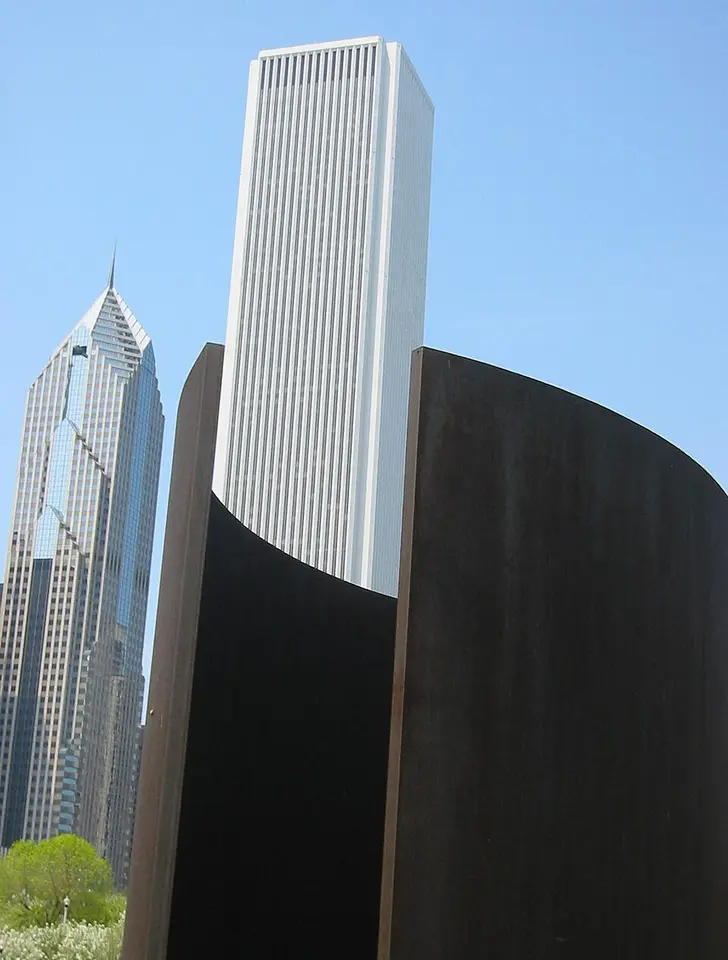
Reading Cones Two enormous curved steel walls stand on Butler Field just south of Monroe Street.
Richard Serra named the work for Reading, Pennsylvania, where it was made.
View from the surrounding park paths and follow any event fencing.
Photo: discosour · CC BY-SA 2.0 ↗
Nearby detour
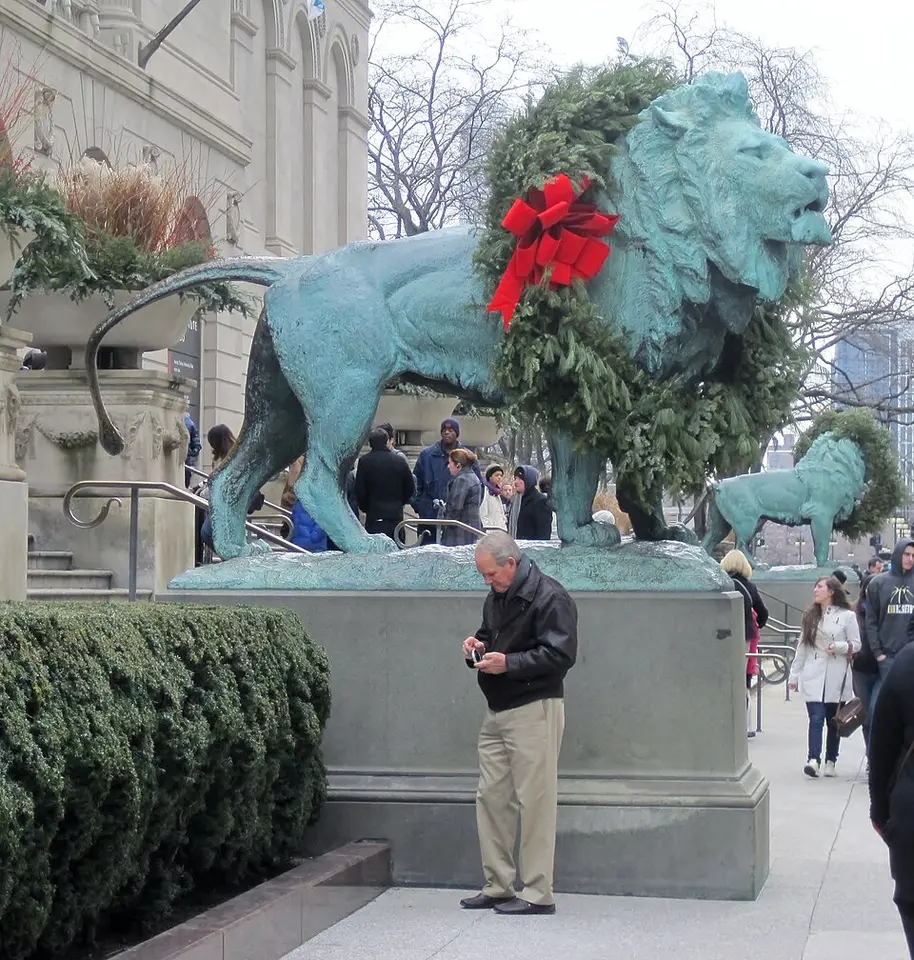
The Art Institute Lions The familiar bronze guardians flank the museum’s Michigan Avenue steps, each with a different stance.
Edward Kemeys created the lions, which were installed at the Art Institute in 1894.
View them from the public entrance plaza; museum admission is a separate visit.
One of the Art Institute’s two bronze lions, dressed for winter.
Photo: Teemu008 from Palatine, Illinois · CC BY-SA 2.0 ↗
Nearby detour
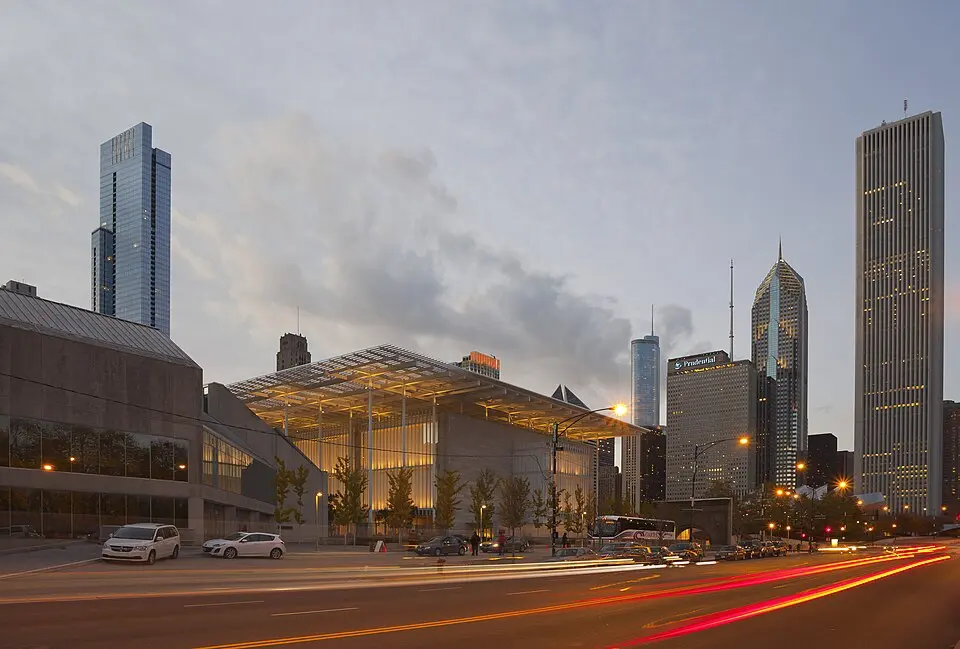
Art Institute of Chicago The museum behind the bronze lions brings centuries of art together beside Grant and Millennium parks.
Its historic Michigan Avenue building and Modern Wing form a single museum destination.
Museum admission applies. Use the official ticket page for current hours and access.
Photo: Diego Delso · CC BY-SA 3.0 ↗
Nearby detour
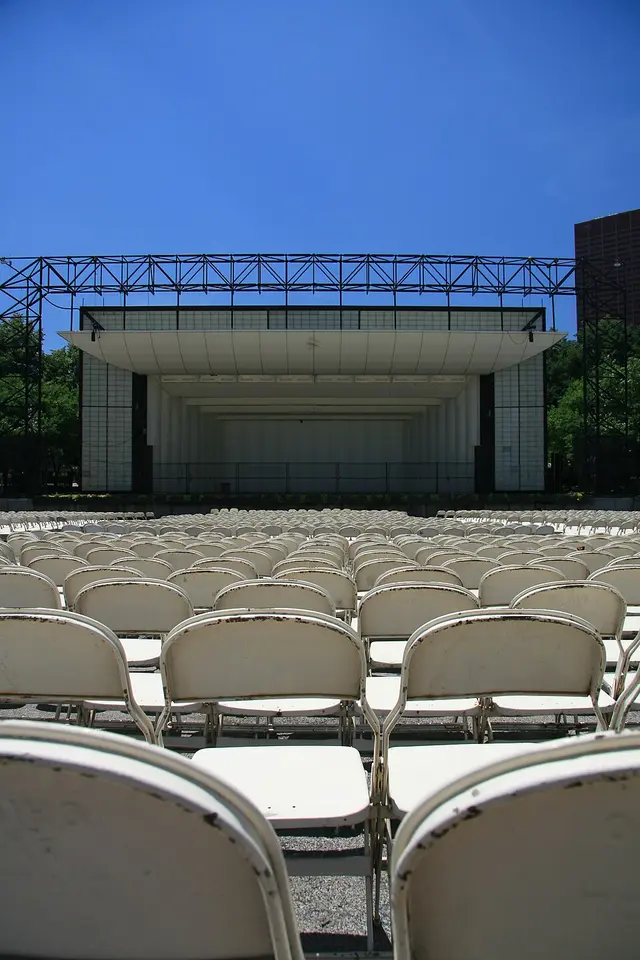
Petrillo Music Shell An outdoor stage and broad audience lawn occupy Grant Park south of Monroe Street.
The present music shell was built in 1978 and named for musicians’ union leader James C. Petrillo.
Check the organizer’s schedule and access arrangements for individual performances.
Photo: flickr user Antre · CC BY-SA 2.0 ↗
Nearby detour
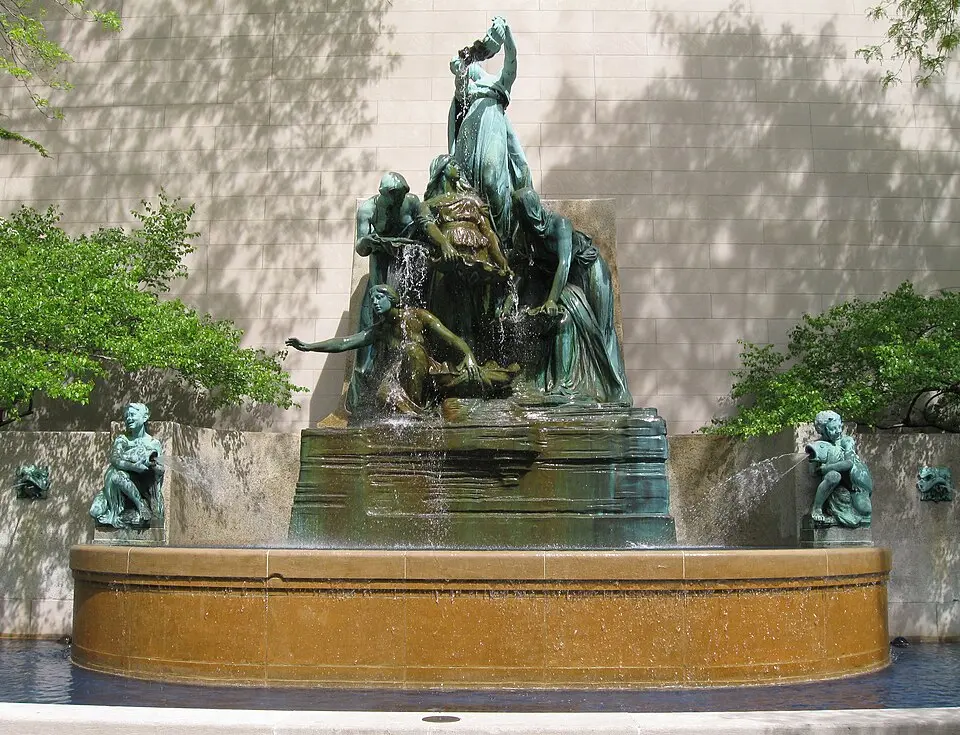
Fountain of the Great Lakes Five bronze figures pass water from one shell to the next in the Art Institute’s South Garden.
Lorado Taft’s 1913 fountain represents the connected flow of the five Great Lakes.
Enter through the garden’s posted access points; fountain operation and garden access may vary.
Photo: Joe Ravi · CC BY-SA 3.0 ↗
Nearby detour
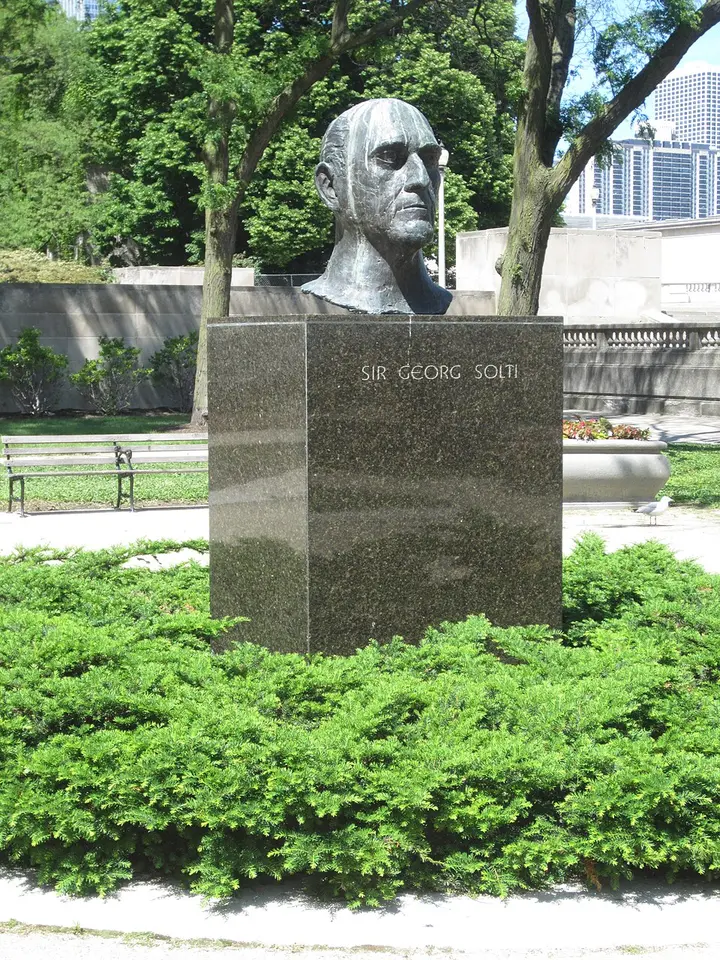
Sir Georg Solti Bust & Garden A small portrait of the conductor makes an easily missed musical stop just off Michigan Avenue.
Dame Elisabeth Frink’s bronze bust moved to its Grant Park garden setting in 2006.
Use the garden paths south of Jackson Drive and east of Michigan Avenue.
Photo: Another Believer · CC BY-SA 4.0 ↗
Nearby detour
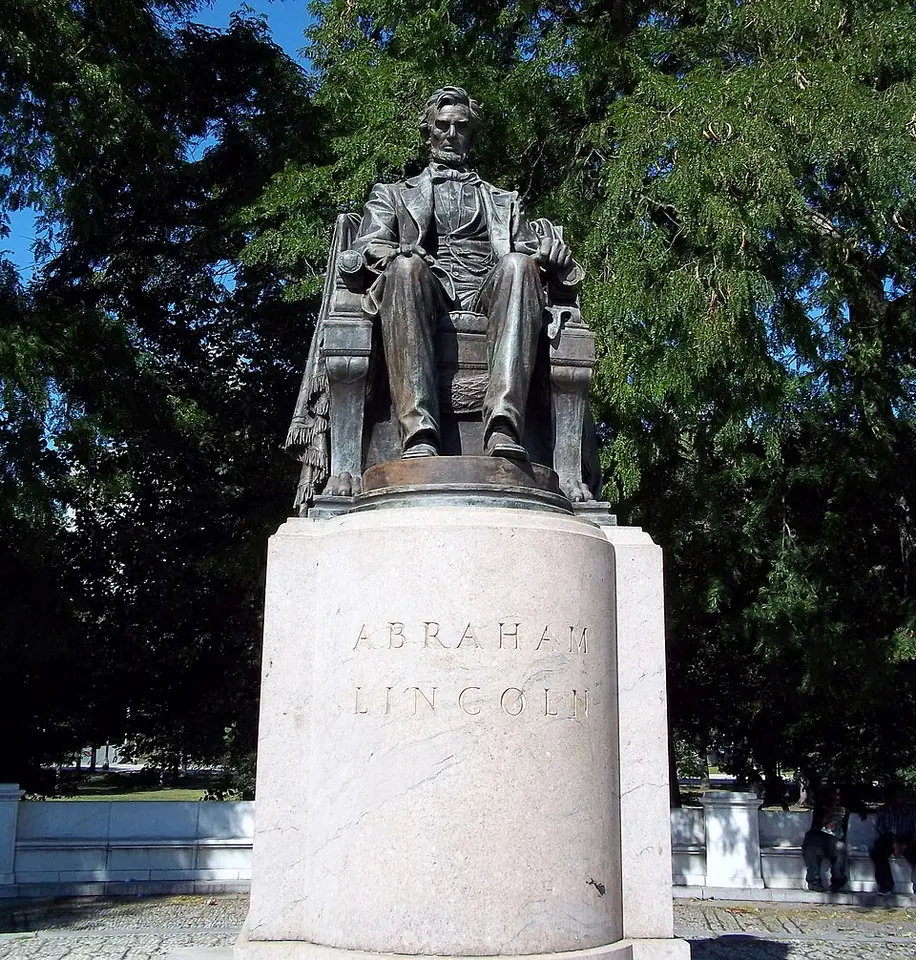
Abraham Lincoln · Head of State A seated Lincoln looks out from a broad stone setting in the quieter interior of Grant Park.
Augustus Saint-Gaudens’ bronze figure was installed here in 1926, in the north Court of Presidents.
Reach the monument by park paths west of Columbus Drive; use marked crossings at nearby roads.
Photo: Alanscottwalker · CC BY-SA 3.0 ↗
Nearby detour
Grant Park Fountain Figures Four small bronze children inhabit their own circular fountains in the gardens north and south of Buckingham Fountain.
Leonard Crunelle’s Crane Girl, Fisher Boy, Turtle Boy and Dove Girl moved to Grant Park in 1964.
The map dot marks Fisher Boy in the northern pair. The other two fountains are south of Buckingham Fountain; water operates seasonally.
Nearby detour
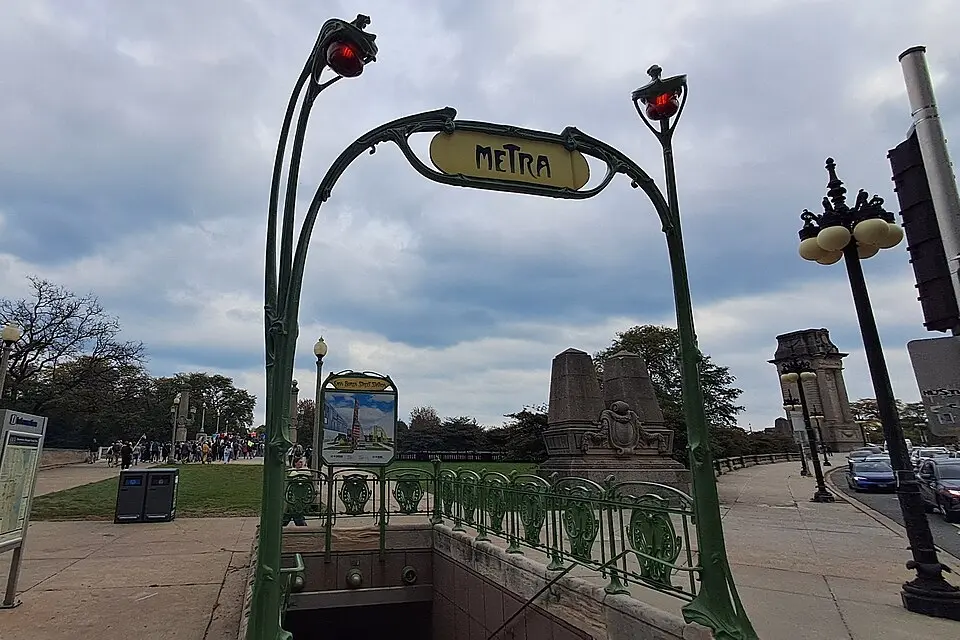
Paris Métro Entryway Art Nouveau ironwork gives a Van Buren Street Metra entrance a Parisian silhouette.
The Paris transit authority cast this reproduction from Hector Guimard’s original molds.
View from the sidewalk at Michigan and Van Buren; the stairs serve a working commuter-rail station.
Photo: AlphaBeta135 · CC BY 4.0 ↗
Nearby detour
The Bowman & The Spearman Two monumental riders frame Congress Plaza at the Michigan Avenue entrance to Grant Park.
Ivan Meštrović intentionally omitted the bow and spear from his 1928 sculptures; the missing weapons were never part of them.
View the sculptures from the plaza sidewalks and use marked crossings between the two sides.
Photo: TRUsmith · CC BY-SA 4.0 ↗
Via a connector
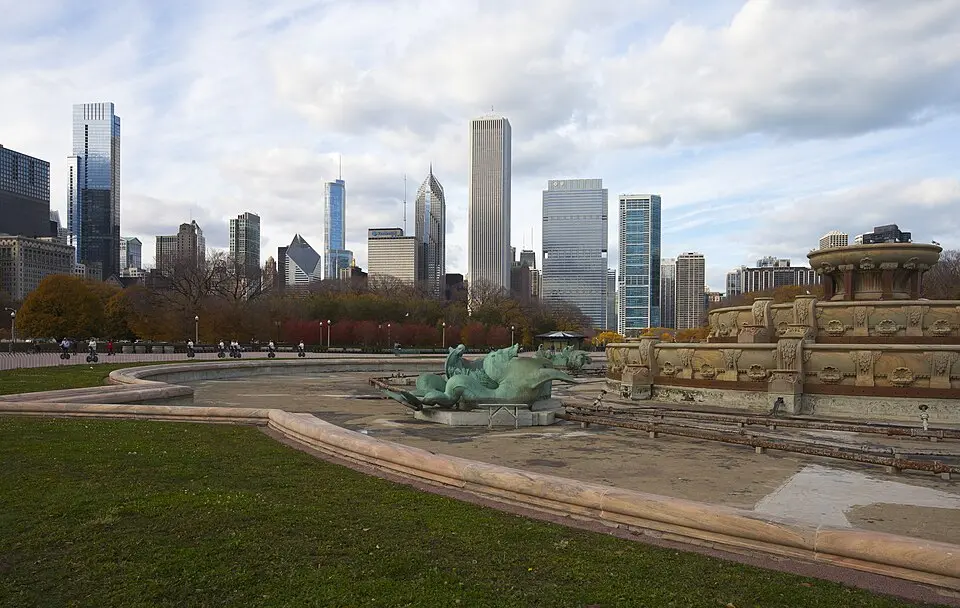
Buckingham Fountain Rose-colored stone and sculpted water give Grant Park its grand, lake-facing centerpiece.
The Clarence F. Buckingham Memorial Fountain was dedicated in 1927.
Fountain displays are seasonal. Check the official schedule and use designated crossings.
Photo: Diego Delso · CC BY-SA 3.0 ↗
Nearby detour
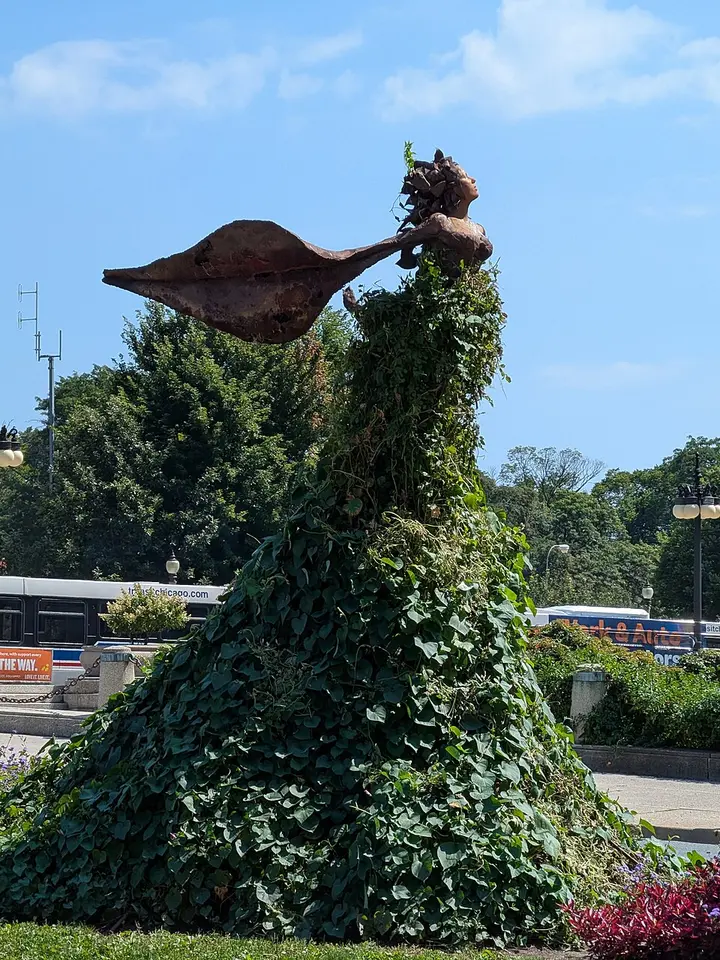
Magdalene A tall female figure rises from a small triangular garden at Michigan Avenue and Ida B. Wells Drive.
Dessa Kirk designed the sculpture so surrounding plants become part of its dress.
Use the designated pedestrian crossings to approach the garden.
Photo: Yoshi121212 · CC0 ↗
Via a connector
Magma An angular steel sculpture punctuates the lakeward side of Grant Park.
Mark di Suvero created Magma.
Approach from the park paths and observe temporary event barriers.
Nearby detour
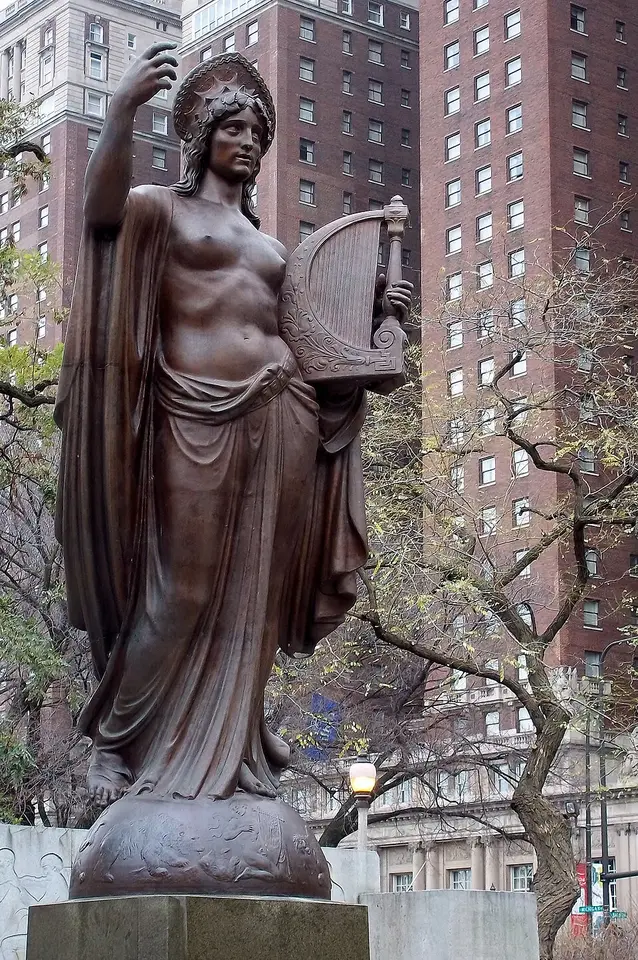
Spirit of Music & Garden A bronze muse holding a lyre stands before a carved orchestral backdrop, near a garden used for dance events.
Albin Polasek’s sculpture honors Theodore Thomas, the first conductor of the Chicago Symphony Orchestra.
Find it just north of Balbo Drive; check city event listings before planning a dance or concert visit.
Photo: Alanscottwalker · CC BY-SA 3.0 ↗
Nearby detour
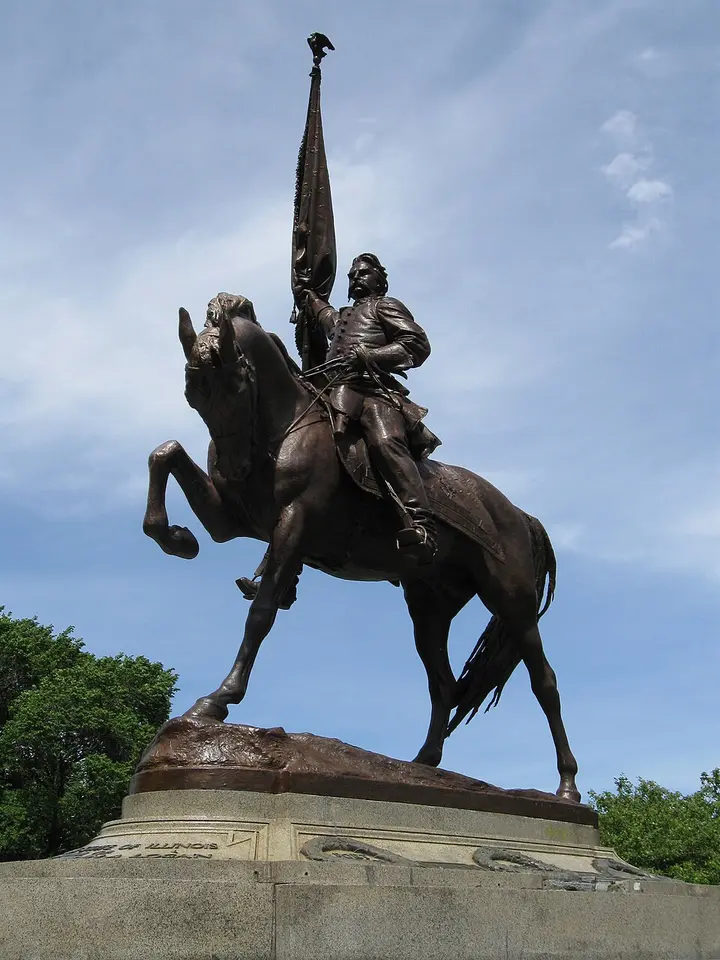
John Alexander Logan Monument An equestrian figure rises above a grassy mound along Grant Park’s Michigan Avenue edge.
Augustus Saint-Gaudens sculpted Logan and Alexander Phimister Proctor created the horse for the 1897 monument.
Approach on the park paths near 9th Street; the monument is inland from the lakefront route.
Photo: Joe Ravi · CC BY-SA 3.0 ↗
Nearby detour
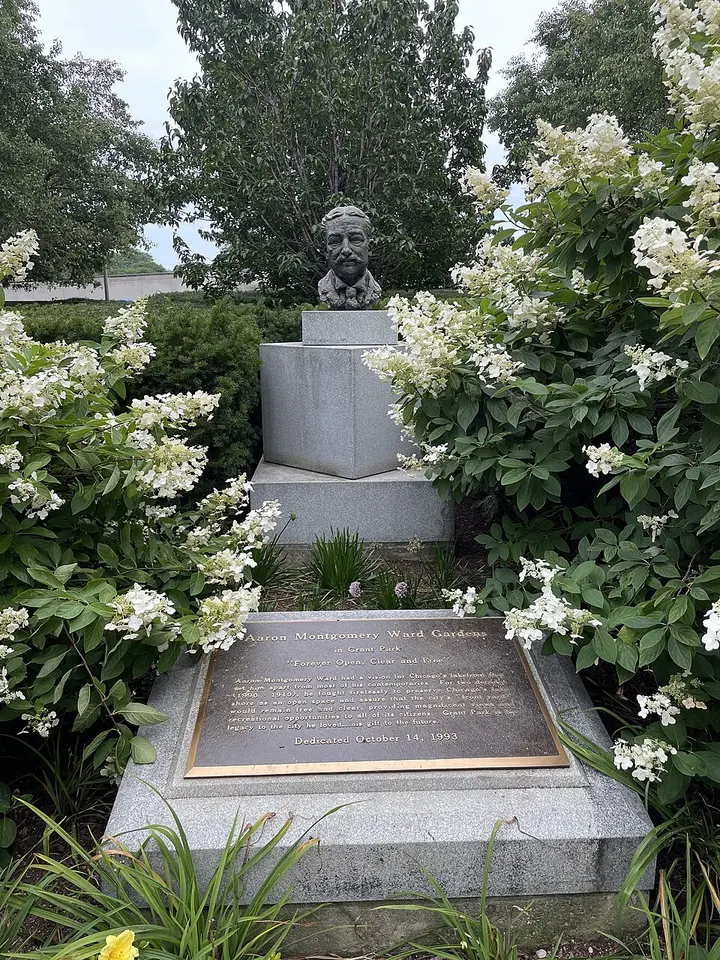
Aaron Montgomery Ward Bust A bronze portrait honors the businessman whose lawsuits helped preserve Grant Park as open public space.
Milton Horn’s bust was rededicated at this site in 2005.
Look east of Michigan Avenue on the axis of 11th Street, at the southwest edge of Grant Park.
Aaron Montgomery Ward Bust in Grant Park · 2026
Photo: NameNotUsed20 · CC0 ↗
Nearby detour
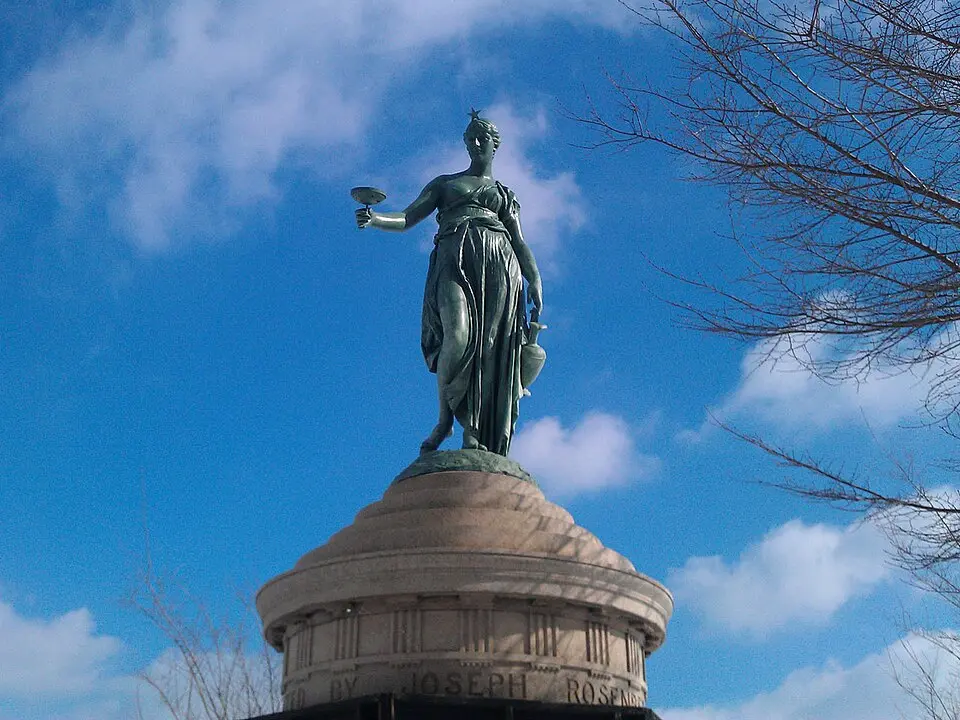
Joseph Rosenberg Fountain A small classical pavilion supports a bronze figure of Hebe, with a story rooted in a newsboy’s thirst.
Joseph Rosenberg funded the ornamental fountain so others could obtain water; it no longer supplies drinking water.
Treat this as an artwork stop, not a drinking-water refill point.
Hebe, the bronze figure crowning the Rosenberg Fountain.
Photo: Jeff Kwapil · CC BY-SA 4.0 ↗
On the trail
Chicago Horizon A broad timber canopy frames the lakefront lawn north of Shedd Aquarium.
Yasmin Vobis and Aaron Forrest of Ultramoderne designed the 2015 structure.
Pause beneath or beside the pavilion where access is open; check any temporary event restrictions.
Nearby detour
Agora Walk beside a crowd of towering cast-iron figures, each seeming to pause or move independently of the others.
Magdalena Abakanowicz’s installation comprises 106 headless figures and was installed in 2006.
Use the surrounding walkways near Michigan Avenue and Roosevelt Road; event fencing can alter access.
Nearby detour
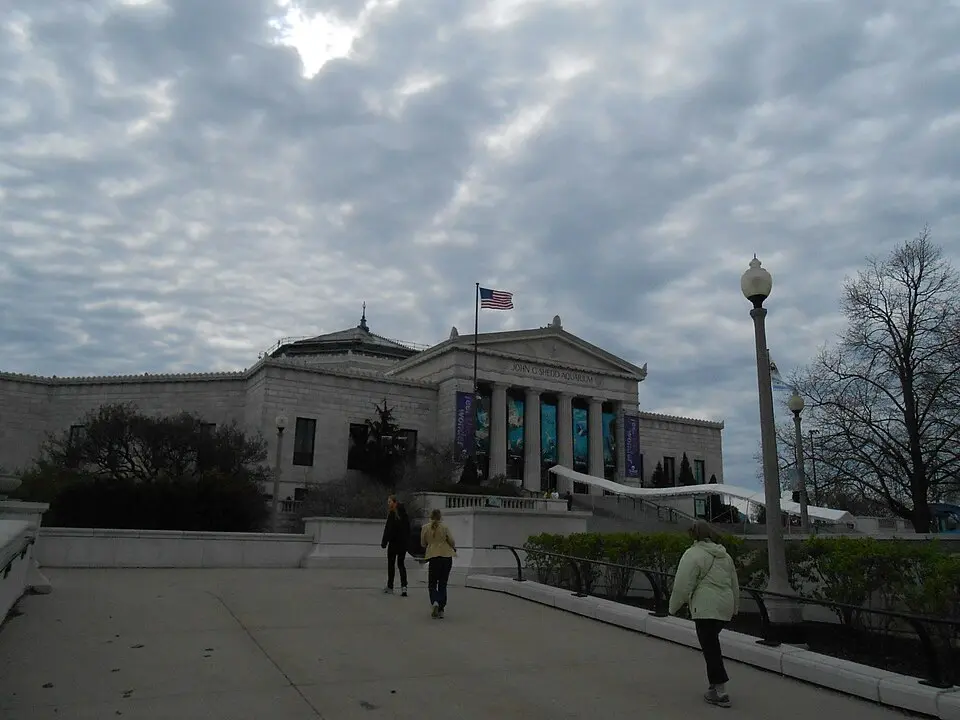
Shedd Aquarium The lake wraps around this grand aquarium, where campus paths open onto wide-water views.
Shedd Aquarium opened in 1930.
Check tickets and hours for entry. Outdoor campus paths can be explored separately.
Photo: Djngsf · CC BY-SA 4.0 ↗
Via a connector
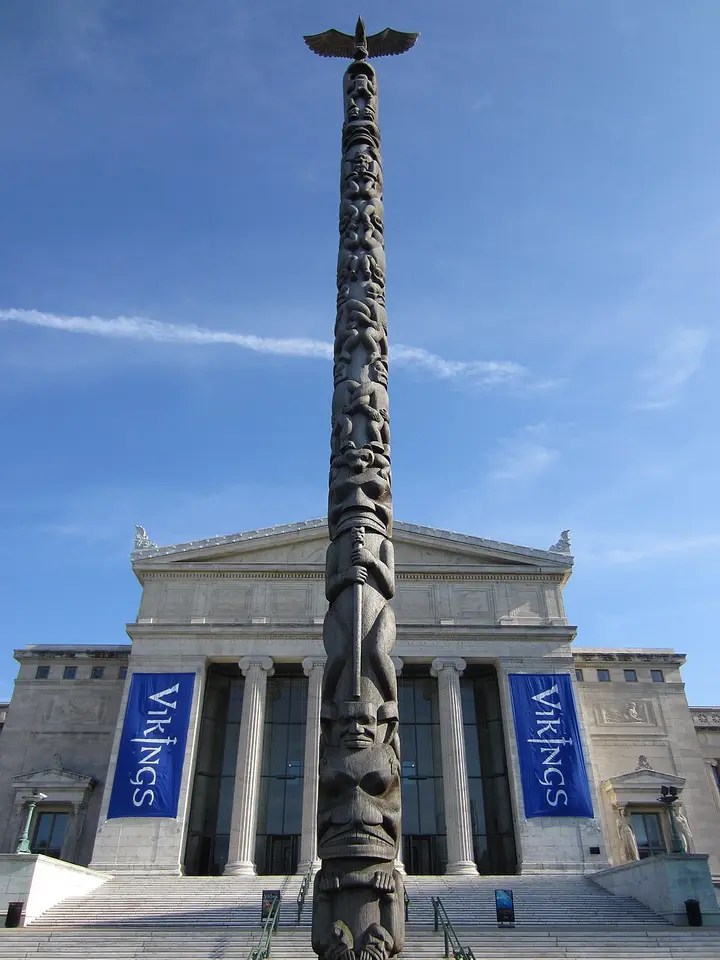
Big Beaver Totem Pole A tall carved pole stands north of the Field Museum, close to the Museum Campus paths.
Nisga’a artist Norman Tait carved the pole for the museum’s 1982 exhibition opening.
View the outdoor work from the public approach north of the museum.
Photo: Another Believer · CC BY-SA 4.0 ↗
Via a connector
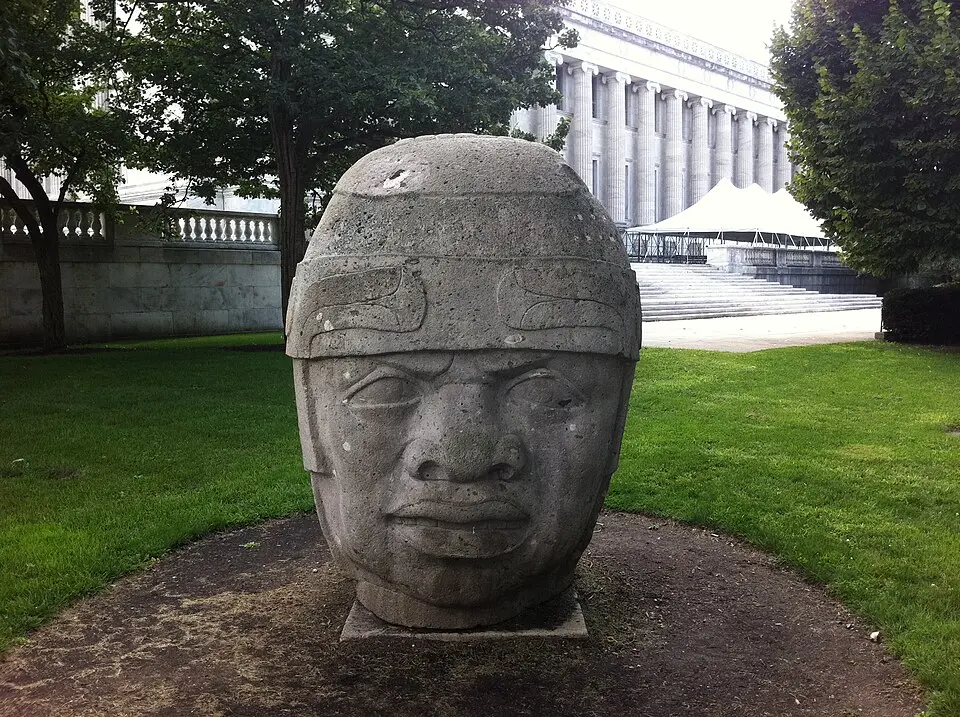
Olmec Head A monumental carved head brings a quiet outdoor encounter with Mexican cultural history beside the Field Museum.
Ignacio Perez Solano made this replica of Olmec Head Number 8; Veracruz presented it to Chicago in 2000.
Look along the museum’s eastern grounds; this outdoor replica is separate from indoor exhibits.
Photo: Adam sk · CC BY-SA 3.0 ↗
Via a connector
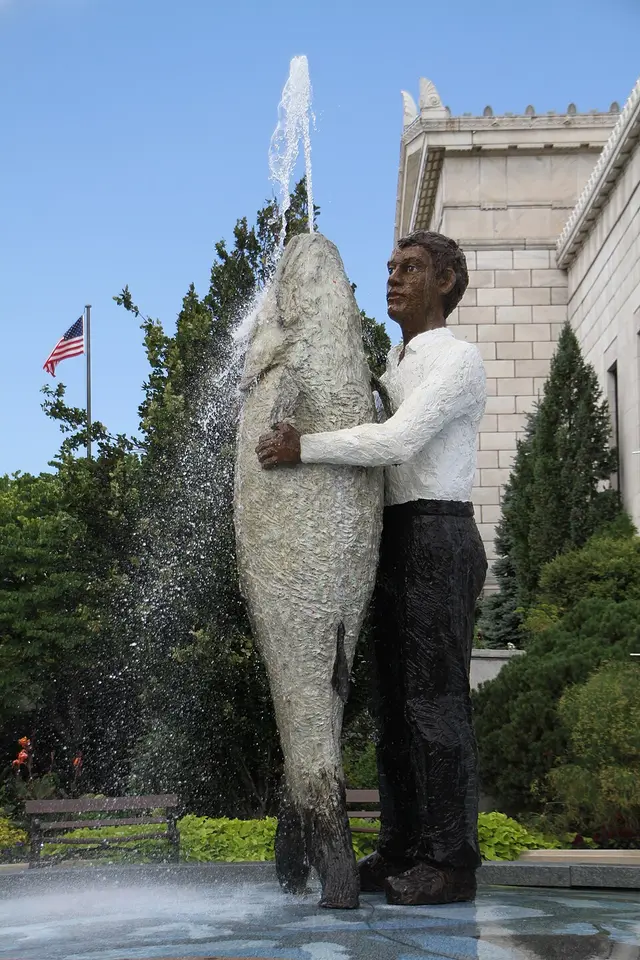
Man with Fish A painted bronze man wraps his arms around an enormous fish outside Shedd Aquarium.
Stephan Balkenhol’s playful sculptural fountain was installed at Shedd in 2001.
Look near the aquarium entrance paths and check posted access; water operation is not guaranteed.
Photo: HaSt · CC BY-SA 4.0 ↗
Via a connector
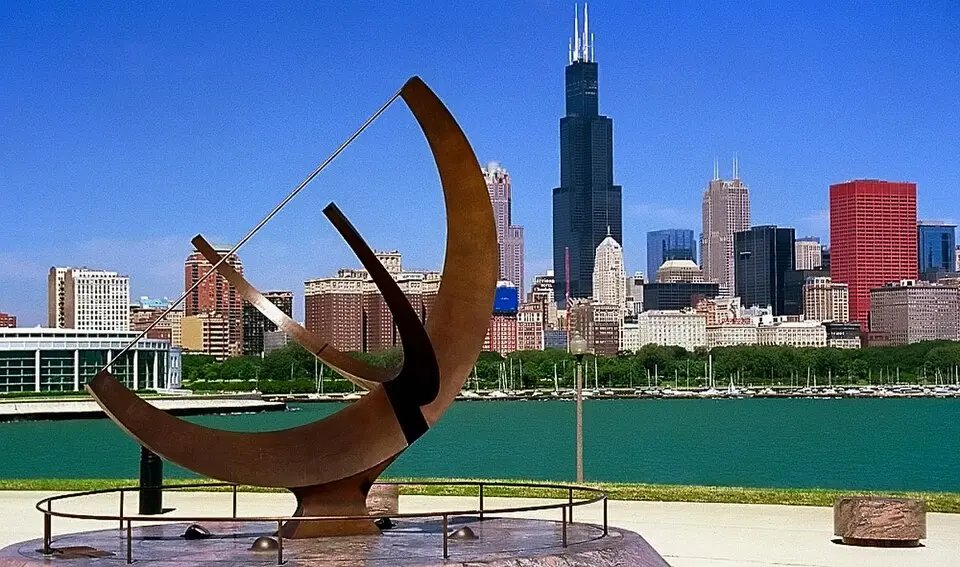
Man Enters the Cosmos A bronze sundial turns sunlight and shadow into another way of looking at the sky beside Adler Planetarium.
Henry Moore created this equatorial sundial in 1980.
Use the outdoor plaza northwest of the planetarium; museum entry is a separate visit.
Photo: David Ohmer from Cincinnati, USA · CC BY 2.0 ↗
Via a connector
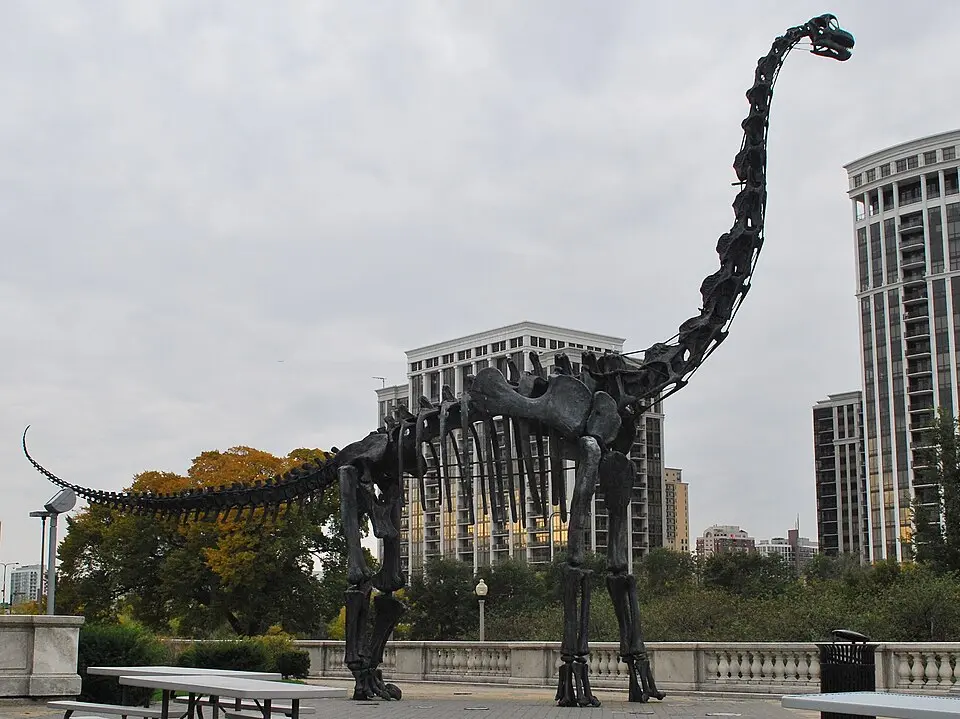
Brachiosaurus Replica A dinosaur skeleton rises over the Field Museum’s west terrace, visible before you ever step inside.
The Field Museum installed its all-weather Brachiosaurus replica on the terrace in 1999.
Use the museum grounds and terraces; the pin marks the outdoor replica, not SUE inside the museum.
Photo: AStrangerintheAlps · CC BY-SA 3.0 ↗
Nearby detour
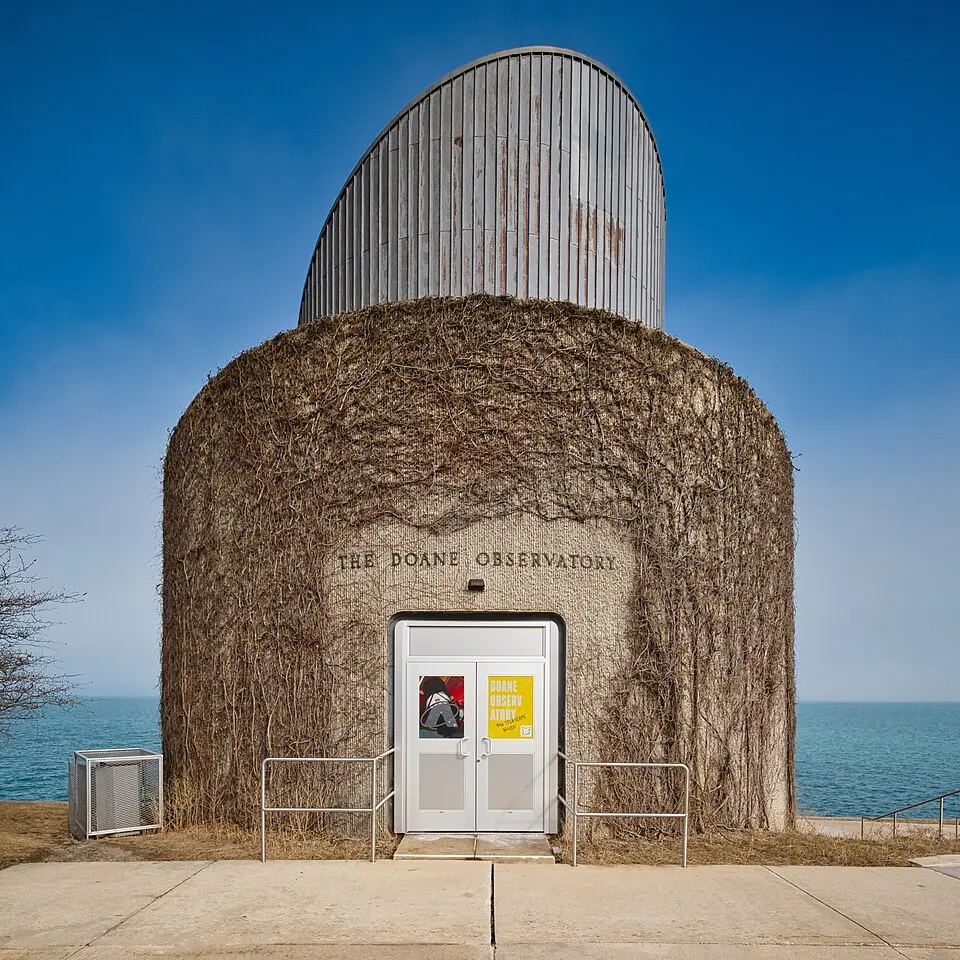
Doane Observatory A separate observatory dome stands just east of Adler Planetarium beside the lake.
The observatory has supported public astronomy viewing since 1977.
Adler reports the observatory closed indefinitely for telescope repairs in its October 13, 2026 update. Check the official page before planning a visit.
Photo: Chris Rycroft · CC BY 2.0 ↗
Nearby detour
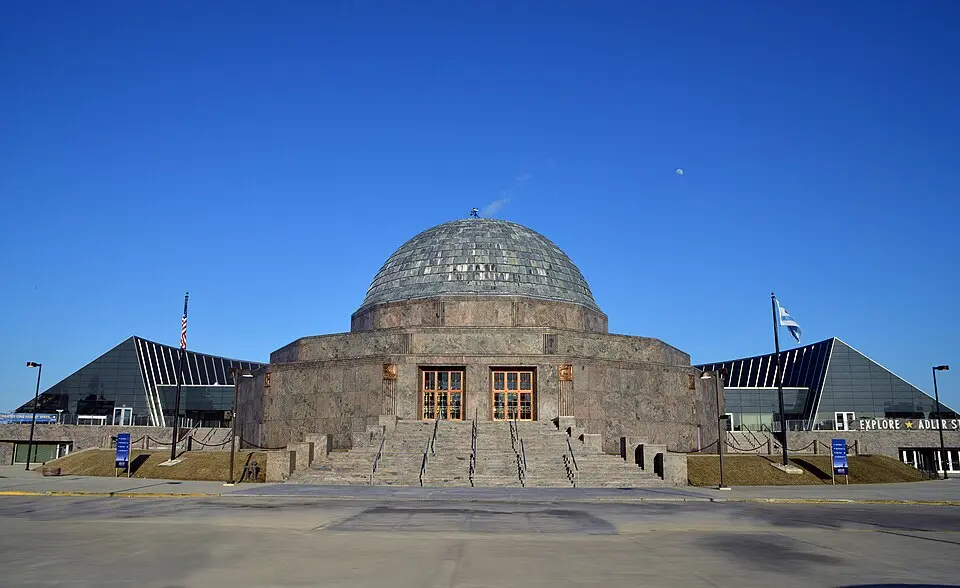
Adler Planetarium At the end of the peninsula, a copper dome meets the sky and the whole city gathers across the water.
Opened in 1930, Adler was the first planetarium in the Western Hemisphere.
The skyline view is outdoors. Museum entry requires separate tickets and planning.
Photo: Adler Planetarium · CC BY-SA 3.0 ↗
Via a connector
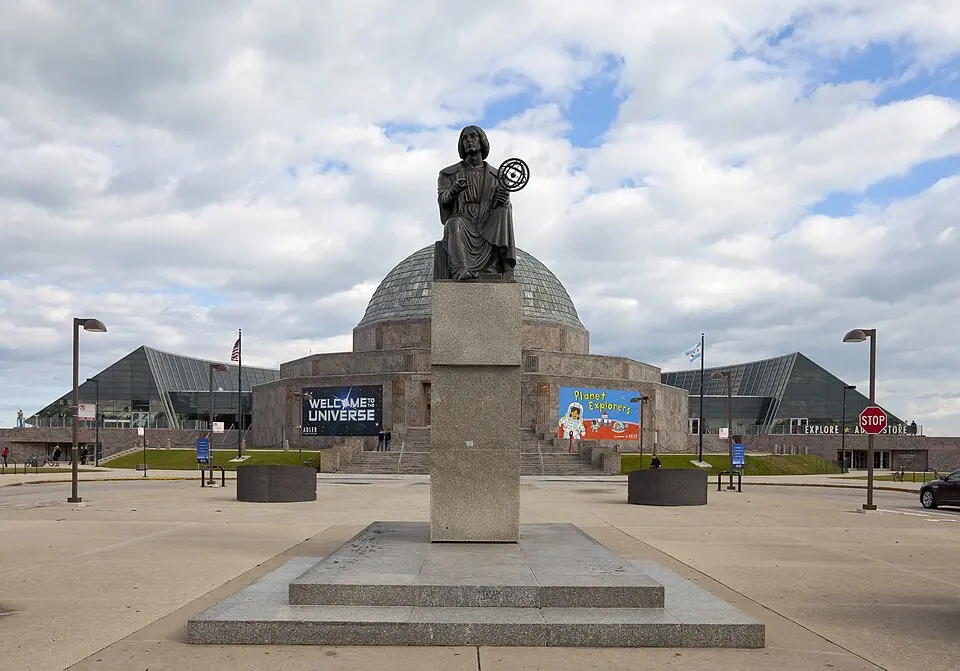
Nicolaus Copernicus Monument The astronomer sits with instruments in hand on the approach to Adler Planetarium.
The monument was dedicated in 1973 to mark the 500th anniversary of Copernicus’ birth.
Use marked crossings around Solidarity Drive; the monument stands in its landscaped median.
Photo: Diego Delso · CC BY-SA 3.0 ↗
Via a connector
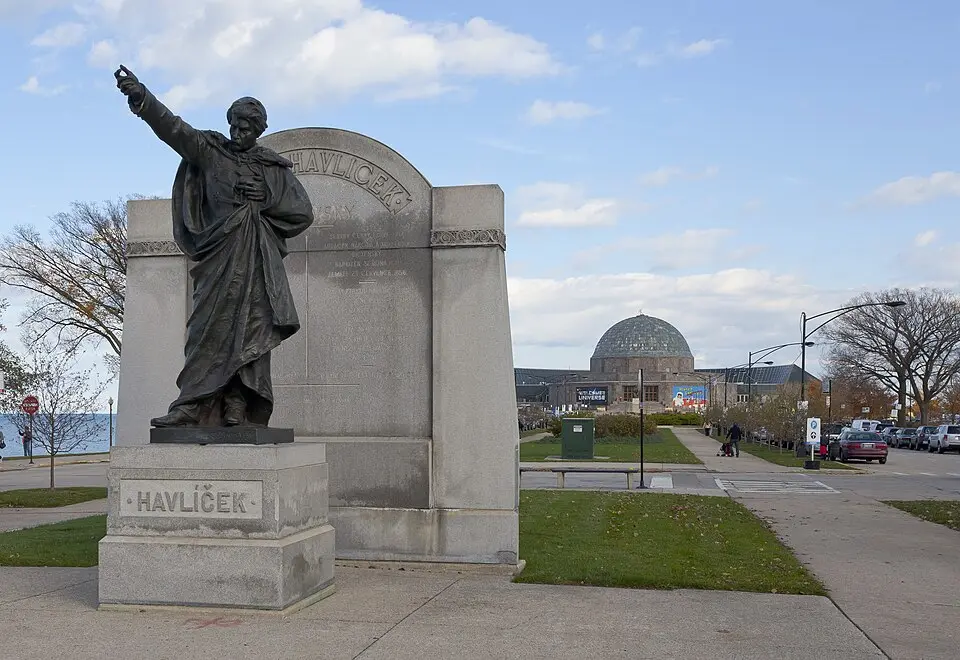
Karel Havlíček Monument A bronze speaker extends his arm toward the museum approach, recalling Chicago’s Czech community.
The monument to journalist and poet Karel Havlíček moved from Douglas Park to Solidarity Drive in 1983.
Use marked crossings around Solidarity Drive; the monument is in the median.
Photo: Diego Delso · CC BY-SA 3.0 ↗
Via a connector
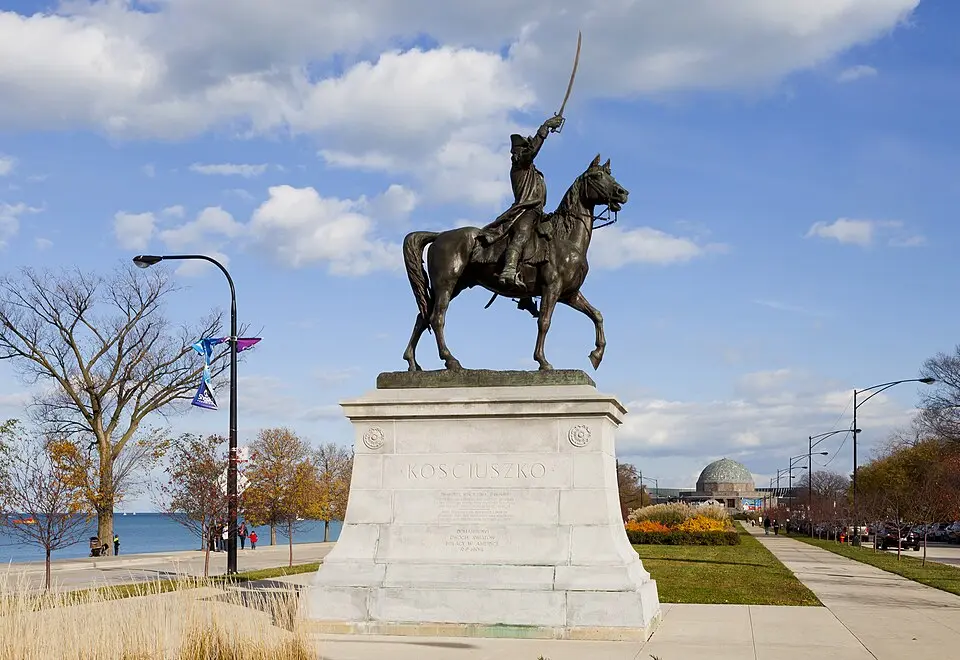
Tadeusz Kościuszko Monument An equestrian monument occupies the western part of Solidarity Drive, southeast of Shedd Aquarium.
The 1904 monument honors the Polish engineer and American Revolution officer; it moved here in 1978.
Use marked crossings to reach the median and keep clear of moving traffic.
Photo: Diego Delso · CC BY-SA 3.0 ↗
Nearby detour
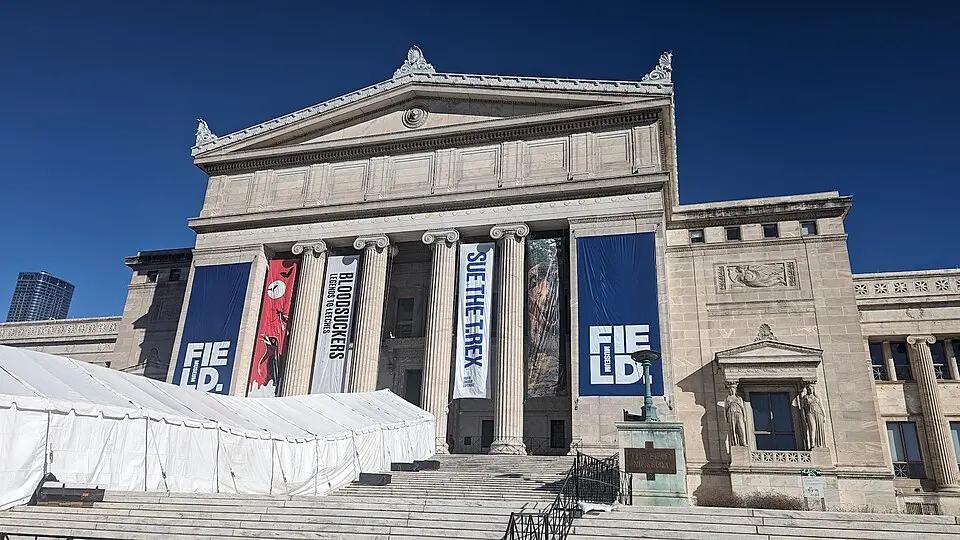
Field Museum A monumental limestone museum guards stories of the natural world, just inland from the water.
The museum grew out of collections assembled around the 1893 World’s Columbian Exposition.
Plan tickets and hours separately; allow several hours for an indoor visit.
Photo: SarahLucciaLynch · CC BY 4.0 ↗
Via a connector
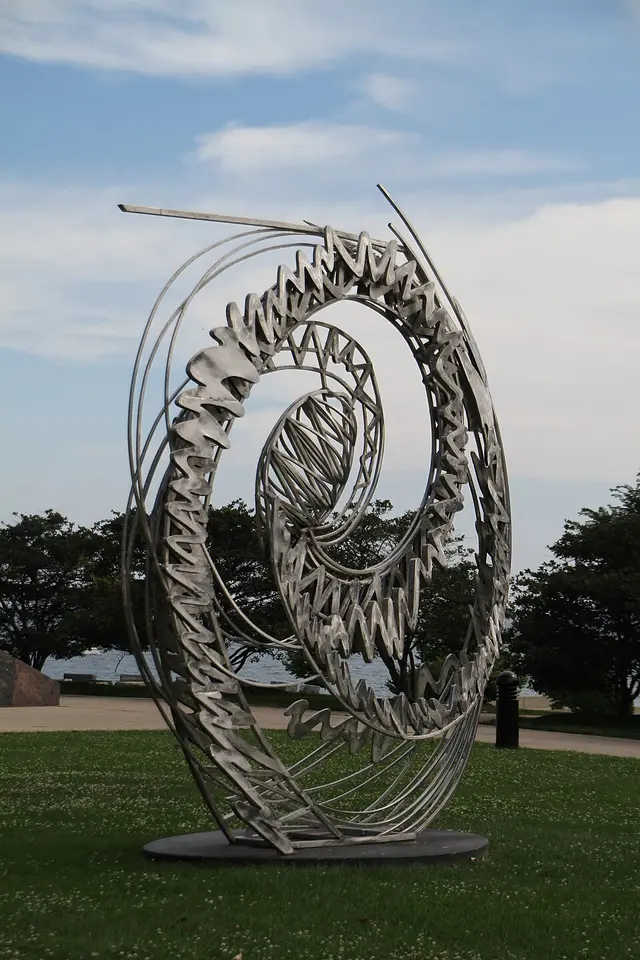
Spiral Galaxy Curving stainless steel suggests a galaxy in motion on the lawn just south of Adler Planetarium.
John David Mooney’s sculpture was installed at Adler in 2005 for the planetarium’s 75th anniversary.
Explore on the outdoor paths south of Adler; exposed lakefront weather can be strong here.
Photo: HaSt · CC BY-SA 4.0 ↗
Via a connector
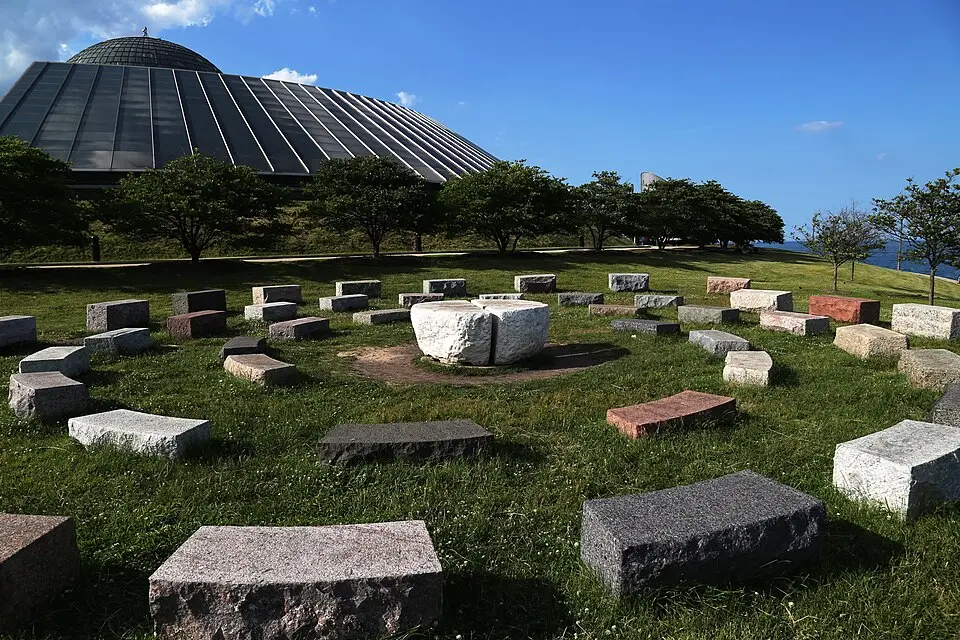
Americas Courtyard Stone blocks form a gathering place beneath the open sky just south of the planetarium.
Denise Milan and Ary Perez arranged 56 granite blocks around four marble pieces; the work moved here in 2000.
Approach along the public paths south of Adler and leave room for other visitors.
Photo: Bohao Zhao · CC BY 3.0 ↗
Via a connector
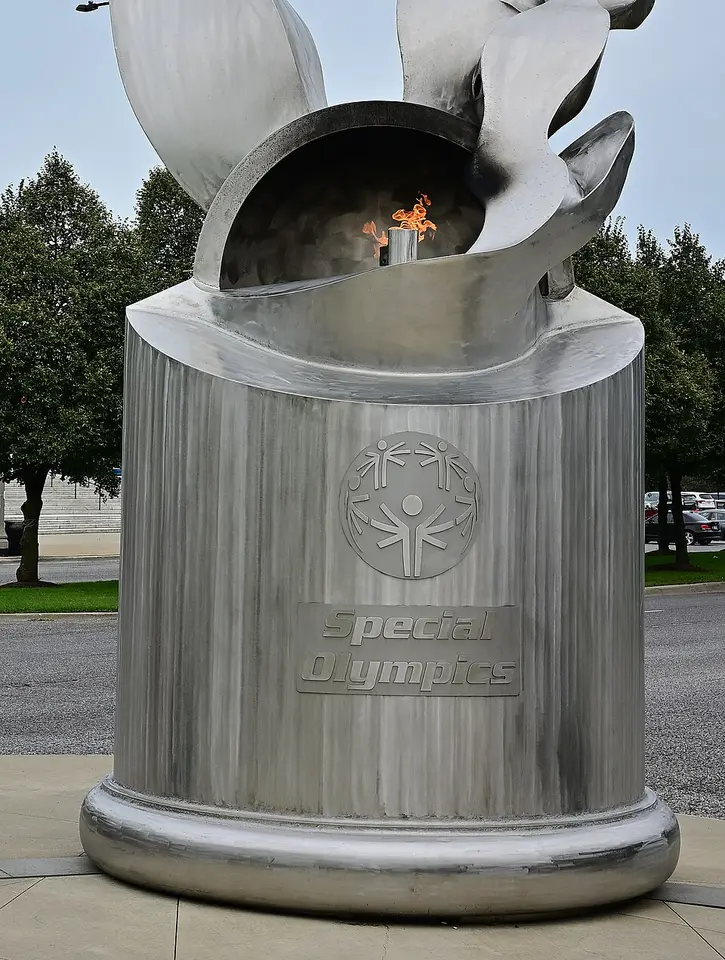
Eternal Flame of Hope A tall monument on Soldier Field’s north lawn celebrates the Special Olympics movement.
It was dedicated for the fiftieth anniversary of the first Special Olympics games at Soldier Field.
Use public Museum Campus paths and follow stadium event access signs.
Photo: Nairn McWilliams · CC BY-SA 2.0 ↗
Via a connector
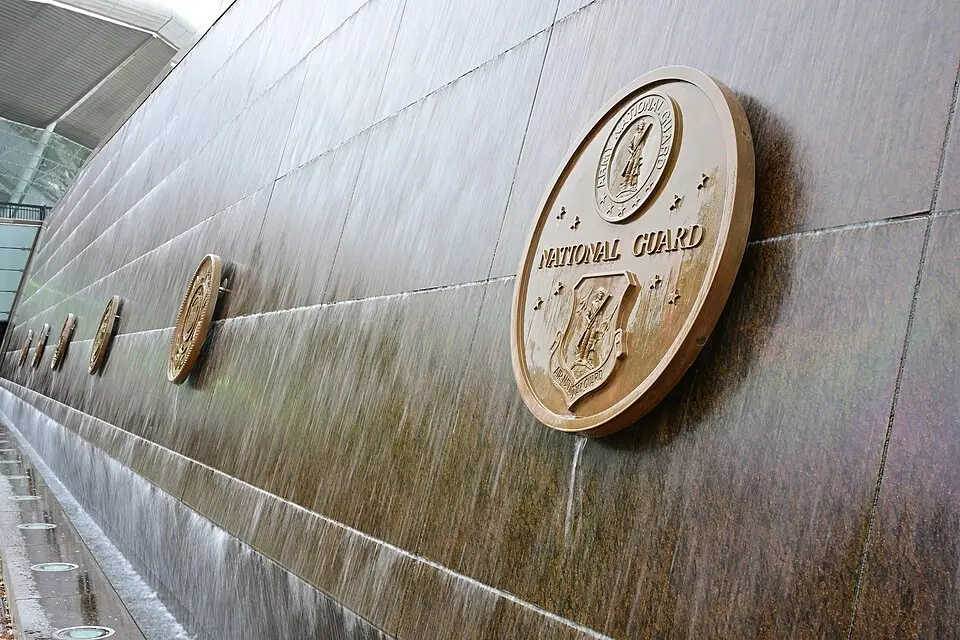
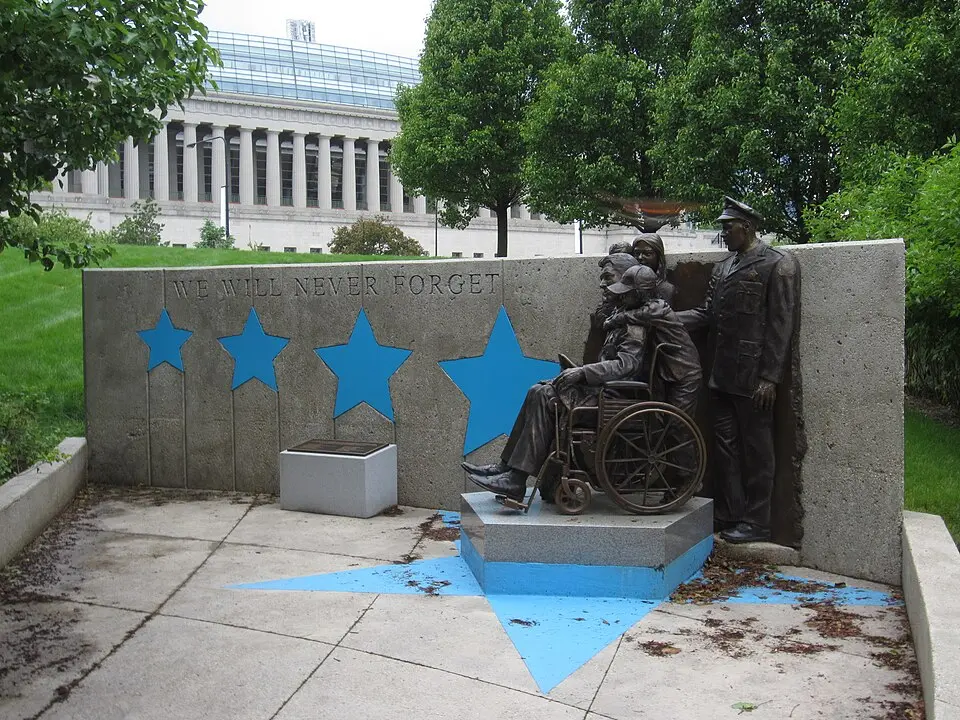
Tribute to Freedom & Water Wall A large bronze relief at Soldier Field’s north entrance depicts service members and families along Chicago’s shoreline.
Anna Koh Varilla and Jeffrey Hanson Varilla created the work, dedicated on Veterans Day in 2003.
Check stadium event restrictions before entering the north plaza; the pin marks the relief.
The adjoining Water Wall at Soldier Field, with military service emblems.
Photo: Nairn McWilliams · CC BY-SA 2.0 ↗
Via a connector
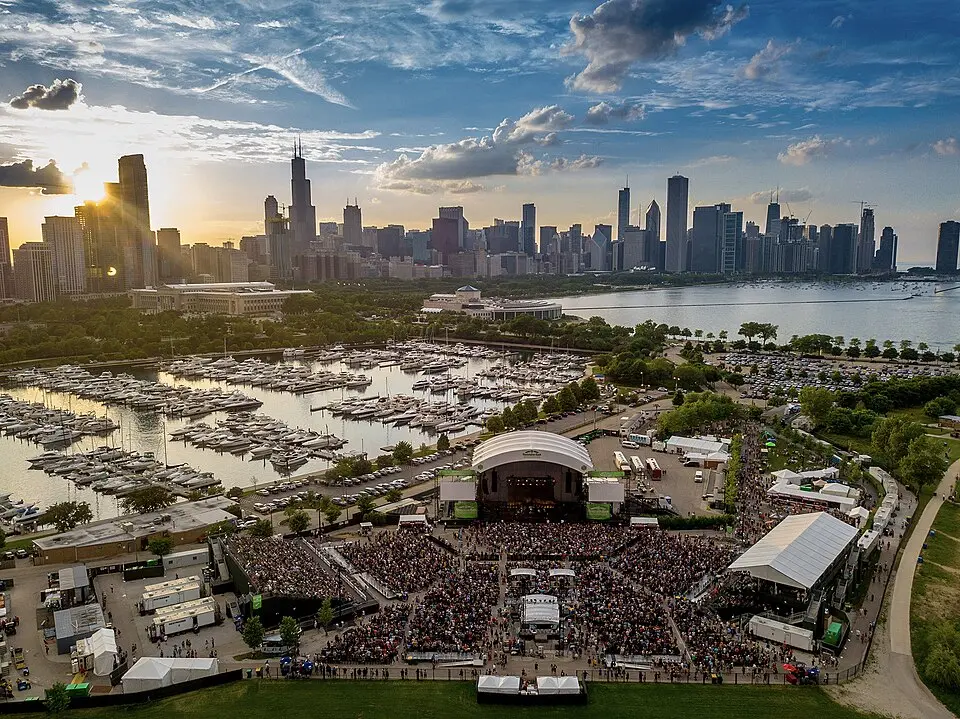
Huntington Bank Pavilion An outdoor concert venue brings a different kind of energy to the northern end of Northerly Island.
The pavilion is a dedicated concert venue within Northerly Island Park.
Check the event operator for tickets and entry instructions; nearby island access can change around events.
Photo: Wayne Ward · CC BY-SA 4.0 ↗
On the trail
Gold Star Families Memorial & Park A sequence of paths and memorial spaces beside Burnham Harbor offers a quieter stop east of Soldier Field.
Dedicated in 2006, the memorial honors Chicago police officers killed or injured in the line of duty.
Visit respectfully, follow the memorial paths, and keep ceremonial areas clear.
“Sacrifice,” within Gold Star Families Memorial and Park.
Photo: Another Believer · CC BY-SA 4.0 ↗
Nearby detour
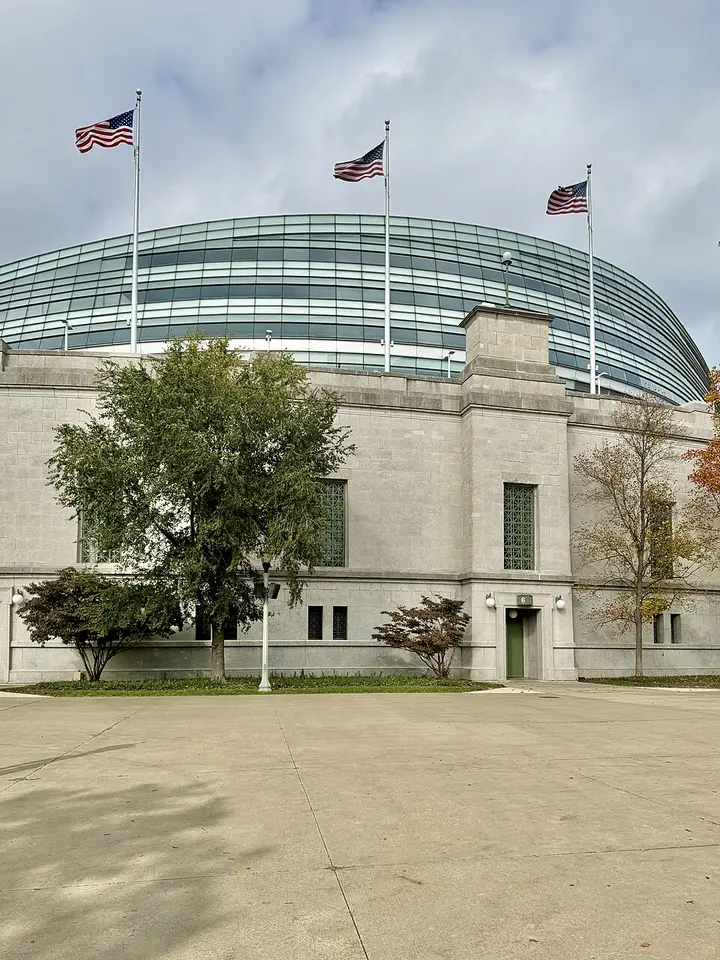
Soldier Field Stone colonnades and a modern stadium bowl mark the southern edge of Museum Campus.
The stadium’s historic colonnades remain a prominent lakefront landmark.
Check event schedules and pedestrian directions; access differs on event days.
Photo: Warren LeMay from Chicago, IL, United States · CC BY-SA 2.0 ↗
Via a connector
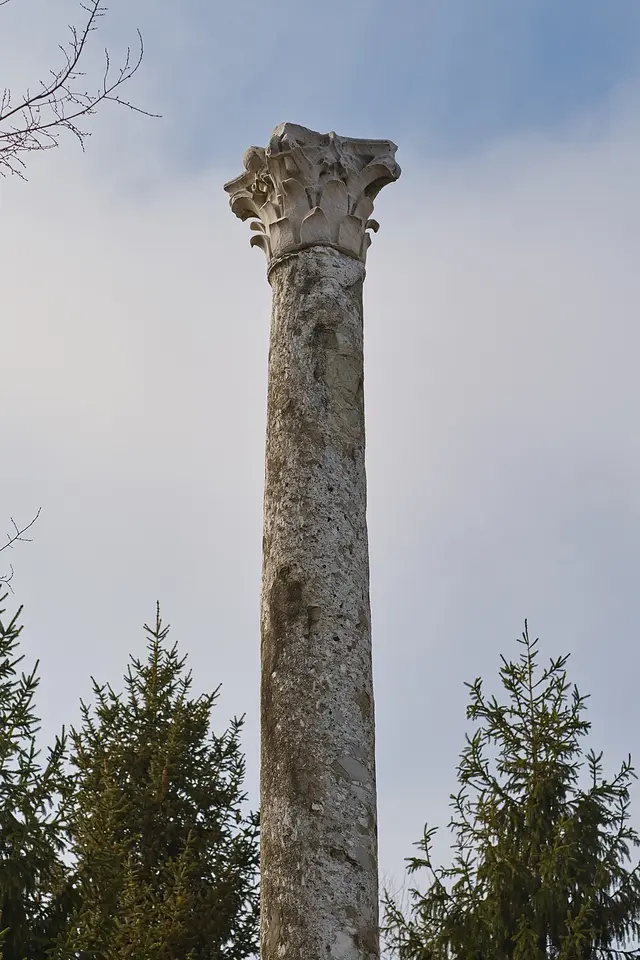
Balbo Monument An ancient stone column stands beside the paths west of Burnham Harbor.
Mussolini’s government gave the column for the 1934 fair; its fascist associations remain part of its history.
Read the monument in its historical context from the surrounding park paths.
Photo: Chris Rycroft from Cambridge, Massachusetts, United States · CC BY 2.0 ↗
Nearby detour
American Doughboy A restored World War I soldier figure occupies a location near Soldier Field’s Gate O.
The 1926 monument was conserved and moved to Soldier Field in 2003.
The Park District identifies this as an indoor artwork near Gate O; stadium access may require an event or tour.
Via a connector
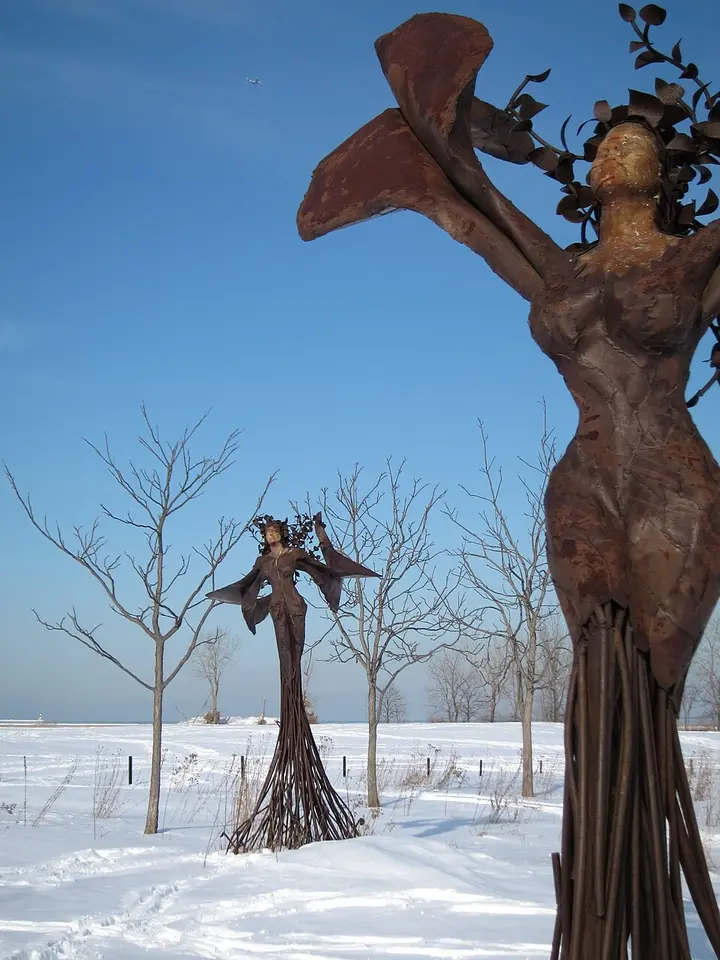
Daphne Garden Three figures with leaf-like arms emerge among plants north of the Northerly Island visitor center.
Dessa Kirk made the figures from welded automobile parts; the installation moved here in 2006.
Use the island’s walking paths and stay out of planted areas.
Daphne Garden on Northerly Island in winter.
Photo: Delphine Coursault · CC BY-SA 4.0 ↗
Nearby detour
Arie Crown Theater The lakefront side of McCormick Place contains a long-running indoor home for concerts, dance, and large stage events.
Arie Crown Theater’s history includes performances by artists ranging from Duke Ellington to major ballet companies.
This is an indoor, event-based destination; use the theater’s directions rather than assuming entry from the trail.
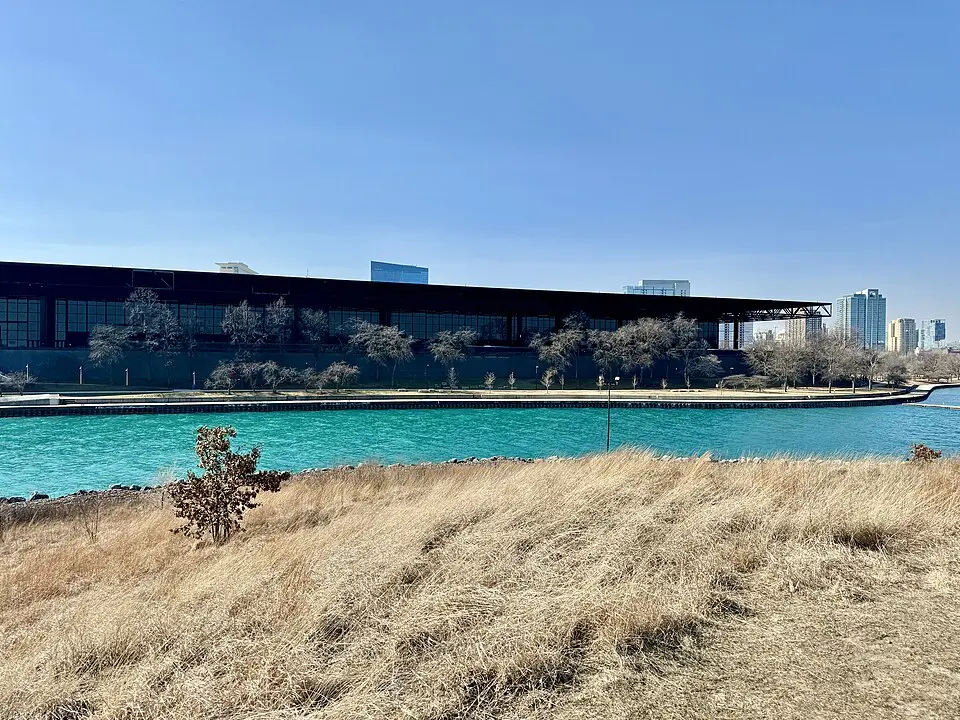
Arie Crown Theater is inside McCormick Place’s Lakeside Center, shown here from the lakefront.
Photo: Warren LeMay from Chicago, IL, United States · CC BY-SA 2.0 ↗
On the trail
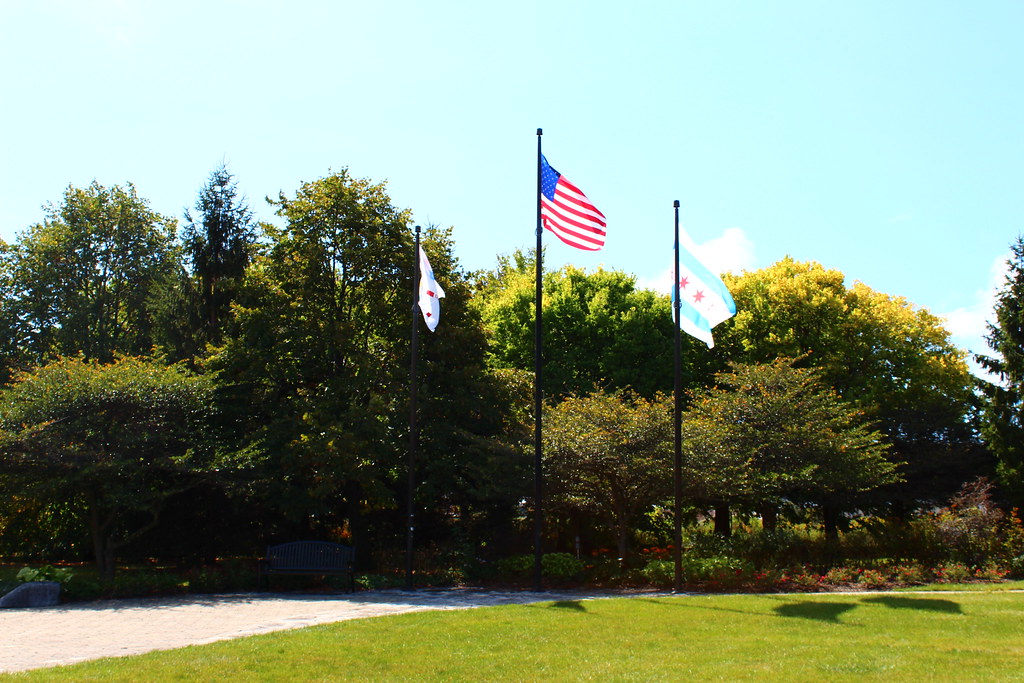
Chicago Firefighter & Paramedic Memorial Memorial stones and bronze objects form a place of remembrance beside the trail south of McCormick Place.
The memorial honors Chicago firefighters and paramedics killed in the line of duty.
Leave the through trail clear while visiting and respect the memorial’s quiet purpose.
The memorial’s flag plaza and landscaped grounds.
Photo: Richard Bartlaga · CC BY-ND 2.0 ↗
Nearby detour
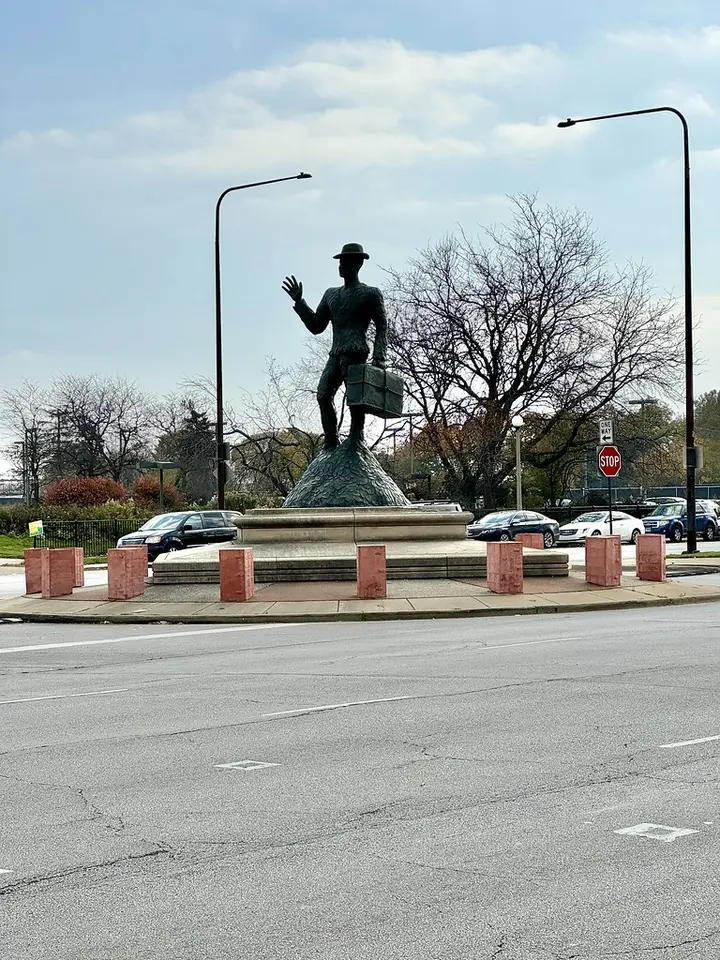
Monument to the Great Northern Migration A figure carrying a suitcase welcomes visitors to Bronzeville on King Drive, inland from the lake.
Alison Saar created the monument at Dr. Martin Luther King Jr. Drive and 26th Place.
Plan this as an inland detour using designated street crossings; it is not directly on the Lakefront Trail.
Photo: Warren LeMay · CC BY-SA 2.0 ↗
On the trail
Caracol A gathering place south of McCormick Bird Sanctuary joins public art with the wildlife corridor.
Caracol was installed in spring 2016 as part of the corridor’s gathering spaces.
Approach on designated paths and keep surrounding native plantings undisturbed.
On the trail
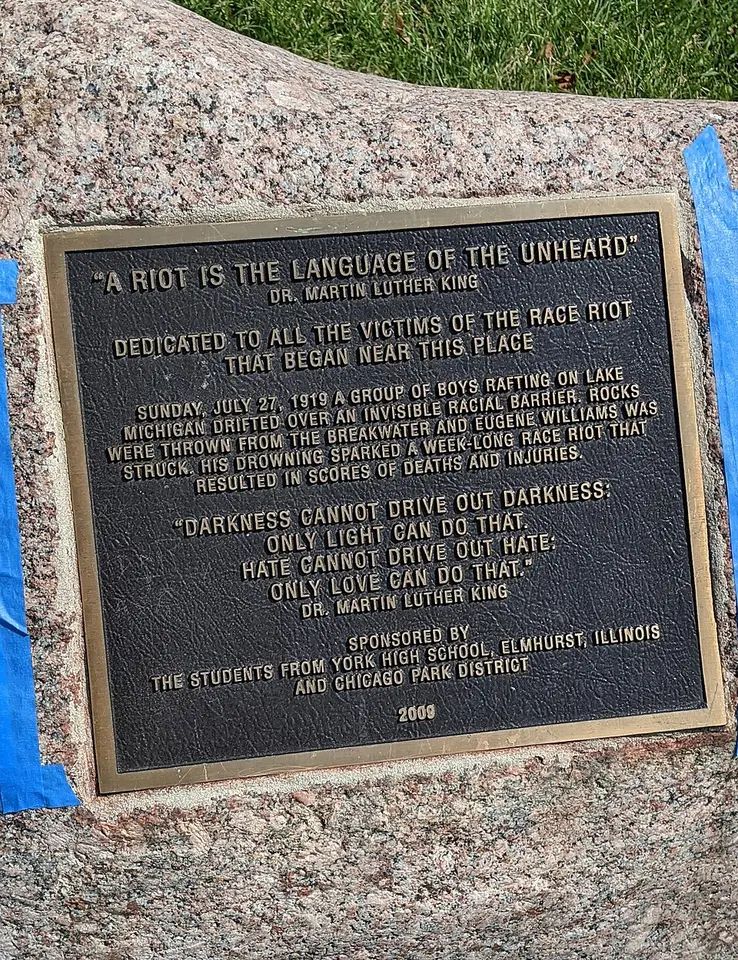
1919 Race Riot Memorial Plaque A small plaque near the lake asks visitors to remember the victims of Chicago’s 1919 racial violence.
Students at York High School sponsored the plaque, placed along the lakefront near 29th Street.
Pause clear of the trail to read the memorial; the marker identifies a place of remembrance, not the historic shoreline itself.
Photo: IntegrityPen · CC BY-SA 4.0 ↗
On the trail
La Ronda Parakata A community gathering space sits among native plantings just south of 31st Street Harbor.
The artwork was installed in 2016 as part of the Burnham Wildlife Corridor gathering spaces.
Follow the established approach paths and respect habitat plantings.
Photo: David Wilson · CC BY 2.0 ↗
Via a connector
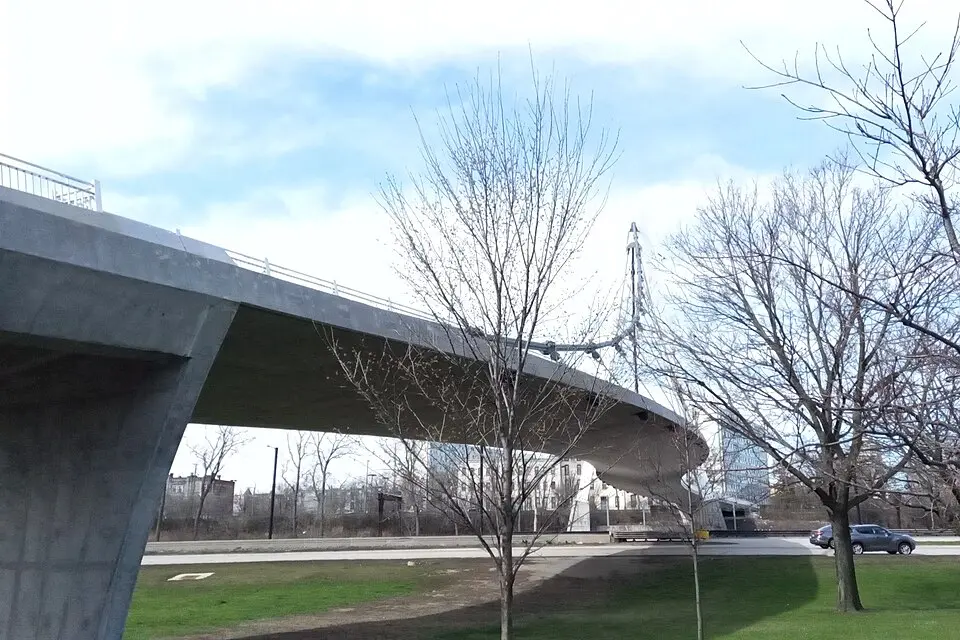
35th Street Pedestrian Bridge A sweeping pedestrian and bicycle bridge carries neighborhood access over the railroad and Lake Shore Drive.
The suspension bridge opened in November 2016.
Follow the bridge’s ramps and signs; the pin marks the structure, not either entrance.
The eastern approach from the Lakefront Trail.
Photo: AlphaBeta135 · CC BY 4.0 ↗
On the trail
Letter to Bessie Coleman Tall steel poles carry cut-out symbols into the sky near Oakwood Beach.
Bernard Williams created the work in 2018 in honor of aviation pioneer Bessie Coleman and her international spirit.
Find the sculpture near the 39th Street lakefront, beside the trail north of Oakwood Beach.
Via a connector
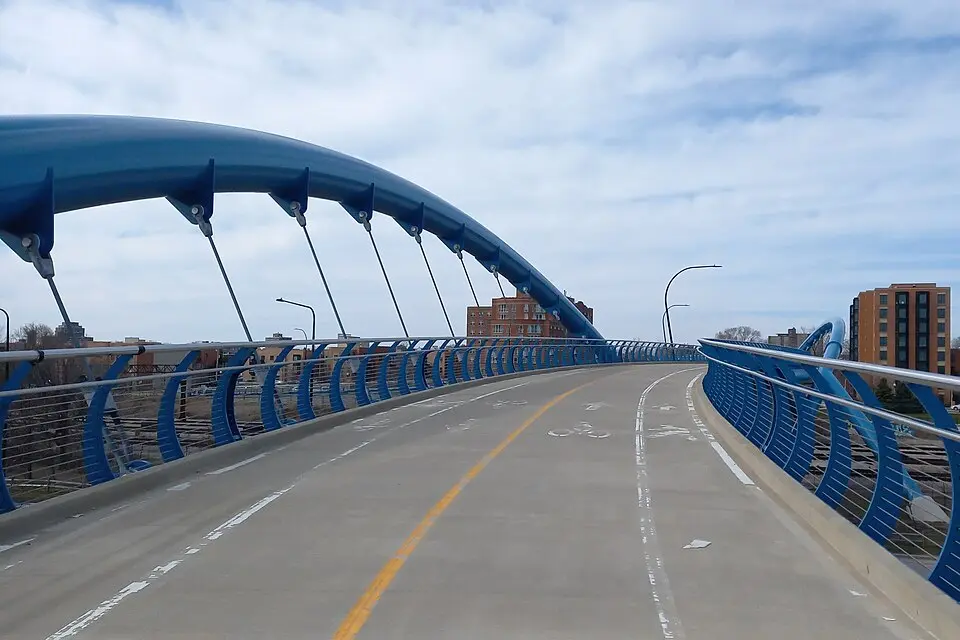
41st Street Pedestrian Bridge An S-shaped bridge links Bronzeville streets with the lakefront near Oakwood Beach.
The bridge opened in 2018 as a new pedestrian and bicycle connection.
Use the bridge’s ramps and designated paths to reach the beach.
Photo: AlphaBeta135 · CC BY 4.0 ↗
On the trail
Mermaid · La Sirena A reclining mermaid carved into limestone rests near 41st Street, with Lake Michigan behind her.
Chicago artists carved the figure into lakefront stone in 1986; it moved to this landscaped setting in 2010.
Find the artwork from the paved lakefront paths; avoid climbing the sculpture.
Nearby detour
Sankofa for the Earth An art-filled gathering space sits among the trees of the Burnham Wildlife Corridor.
Artists from Bronzeville created the space around the Sankofa bird, a symbol of learning from the past.
Use the signed woodland paths from the 47th Street access area. Stay on paths through the surrounding habitat.
On the trail
David Wallach Memorial Fountain A small bronze fawn rests above a polished stone fountain at the approach to Promontory Point.
Elisabeth Haseltine Hibbard sculpted the fawn and Frederick Hibbard designed the fountain, installed in 1939.
Look east of the 55th Street underpass; do not rely on the fountain for drinking water without checking it on site.
Via a connector
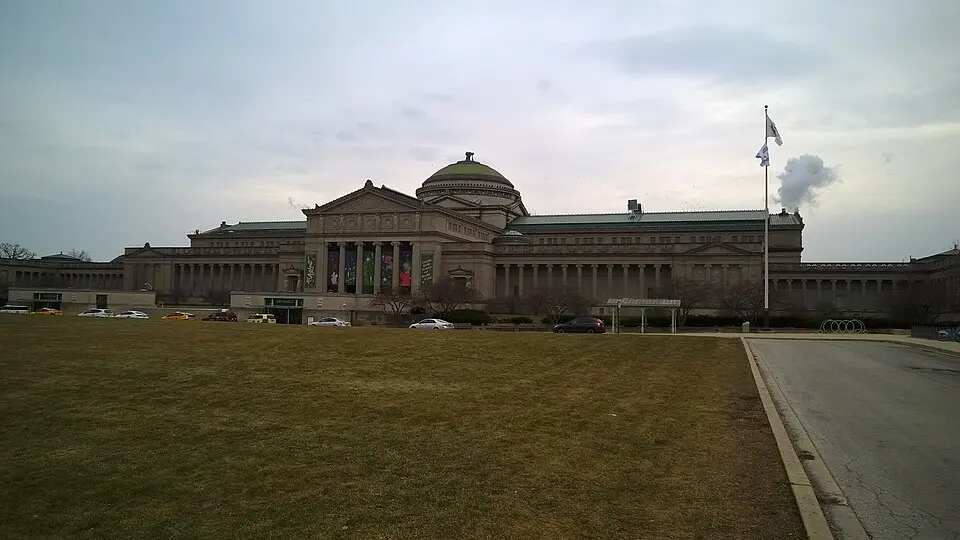
Griffin Museum of Science and Industry The surviving Palace of Fine Arts from the 1893 fair is now a monumental home for science and discovery.
The building began as the Palace of Fine Arts at the World’s Columbian Exposition.
Check admission and hours; use designated park and lakefront connections.
Photo: GualdimG · CC BY-SA 4.0 ↗
Nearby detour
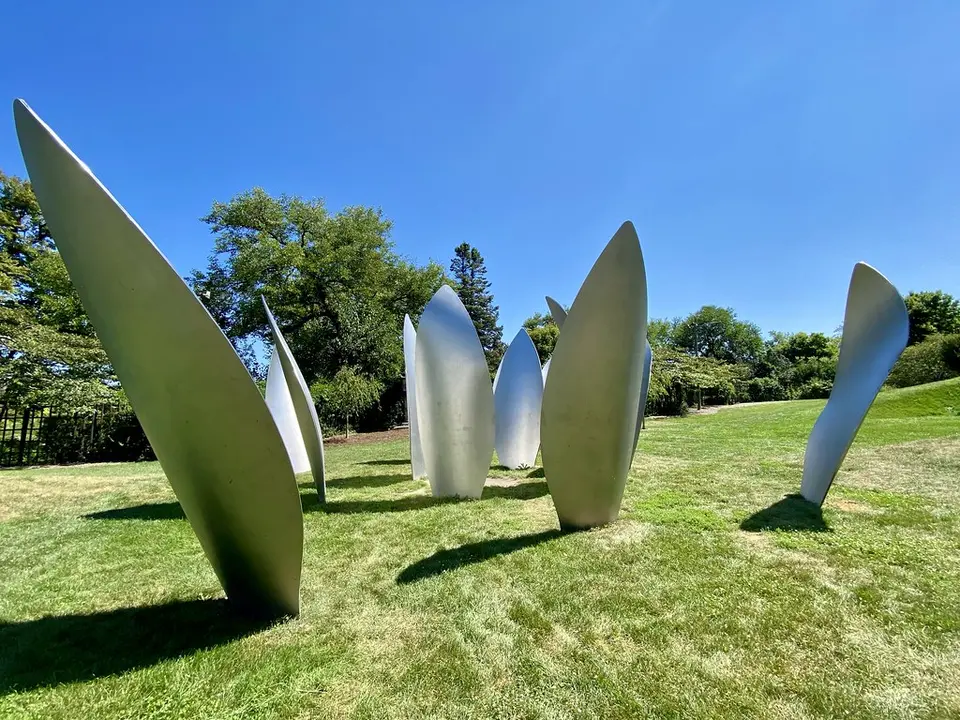
Sky Landing A cluster of silver lotus petals rises from the lawn near the Japanese garden on Wooded Island.
Yoko Ono installed this twelve-petal sculpture in 2016 as a symbol of peace.
Reach it on Wooded Island’s paths using designated bridges and road crossings.
Photo: Raed Mansour · CC BY 2.0 ↗
Nearby detour
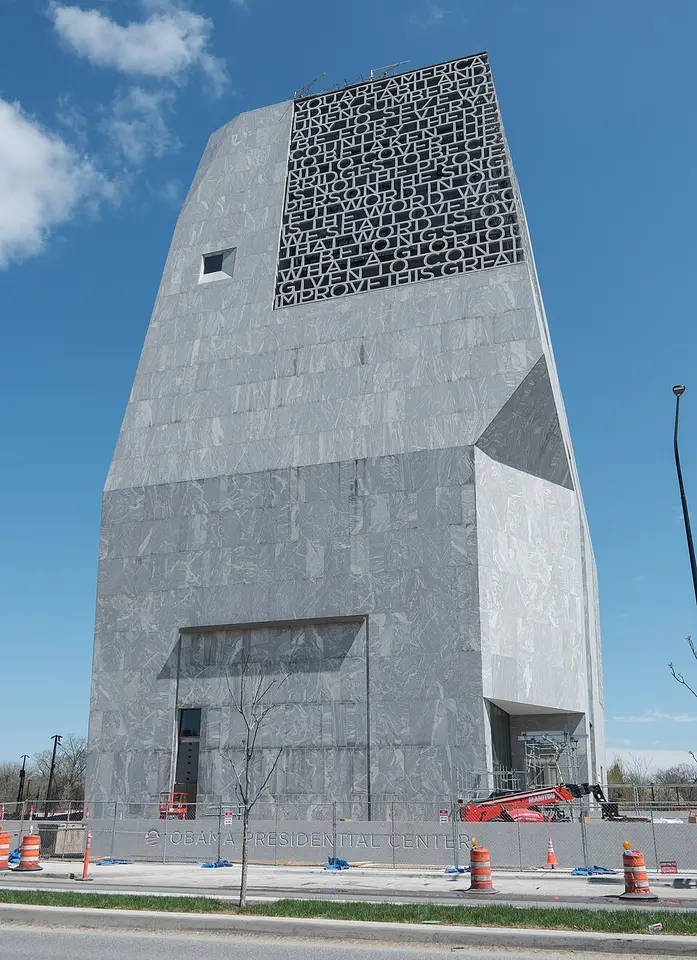
Obama Presidential Center A museum and public campus occupy the western edge of Jackson Park along Stony Island Avenue.
The campus combines museum exhibits, public art, gardens and a Chicago Public Library branch.
The campus has free public spaces; the museum requires a timed ticket. Use the operator’s current visitor information and designated park crossings.
Museum exterior in April 2026, before the campus opened.
Photo: Claire Fridkin · CC BY-SA 4.0 ↗
On the trail
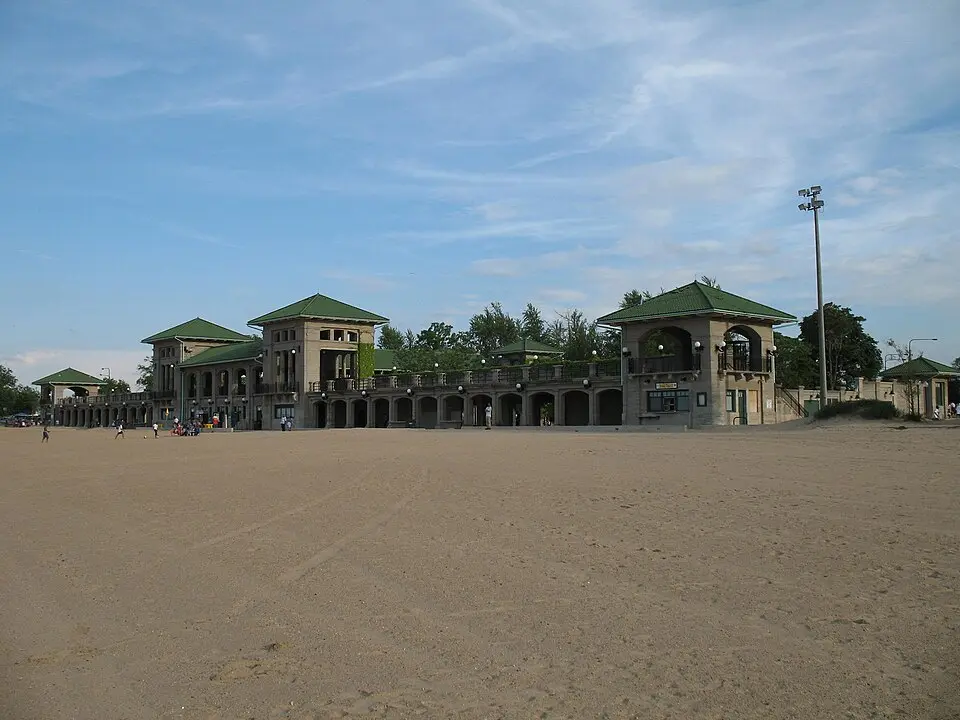
63rd Street Beach House Long arcades and courtyards make this historic bathing pavilion a landmark beside the sand.
The pavilion was constructed by 1919 and restored in 2000.
Check seasonal facility access and event reservations; this pin identifies the building, not the swimming beach.
Photo: User:TonyTheTiger · CC BY-SA 3.0 ↗
Nearby detour
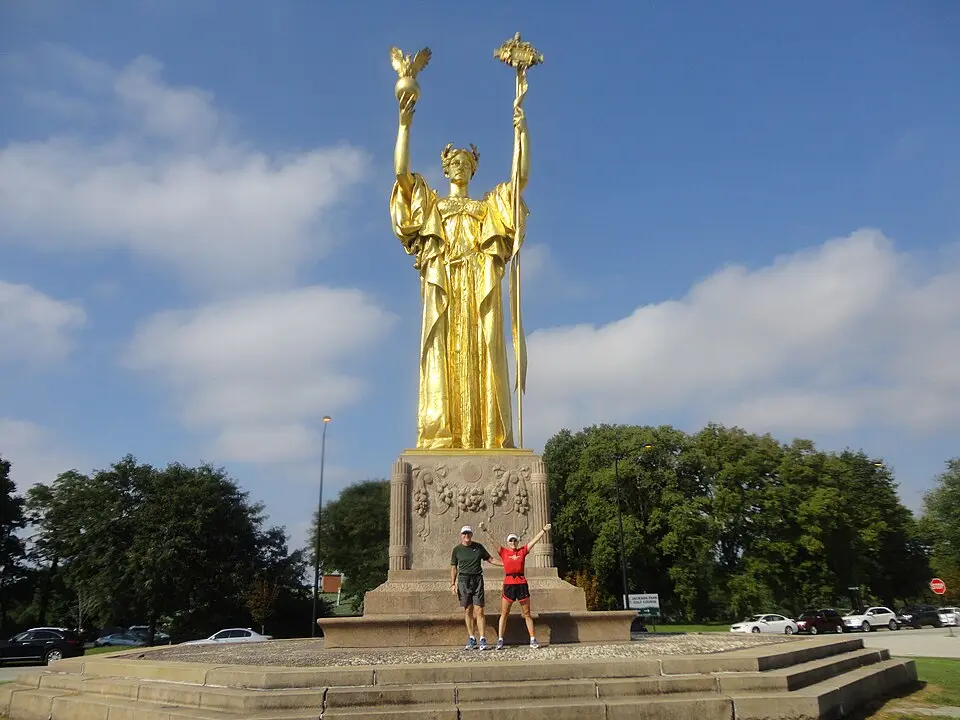
Statue of the Republic The gilded figure known as the Golden Lady stands at Hayes and Richards Drives in Jackson Park.
Daniel Chester French’s 1918 statue is a smaller commemorative version of the one made for the 1893 exposition.
Use designated crossings to approach the monument; the pin is on the statue itself.
Photo: Marlin Keesler · CC BY 2.0 ↗
Via a connector
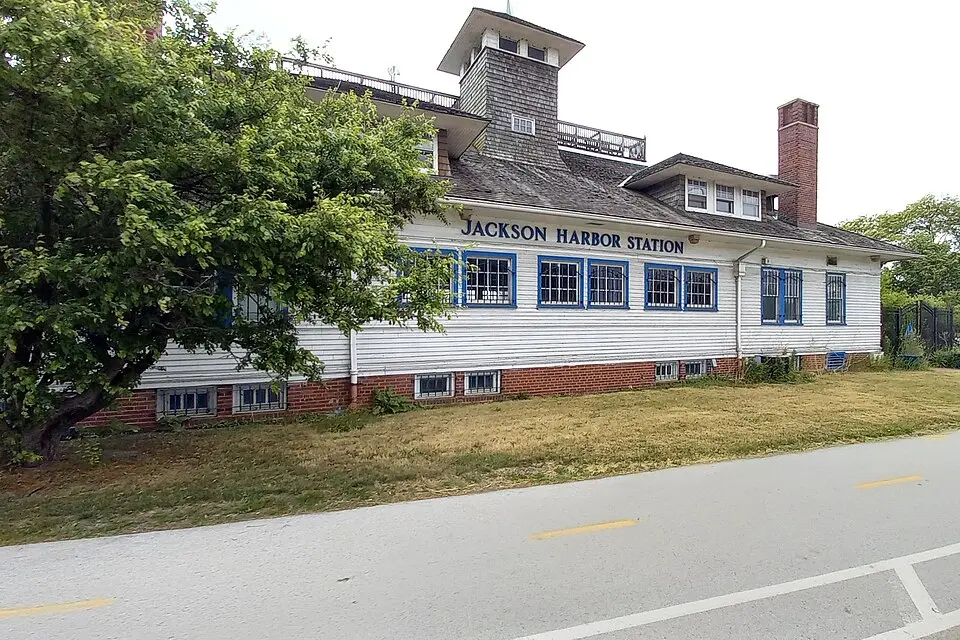
Jackson Harbor Station A historic lifesaving station survives beside Jackson Park’s outer harbor, a small reminder of the lake’s working past.
The surviving station house was built in 1908 to a design by Victor Mindeleff.
View the exterior from public harbor paths; check current building access before entering.
Photo: AlphaBeta135 · CC BY 4.0 ↗
Nearby detour
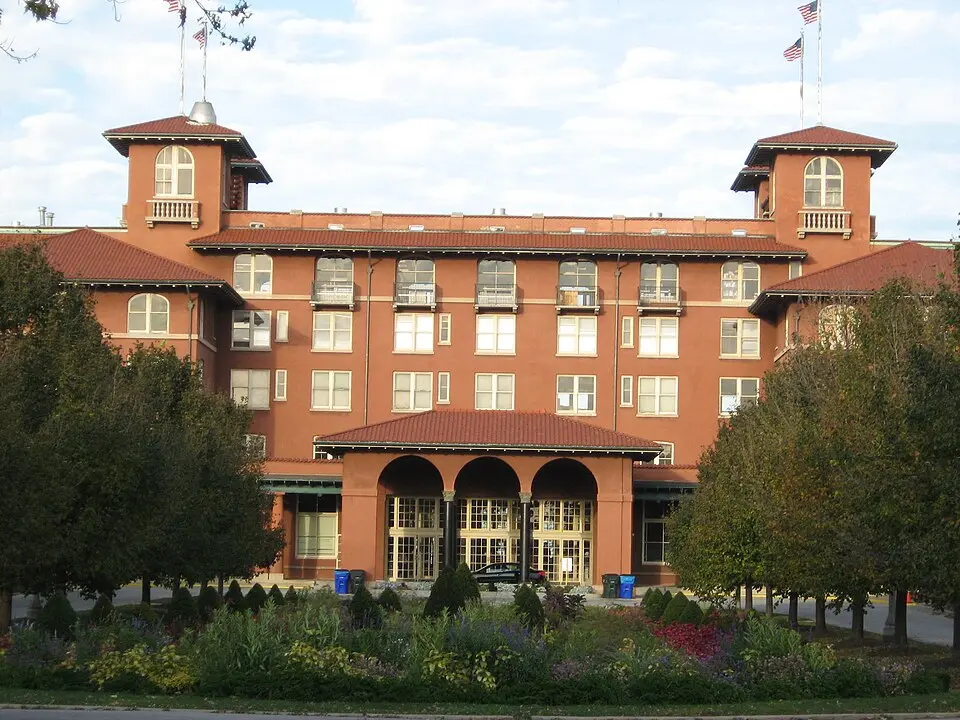
South Shore Cultural Center A former country club, now a cultural landmark, set among lawns and a long view of the lake.
The cultural center occupies the former South Shore Country Club.
Building hours and event access differ from park access. Follow public paths.
Photo: Zol87 from Chicago, IL, USA · CC BY-SA 4.0 ↗
Nearby detour
Paul Robeson Theatre A named performance venue forms part of the South Shore Cultural Center complex.
The Park District lists the theatre at the Cultural Center’s 7059 South Shore Drive address.
Check scheduled performances or rental access; this is an indoor venue, not an always-open trail facility.
On the trail
71st Street · The southern end Eighteen miles of lakefront behind you. A whole city of discoveries to come back for.
71st Street is the official southern endpoint of the Lakefront Trail.
Plan onward travel separately from the trail, using current transit or street navigation.
Photo: AlphaBeta135 · CC BY 4.0 ↗